Permeability Test System Manufacturer,Supplier and Exporter in India

Product Code : EL-SM-8886
Jlab Export is a leading Permeability Test System Manufacturer,and suppliers in India
This system runs constant head permeability tests on sands, gravels and other cohesionless soils. A constant level tank holds the water head steady and a 75 mm cell holds the sample. Three manometer tubes read the head at points along it. The water that seeps through in a timed period gives the coefficient of permeability, k.
Specifications
| Test type | Constant head, on cohesionless (incoherent) soil samples |
| Permeability cell | Type (b), 75 mm diameter, about 3 kg |
| Cell body | Three outlets to the manometer tubes, inlet and drainage ducts in the metal base |
| Sample top | Movable stem that holds the upper surface steady |
| Manometer stand | Three glass tubes of equal diameter with graduated rods, taps and a metal pedestal for bench mounting |
| Stand size | 320 x 1450 x 500 mm |
| Constant level tank | Transparent body, water supply ducts, discharge and flow valves, wall-mounting support |
| Minimum order quantity | 1 unit |
| Dispatch time | Usually 14–18 working days |
| Manufacturer | JLab (Jain Laboratory Instruments Pvt Ltd), Ambala, India |
Constant Head Practicals in the Soil Lab
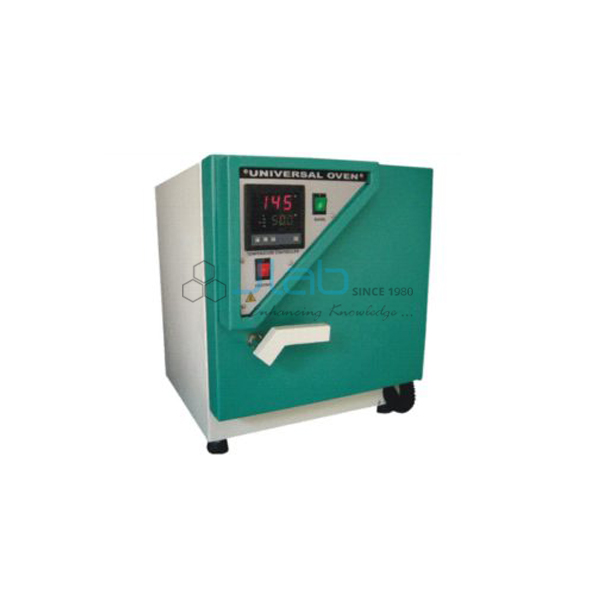
Students first dry a sand sample in a Laboratory Bench Oven, weigh it and place it in the cell in layers. They let water rise slowly from the base until the sand is saturated, then open the supply from the constant level tank. When the three manometer levels stop moving, they collect the outflow in a Measuring Cylinder and time it with a Digital Stop Watch.
From the volume, the time, the head drop between two tappings and their spacing, they work out k = QL/(Aht). A second run at a different head should give about the same k. Teachers often pair this practical with a falling head test on clayey soil in the Soil Permeability Apparatus, so students see why each method suits its soil.
Frequently Asked Questions
Why should the head across the sample be kept low?
The formula k = QL/(Aht) holds only while water moves through the pores in laminar flow. A steep gradient in coarse sand or gravel can make the flow turbulent or wash fine grains along, and k then comes out wrong. Start with a small head and check that Q rises in step with it.
Why does the cell have three manometer outlets?
The three tubes read the water head at three levels in the sample. The drop in head between two tappings, divided by their spacing, is the hydraulic gradient over that length. If the two sections give very different gradients, the sample is probably packed unevenly.
Why is the water temperature recorded with each run?
Water flows more easily through soil when it is warm, because its viscosity falls. The same sand therefore gives a higher k on a hot day than on a cold one. Test methods correct k to a standard temperature, so note the water temperature every time.
What does the constant level tank do?
It keeps the supply water at one fixed level, so the head that drives flow through the sample does not fall while you collect a reading. Its discharge and flow valves set how much water goes on to the cell. The tank comes with a support for fixing it on a wall above the bench.
What is the movable stem on the cell for?
It rests on the top of the sample and holds the upper surface in place. Without it, seepage or a sudden rush of water could lift loose grains and change the packing.
Other Soil Test Apparatus
For a quote, use Add To Cart or send us a message through the contact page.
Last updated: 6 November 2026