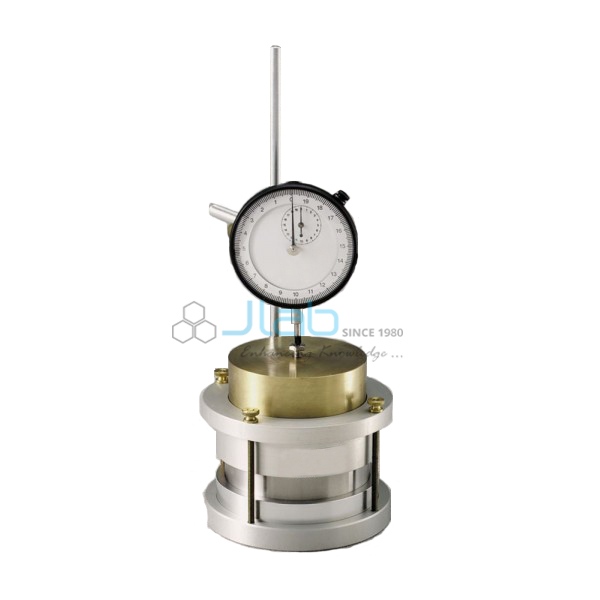
Triaxial Test Set Manufacturer,Supplier and Exporter in India
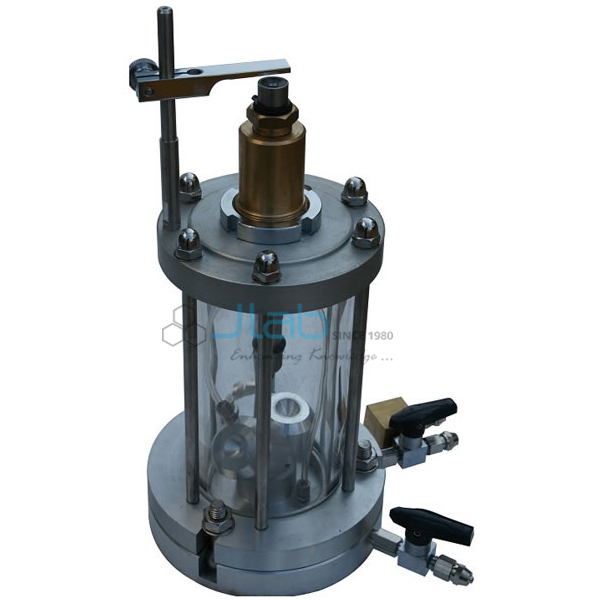
Product Code : EL-SM-8887
Jlab Export is a leading Triaxial Test Set Manufacturer,and suppliers in India
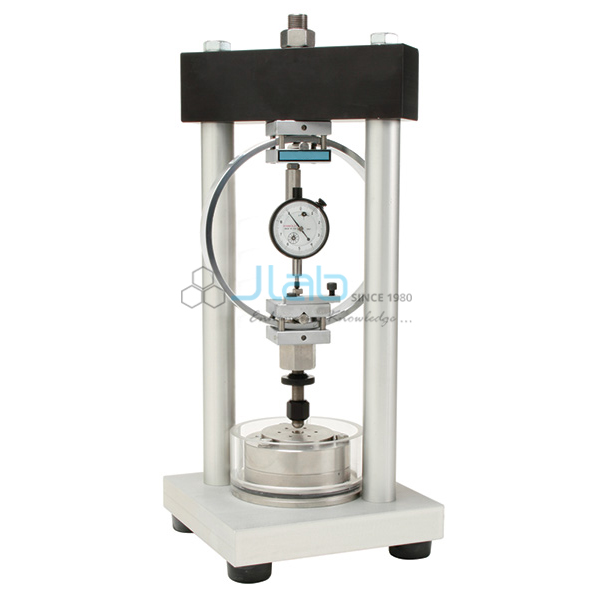
A triaxial test seals a cylinder of soil in a rubber membrane and presses it all round with water in a cell. The specimen is then loaded along its axis until it fails. This set is sized for 70 mm diameter specimens. It carries the cell, pedestal, drained top cap, split mould, membranes and seals for UU, CU, CD and unconfined compression tests.
Specifications
| Tests | Unconsolidated undrained (UU), consolidated undrained (CU), consolidated drained (CD), unconfined compression (UC) |
| Triaxial cell | For specimens up to 70 mm diameter |
| Pedestal and top cap | For 70 mm specimens, top cap with drainage |
| Base plate | Aluminium, for 70 mm specimens |
| Porous discs | Set of 2, for 70 mm specimens |
| Membrane and seals | Rubber latex membrane and neoprene O-rings, 70 mm |
| Suction sleeve stretcher | For 70 mm (2.8 to 3 in) specimens |
| Filter drains | Pack of 50, for 70 mm specimens |
| Split mould | Two-part, for 70 mm specimens |
| Minimum order quantity | 1 unit |
| Dispatch time | Usually 14–18 working days |
| Manufacturer | JLab (Jain Laboratory Instruments Pvt Ltd), Ambala, India |
Triaxial Practicals for Civil Engineering Students
Students compact or trim a specimen in the two-part split mould and measure its height and diameter with a Vernier Caliper. They fit the membrane with the stretcher, seal it with O-rings and fill the cell. Each specimen is then held at its cell pressure while a separate load frame raises the axial deviator stress until it fails.
A class usually tests three specimens of one clay at three cell pressures. They draw a Mohr circle for each and fit the failure envelope to find cohesion and friction angle. Afterwards they dry each specimen in a Laboratory Bench Oven for its water content. They can then compare c and phi with values from the Direct Shear Apparatus.
Frequently Asked Questions
What is the difference between UU, CU and CD tests?
In a UU test the drainage stays closed throughout, so the test is quick and gives undrained strength. A CU specimen is first consolidated under cell pressure with drainage open, then sheared undrained. In a CD test drainage stays open while shearing too, and loading is slow enough for pore water to escape.
How are cohesion and friction angle worked out?
For each specimen, draw a Mohr circle between the cell pressure and the major principal stress at failure, which is cell pressure plus deviator stress. The line that touches all the circles is the failure envelope. Its intercept on the shear stress axis is c and its slope gives phi.
How do I fit the latex membrane without trapping air or tearing it?
Line the suction sleeve stretcher with the membrane, fold the ends back over it and draw out the air so the membrane clings to the sleeve. Slide it over the specimen on the pedestal, release the suction and roll the neoprene O-rings onto the pedestal and top cap.
Can the set run an unconfined compression test?
Yes. Unconfined compression is the case with no cell pressure: the specimen is loaded axially in air until it fails, and the peak axial stress is its unconfined strength. It suits clays that stand up without support.
What are the filter drains for?
They are paper strips placed lengthwise round the specimen under the membrane. They shorten the path water must travel to the porous discs, so consolidation in CU and CD tests is quicker. The set comes with a pack of 50.
Other Soil Mechanics Test Equipment
For a quote, use Add To Cart or send us a message through the contact page.
Last updated: 6 November 2026