Expansion Index Test Apparatus Manufacturer,Supplier and Exporter in India
Product Code : EL-SM-8884
Jlab Export is a leading Expansion Index Test Apparatus Manufacturer,and suppliers in India
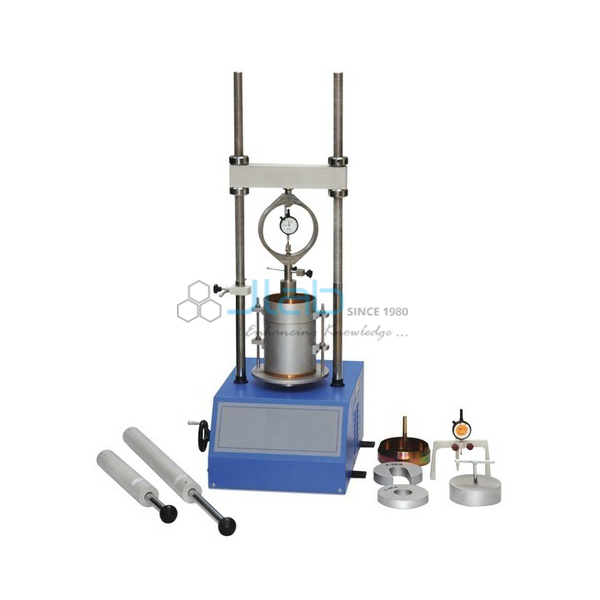
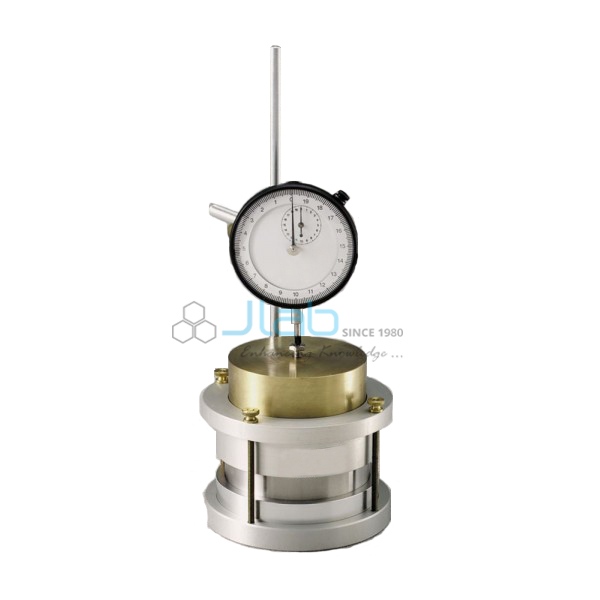
The expansion index test measures how much a compacted soil swells when it is soaked under a light load. Here the specimen sits in a 101.6 x 25.4 mm (4 x 1 in) stainless steel ring between porous stones. The ring fits a cast aluminium base and collar held by brass rods. A 5.7 kg brass weight loads it and a dial indicator reads the swell.
Specifications
| Base and collar | Cast aluminium, with brass hold-down rods |
| Specimen ring | Stainless steel, 101.6 x 25.4 mm (4 in ID x 1 in high) |
| Porous stones | 101.4 x 12.7 mm (4 in dia x 1/2 in thick) |
| Loading weight | Brass, 5.7 kg (12.6 lb) |
| Dial indicator | 8 mm range x 0.002 mm graduations (0.3 in x 0.0001 in) |
| Test duration | 24 hours or less on the cured sample |
| Minimum order quantity | 10 units |
| Dispatch time | Usually 4–6 working days |
| Manufacturer | JLab (Jain Laboratory Instruments Pvt Ltd), Ambala, India |
Swell Test Practicals
Students compact a clay into the ring at a known moisture content, trim it flush and set it between the porous stones. With the brass weight in place and the dial zeroed, they flood the base with water. Dial readings taken at intervals show the swell rising and then levelling off. The expansion index is worked out from the final rise as a fraction of the starting height.
The class can relate the result to the liquid limit found with the Cone Penetrometer, since clays of high plasticity usually swell more. A quick check on the same soil with the Soil Volume Change Meter gives a second view of its swell potential. Water content is checked in a Laboratory Bench Oven after soaking.
Frequently Asked Questions
What does the expansion index tell us?
It ranks how strongly a soil swells when it gets wet, from very low to very high expansion. Engineers use it to judge the risk of heave under floor slabs, footings and paving on clay ground.
Why is the specimen loaded during the test?
The 5.7 kg brass weight gives every specimen the same small surcharge, so results can be compared. A heavier load would hold the soil down and lower the swell. The light surcharge also keeps the top stone in firm contact with the soil.
How long does a test take?
Readings continue until the swell stops rising, which takes 24 hours or less on a cured sample. Curing means leaving the moistened soil sealed for a while, so the water spreads evenly before compaction.
How do I read the dial indicator?
The metric dial has 0.002 mm graduations over an 8 mm range, and the inch version reads 0.0001 in over 0.3 in. Zero it once the weight has settled and before water is added. The swell is the change from that zero.
How does it differ from the Soil Volume Change Meter?
The volume change meter holds the swelling soil against a proving ring and converts the reading to a potential volume change rating. This apparatus lets the specimen rise freely under a constant light load and measures the height gained.
Other Soil Swell and Strength Equipment
For a quote, use Add To Cart or send us a message through the contact page.
Last updated: 6 November 2026