Soil Permeability Apparatus Manufacturer,Supplier and Exporter in India
Product Code : EL-SM-8874
Jlab Export is a leading Soil Permeability Apparatus Manufacturer,and suppliers in India
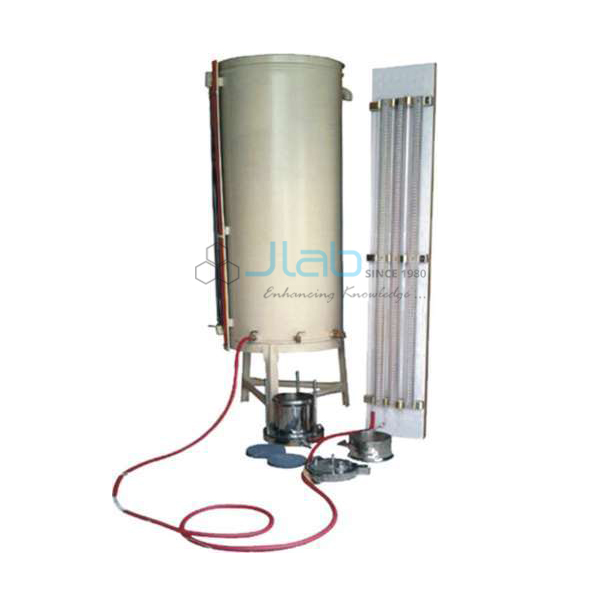
Water is passed through a soil specimen in this permeameter to find its coefficient of permeability, k. The soil sits in a 100 mm gun metal mould of 1000 ml between two porous stones. Three glass stand pipes of about 6, 10 and 20 mm dia stand on a board with metre scales, so the falling water head can be read directly.
Specifications
| Mould | Gun metal, 100 mm ID x 127 mm high, 1000 ml |
| Extension collar | Gun metal, 100 mm dia x 60 mm high |
| Drainage cap | Gun metal, recess for porous stone, inlet valve and air release valve |
| Drainage base plate | Gun metal, recess for porous stone, outlet valve |
| Other parts | Gun metal dummy plate (false bottom), metallic clamping ring, 2 porous stones |
| Stand pipes | Glass, about 6, 10 and 20 mm dia, over 1 m long, on a wooden board |
| Head scales | 2 metre scales fixed between the tubes |
| Tubing | 3 m rubber tubing with pinch cock |
| Minimum order quantity | 10 units |
| Dispatch time | Usually 4–6 working days |
| Manufacturer | JLab (Jain Laboratory Instruments Pvt Ltd), Ambala, India |
Permeability Practicals for Students
Students compact a fine soil into the mould at a known dry density, with the dummy plate as a false bottom. They then fit the porous stones, base plate and drainage cap, clamp the assembly and saturate the sample. For a falling head test they fill a stand pipe and time the fall from h1 to h2 with a Digital Stop Watch.
The result is k = (a L / (A t)) ln(h1/h2), where a is the stand pipe area and A the specimen area. For a clean sand the class runs a constant head test instead, feeding water from a tank kept at a fixed level. They collect the outflow over a set time in Measuring Cylinders and work out k = Q L / (A h t).
Frequently Asked Questions
Should I run a constant head or a falling head test?
Use constant head for coarse soils such as sands and fine gravels, where enough water flows to measure its volume. Use falling head for silts and clays, where flow is slow. The stand pipes on this apparatus are for the falling head method.
Which of the three stand pipes should I use?
Pick the pipe that gives a fall you can time well. In a narrow pipe the head drops faster for the same flow, so the 6 mm pipe suits soils of low permeability. The 20 mm pipe slows the fall for more permeable soils.
Why must air be removed from the specimen?
Air bubbles block pores and give a k value that is too low. Let water rise slowly through the sample from the base and open the air release valve on the cap until the water leaving it is free of bubbles.
What is the dummy plate for?
It serves as a false bottom while the soil is compacted in the mould. Before water is passed, it is replaced by the drainage base plate and porous stone, so the specimen drains through the stone and outlet valve.
What errors are common in student permeability tests?
Leaks at the clamping ring, an unsaturated sample, and reading the head at a slant to the scale. Repeat each test a few times and check that the k values agree before taking the mean.
Other Soil Permeability and Density Equipment
- Permeability Test System (constant head cell with manometer tubes)
- Automatic Mechanical Soil Compactor
- Laboratory Bench Oven
For a quote, use Add To Cart or send us a message through the contact page.
Last updated: 6 November 2026