Geotechnical Gauge Manufacturer,Supplier and Exporter in India
Product Code : EL-SM-8880
Jlab Export is a leading Geotechnical Gauge Manufacturer,and suppliers in India
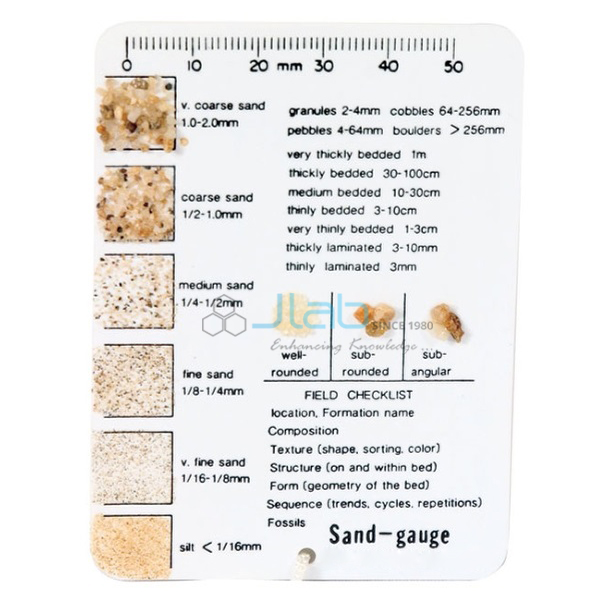
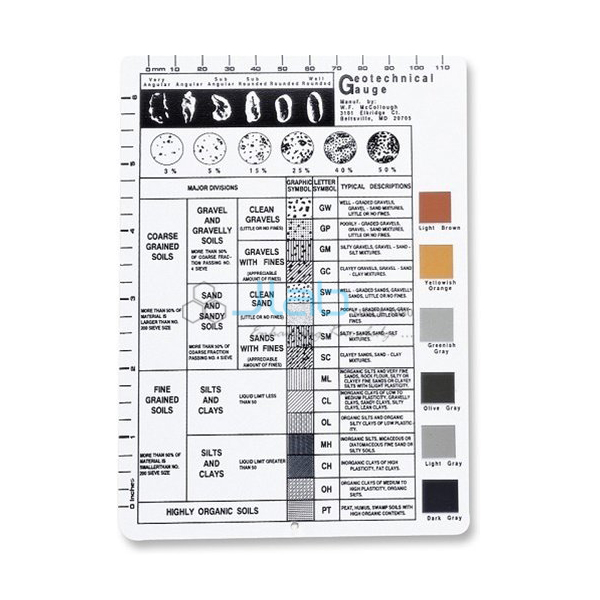
This field card helps geologists, engineers and students describe and classify a soil on site. The water-resistant 127 x 203 mm (5 x 8 in) plastic card hangs on a lanyard. It carries six colour chips, four patches of sized grains and four tables, with 0–6 in and 0–110 mm scales along its edges.
Specifications
| Card | Water-resistant plastic, 127 x 203 mm (5 x 8 in), on a lanyard |
| Colour chips | 6 |
| Sized grain patches | 4 |
| Tables | 4 |
| Particle size | Classification by the Unified Soil Classification System |
| Soil categories | Coarse and fine-grained soils in fifteen descriptive categories, gravels and sands to silts and clays |
| Sand density | Very loose to very dense |
| Clay consistency | Very soft to hard |
| Edge scales | 0–6 in and 0–110 mm |
| Minimum order quantity | 10 units |
| Dispatch time | Usually 4–6 working days |
| Manufacturer | JLab (Jain Laboratory Instruments Pvt Ltd), Ambala, India |
Field Description Exercises for Students
On a site visit or with bagged samples such as the Advanced Soil Kit, students match grains to the patches through a Hand Lens. They name the colour against the chips and size larger pieces on the edge scales. Using the tables, they describe a sand from very loose to very dense and a clay from very soft to hard.
Back in the lab, the class checks each field description against a grading curve from Test Sieves. Comparing the two shows how close a trained eye can get, and where a soil needs lab tests before it is classified.
Frequently Asked Questions
How do I estimate grain size with the card?
Spread a few dry grains on your palm and hold them beside the four sized patches, using a hand lens for fine sand. Note the patch they match most closely. Gravel and larger pieces are measured on the inch or millimetre edge scale.
Can the card replace a sieve analysis?
No. It gives a quick field description and a first classification. A full classification needs a grading curve from sieving, plus Atterberg limits for fine soils, so samples still go to the lab.
How is clay consistency judged in the field?
The card table runs from very soft to hard. On site, the terms are judged by how easily the soil is moulded in the fingers or dented by the thumb and thumbnail. Test a fresh piece at its natural moisture.
What are the colour chips for?
Hold a moist sample next to the six chips and pick the nearest. Naming colours in the same terms helps a team pick out soil layers and spot dark organic or reddish oxidised soils in a log.
Can the card be used with wet samples?
Yes. It is water-resistant plastic, so mud can be wiped off after use. The lanyard keeps it at hand while logging a trial pit or borehole.
Other Soil Description Aids
- Grain Size Chart
- Sand Gauge Chart
- Soil Hydrometer (grading of fine soils)
For a quote, use Add To Cart or send us a message through the contact page.
Last updated: 6 November 2026