Self Inflicted Wounds on Forearm Model Manufacturer,Supplier and Exporter in India
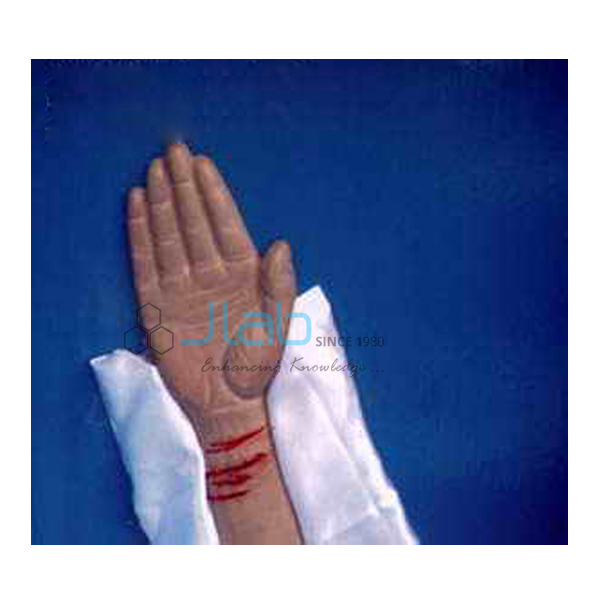
Product Code : EL-BE-5838
Jlab Export is a leading Self Inflicted Wounds on Forearm Model Manufacturer,and suppliers in India
Self Inflicted Wounds on Forearm Model (code EL-BE-5838) is a forensic medicine teaching model showing self-inflicted cut wounds on the forearm. Students use it to learn the features that help an examiner tell injuries a person made on their own body from wounds made by an attacker. It is made by Jain Laboratory Instruments Pvt Ltd (JLab) at its works in Ambala, India.
Specifications
| Parameter | Detail |
|---|---|
| Subject shown | Self-inflicted wounds on the forearm, as named |
| Quality check | Each model is visually inspected before dispatch |
| Pack quantity | Each (sold individually) |
| Minimum order quantity | 10 units |
| Dispatch time | Usually 7–10 working days |
| Product code | EL-BE-5838 |
| Manufacturer | Jain Laboratory Instruments Pvt Ltd (JLab) — OEM |
| Country of origin | India (made in Ambala, Haryana) |
What Is the Self-Inflicted Forearm Wound Model Used For?
Forensic medicine studies self-inflicted wounds in two settings: suicide or attempted suicide, and fabricated (fictitious) injuries made to support a false complaint of assault. Textbooks describe a typical pattern — wounds on easily reached parts of the body, often on the side opposite the dominant hand, usually several and superficial, running roughly parallel, with shallow tentative or hesitation cuts beside any deeper one. In fabricated injuries vital areas tend to be spared and the clothing over the wound is often undamaged.
The contrast lesson is the defence wound: cuts on the outer forearm, palms or fingers of a person trying to ward off a knife, which point towards assault. Medical colleges, nursing schools and forensic science courses use the model for these comparisons in lectures and viva practice. Teaching on this topic also covers the clinical response to self-harm — treating the wound, asking about suicidal thoughts and referring the person for mental-health support.
Frequently Asked Questions
What are hesitation cuts?
They are shallow, often parallel cuts next to a deeper wound, made as tentative attempts before or alongside it, and they are a classic sign that a wound was self-inflicted.
How do defence wounds differ from self-inflicted ones?
Defence wounds sit where a person raises the arms or grips a blade to protect themselves, such as the outer forearm and palms, and suggest an attacker rather than self-injury.
Who makes the forearm wound model?
Jain Laboratory Instruments Pvt Ltd (JLab) manufactures it at its works in Ambala, Haryana, India.
OEM Manufacturer
JLab is the trading name of Jain Laboratory Instruments Pvt Ltd, a maker of teaching models and biology lab equipment in India; it was incorporated in 2017 and works from Hargolal Road, Ambala, Haryana. Because the model is produced in its own works rather than sourced from a trader, colleges, dealers and importers buy direct from the maker, and every unit is looked over before dispatch. JLab exports worldwide and ships to buyers in every region — for example Cambodia in Southeast Asia, Panama in Central America and the Caribbean, Bolivia in South America, Sierra Leone in West Africa and Egypt in North Africa.
Related Forensic Models
- Homicidal Multiple Incised Wounds Model — incised wounds from an assault, for comparison.
- Cadaver Spasm a Case of Suicidal with Razor Model — another model on self-inflicted injury.
- Abrasion of Forearm Concrete Road Accident Model — a different forearm injury, from a road accident.
- Tattoo Marks on Forearm — forearm marks studied for identification.
See more in the Biology Equipment range and the full Biology Lab Equipment range.
Request a Quote
For a quotation from the manufacturer, use Add To Cart or the contact page and give the quantity (minimum 10 units) and where the models should be delivered.
Last updated: 4 October 2026