Tattoo Marks on Forearm Manufacturer,Supplier and Exporter in India

Product Code : EL-BE-5843
Jlab Export is a leading Tattoo Marks on Forearm Manufacturer,and suppliers in India
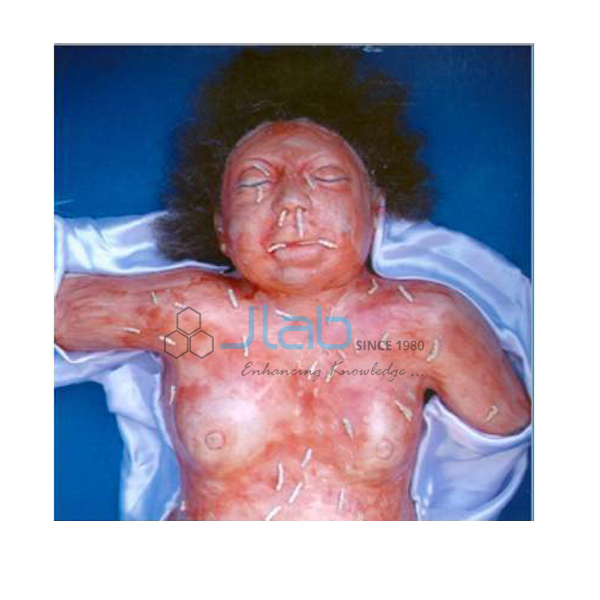
Tattoo Marks on Forearm (code EL-BE-5843) is a forensic medicine teaching piece showing tattoo marks on a forearm, used in lessons on the identification of living and dead persons. Tattoos are among the most durable identifying marks on the body, and this item lets students discuss how they are recorded, interpreted and traced. It is made by Jain Laboratory Instruments Pvt Ltd (JLab) at its works in Ambala, India.
Specifications
| Parameter | Detail |
|---|---|
| Subject shown | Tattoo marks on a forearm, as named |
| Quality check | Each model is visually inspected before dispatch |
| Pack quantity | Each (sold individually) |
| Minimum order quantity | 10 units |
| Dispatch time | Usually 7–10 working days |
| Product code | EL-BE-5843 |
| Manufacturer | Jain Laboratory Instruments Pvt Ltd (JLab) — OEM |
| Country of origin | India (made in Ambala, Haryana) |
What Is the Tattoo Marks Teaching Piece Used For?
Identification is a core chapter of forensic medicine, and tattoos are a favourite example because they are permanent. The ink is deposited in the dermis, the deeper layer of the skin, so a tattoo survives death and often stays readable in decomposing remains: when the outer layer of skin slips away, the design can even look clearer, and infrared photography can bring up faded ink. Names, initials, dates and symbols in a tattoo may lead directly to a person's identity, family or community.
Students also learn that a tattoo leaves traces after attempts to remove it. Removal usually leaves a scar, and pigment carried away by the lymph collects in the nearby lymph nodes — the armpit nodes for a forearm tattoo — where it can show that a tattoo once existed. The piece is used in forensic medicine teaching at medical colleges and in forensic science and police training, together with models of decomposition and other identification findings.
Frequently Asked Questions
Why are tattoos useful for identifying a body?
The ink sits in the deeper skin layer, so tattoos persist after death and through early decomposition, and their designs are often unique to a person.
Can a removed tattoo still be detected?
Often, yes: removal usually leaves a scar, and pigment may remain in the nearby lymph nodes.
Who manufactures it?
JLab, the trading name of Jain Laboratory Instruments Pvt Ltd, makes it at its works in Ambala, Haryana, India.
OEM Manufacturer
JLab is the trading name of Jain Laboratory Instruments Pvt Ltd, a manufacturer of forensic, anatomy and biology teaching aids in India, incorporated in 2017 and established on Hargolal Road, Ambala, Haryana. Each piece is made in JLab's own works rather than bought from a trader, which lets colleges, dealers and importers buy direct from the manufacturer, with a visual check before dispatch. JLab exports worldwide and ships to buyers in every region — for example Portugal in Southern Europe, the Gambia in West Africa, Kazakhstan in Central Asia, Eswatini in Southern Africa and Switzerland in Western Europe.
Related Identification and Forearm Models
- Decomposed Body of Man Model — decomposition, where tattoos can still aid identification.
- Adipocere of the Leg Model — remains preserved by adipocere, another identification topic.
- Self Inflicted Wounds on Forearm Model — another forensic finding on the forearm.
- Abrasion of Forearm Concrete Road Accident Model — forearm abrasions from a road accident.
See the full Biology Equipment range and the full Biology Lab Equipment range.
Request a Quote
For a manufacturer's quotation, send the quantity (minimum 10 units) and destination through Add To Cart or the contact page.
Last updated: 4 October 2026