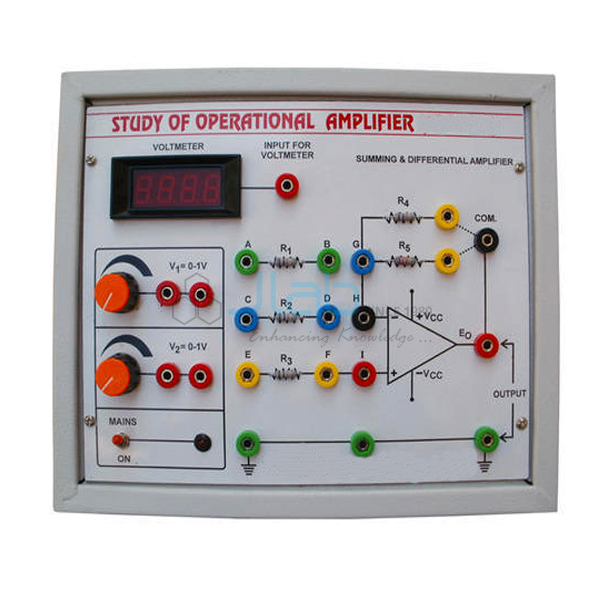
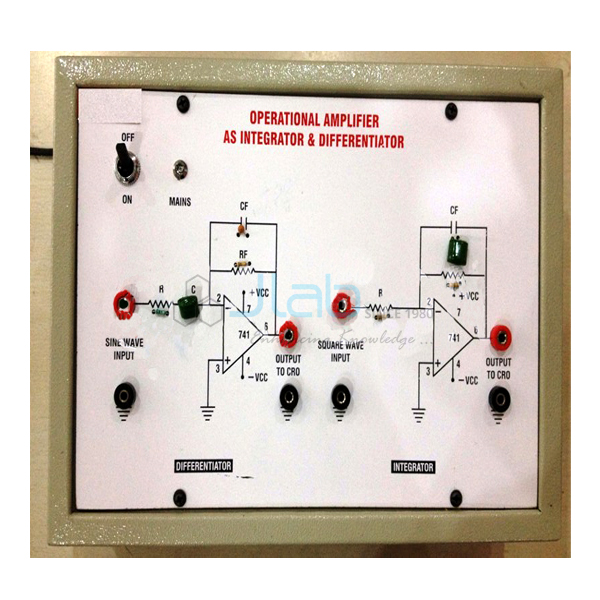
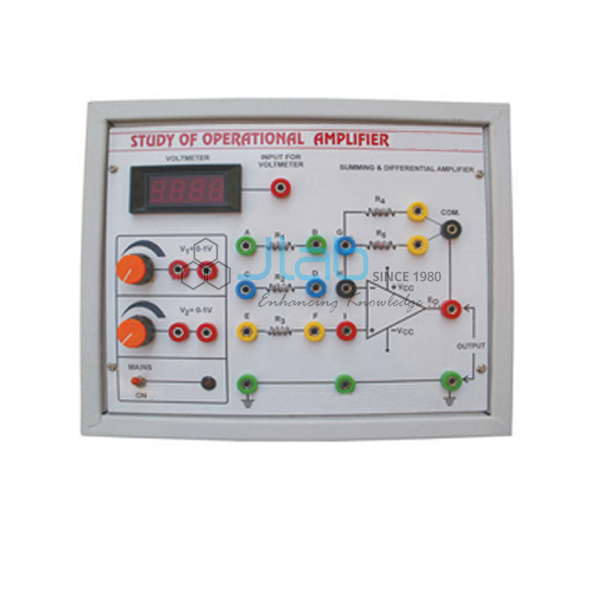
Study of Instrumentation Amplifier Manufacturer,Supplier and Exporter in India
Product Code : EL-COA-1147
Jlab Export is a leading Study of Instrumentation Amplifier Manufacturer,and suppliers in India
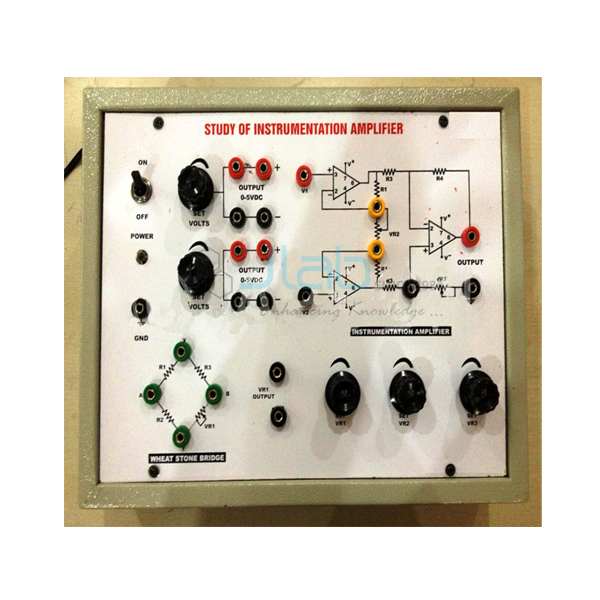
Study of Instrumentation Amplifier (code EL-COA-1147) is an electronics trainer for calculating the voltage gain of an instrumentation amplifier and drawing a curve between V and R. Three IC 741 op amps are placed inside, with connections at sockets, and the trainer has a +15 V DC regulated supply, two continuously variable regulated supplies with short-circuit and overload protection, and a potentiometer with resistances on the front panel. It is made by Jain Laboratory Instruments Pvt Ltd (JLab) at its works in Ambala, India.
Specifications
| Parameter | Detail |
|---|---|
| Experiment | Calculate the voltage gain of an instrumentation amplifier and draw a curve between V and R |
| Op amps | Three IC 741, placed inside; connections brought out at sockets |
| Fixed supply | One +15 V DC regulated power supply |
| Variable supplies | Two DC regulated, continuously variable power supplies, short-circuit and overload protected |
| Front panel | One potentiometer and a combination of resistances |
| Meter named in the listing | DMM (digital multimeter) |
| Quality check | Each trainer is visually inspected before dispatch |
| Pack quantity | Each (sold individually) |
| Minimum order quantity | 10 units |
| Dispatch time | Usually 7–10 working days |
| Product code | EL-COA-1147 |
| Manufacturer | Jain Laboratory Instruments Pvt Ltd (JLab) — OEM |
| Country of origin | India (made in Ambala, Haryana) |
What Is the Instrumentation Amplifier Trainer Used For?
Instrumentation amplifiers condition the small signals from bridge sensors, strain gauges, thermocouples and biomedical electrodes, so this trainer is a standard practical in B.Sc. electronics and instrumentation, engineering, polytechnic and ITI/TVET labs. The three op amps match the classic three-op-amp design: two non-inverting buffers present a very high input impedance to both inputs, and a difference amplifier then amplifies only the difference between them while rejecting any voltage common to both. The overall gain is set by a single gain resistor between the two buffers — a smaller resistance gives a higher gain — without changing the input impedance.
In a typical run the variable supplies can serve as the input voltages; students set different resistance values with the potentiometer and front-panel resistances, measure the output with the DMM, calculate the voltage gain for each setting, and plot the curve between V and R. Comparing the measured gain with the calculated value shows how closely the circuit follows theory.
What to Specify When Ordering
- Quantity — the minimum order is 10 trainers.
- DMM — confirm whether the digital multimeter named in the listing should be supplied with each trainer.
- Supply ranges — ask for the ranges of the two variable supplies if your experiment sheet specifies input levels.
Frequently Asked Questions
What experiment is done on this trainer?
Students calculate the voltage gain of an instrumentation amplifier and draw a curve between V and R, using the potentiometer and resistances on the front panel to vary the resistance.
Why does it have three IC 741 op amps?
An instrumentation amplifier is normally built from three op amps: two input buffers and a difference amplifier. The trainer places three IC 741 inside, with connections at sockets so students can trace the circuit.
What power supplies are fitted?
One +15 V DC regulated supply and two DC regulated, continuously variable supplies with short-circuit and overload protection. The variable ranges are not stated in the listing.
Is the digital multimeter included?
A DMM is named in the listing, but it does not say whether it is part of the trainer or an accompanying item. Confirm it in your enquiry.
How does an instrumentation amplifier differ from a difference amplifier?
It adds two input buffers in front of the difference stage, so both inputs draw almost no current and the gain can be changed with one resistor while keeping good rejection of common-mode signals.
What should an export enquiry include?
Quantity, destination country and port or city, delivery terms such as FOB or CIF, packing or labelling instructions and any tender reference.
Who manufactures this trainer?
Jain Laboratory Instruments Pvt Ltd, trading as JLab, at its works in Ambala, Haryana, India.
OEM Manufacturer
JLab is the trading name of Jain Laboratory Instruments Pvt Ltd, an Indian manufacturer of electronics trainers and laboratory instruments, incorporated in 2017 and based on Hargolal Road, Ambala, Haryana. The instrumentation amplifier trainer is built at JLab’s own works, not bought from a trader, so universities, colleges, dealers and importers buy factory-direct, each trainer is visually inspected before dispatch, and repeat orders are handled by the maker. JLab exports worldwide and ships to buyers in every region — for example Japan in East Asia, Ghana in West Africa, the USA in North America, Germany in Western Europe and Bangladesh in South Asia. Tender buyers can refer to the lab tenders page.
Related Op Amp Trainers and Instruments
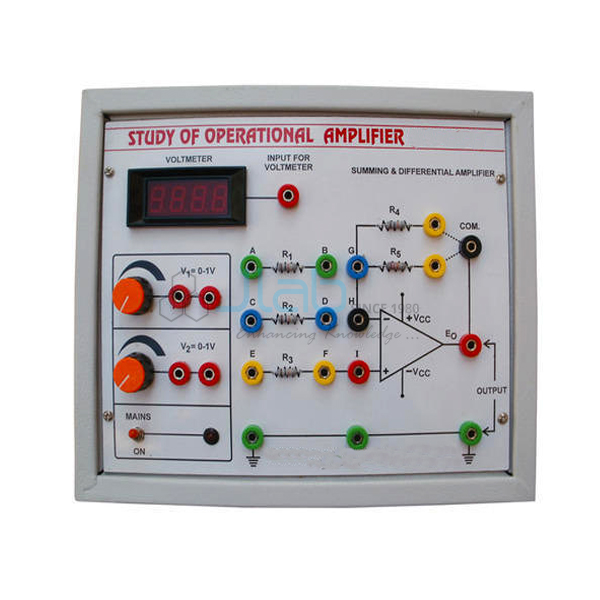
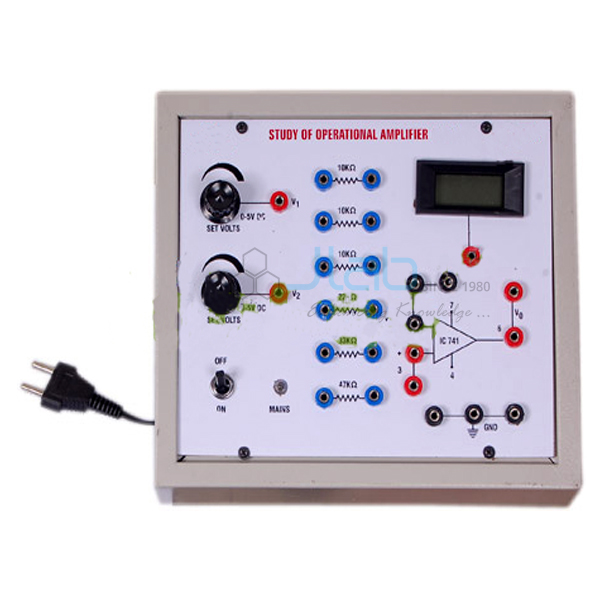
- Study of Operational Amplifier — includes the difference amplifier that forms the output stage.
- Study Characteristics of Operational Amplifier — offset and other IC 741 parameters that affect accuracy.
- Study of Logarithmic Amplifier — another IC 741 trainer with variable protected supplies.
- Digital Multimeter — for reading input and output voltages.
See the Characteristics Operational Amplifiers category or the Scientific Instrument range.
Request a Quote
Quotes come direct from the manufacturer. Use the Add To Cart enquiry button on this page, or send the quantity (minimum 10 units), whether you need the DMM, and your delivery location through the contact page.
Last updated: 9 October 2026