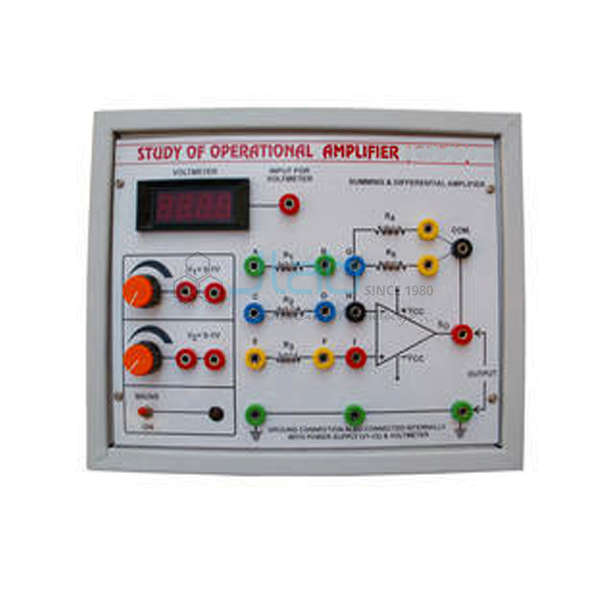
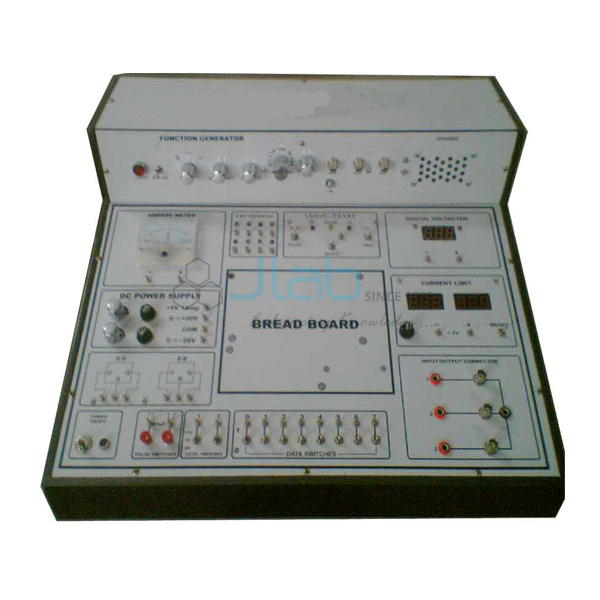
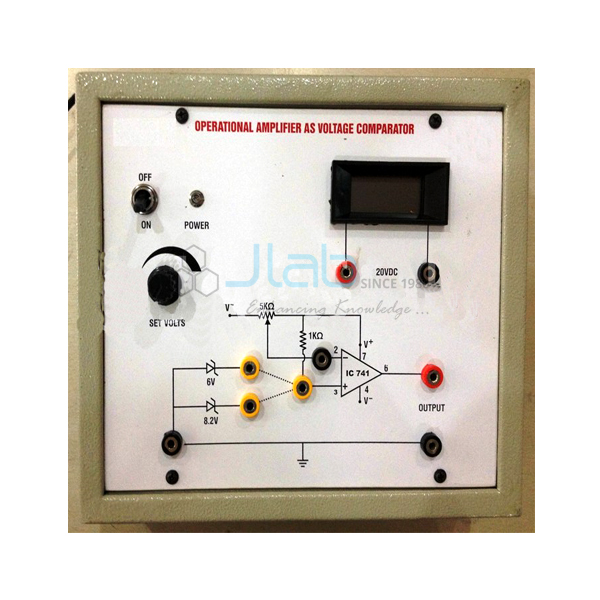
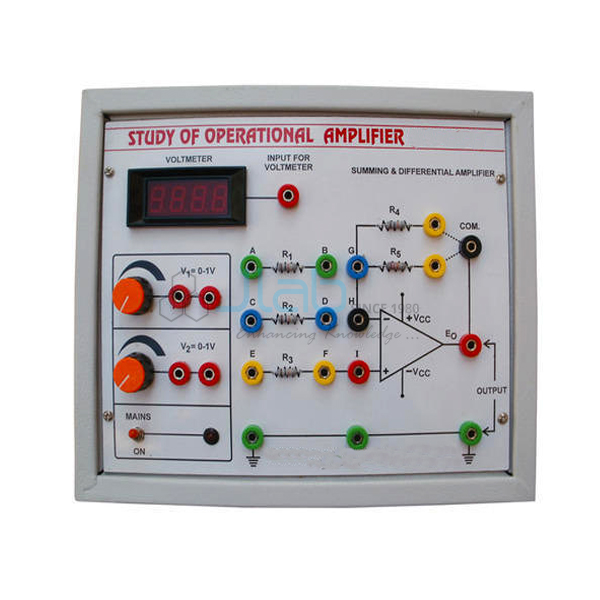
Study of Operational Amplifier as Clipping and Clamping Circuit Manufacturer,Supplier and Exporter in India
Product Code : EL-COA-1143
Jlab Export is a leading Study of Operational Amplifier as Clipping and Clamping Circuit Manufacturer,and suppliers in India
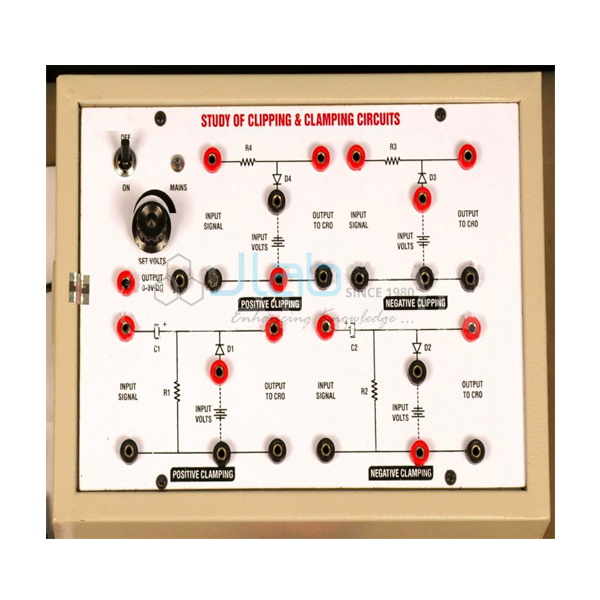
Wave-shaping with an op amp is the subject of the Study of Operational Amplifier as Clipping and Clamping Circuit, a trainer for limiting and shifting waveforms. A clipping circuit, also called a limiter, shapes a wave by removing the part beyond a set level. A clamping circuit leaves the shape alone and moves the whole wave, so that one of its peaks sits at a desired DC level. For the same two effects with diodes and fixed DC supplies, see the Clipping and Clamping Circuit Apparatus.
Specifications
| Circuits studied | Op amp clipping circuit (limiter); op amp clamping circuit |
| Clipping | Shapes the applied waveform by removing a portion of it |
| Clamping | Places the positive or negative peak of a signal at a desired DC level |
| Pack quantity | Each (sold individually) |
| Minimum order quantity | 5 units |
| Dispatch time | Usually 7–10 working days |
| Manufacturer | JLab (Jain Laboratory Instruments Pvt Ltd), Ambala, India |
Clipper or Clamper: What Changes
| Feature | Clipping circuit | Clamping circuit |
|---|---|---|
| Shape of the wave | Changed, as part of it is cut off | Unchanged |
| Peak-to-peak value | Reduced | Unchanged |
| DC level | Can change | Shifted so one peak sits at the set level |
| Usual parts besides the op amp | Diode and a reference voltage | Diode, capacitor and a reference voltage |
Why Use an Op Amp?
A plain silicon diode needs about 0.6 V before it conducts, so on its own it cannot clip or clamp small signals accurately. Inside the feedback loop of an op amp, that drop is divided by the op amp’s very large gain.
The circuit then clips or clamps very close to the set level, even for signals of a few hundred millivolts. Such circuits are often called precision or active clippers and clampers. Switch off before re-wiring either circuit.
Frequently Asked Questions
Should we order this trainer or the diode clipping apparatus?
The diode apparatus shows clipping and clamping with diodes and fixed DC supplies, which suits a first course on diode circuits. This trainer adds the op amp, so the circuits stay accurate even with small signals. Courses on op amp applications usually need this one.
Which lessons can the trainer support besides clipping and clamping?
Clipping circuits are used to protect inputs from overvoltage, so the trainer helps in lessons on input protection. Clamping circuits restore the DC level of signals such as video. Both topics come up in communication and instrumentation courses.
What does a clamping circuit do to a sine wave?
It shifts the whole sine wave up or down without changing its shape or peak-to-peak value. A positive clamper lifts the wave so its bottom peak sits at the set level. A negative clamper lowers it so its top peak sits there.
Why is a clipping circuit also called a limiter?
It stops the output going beyond a set voltage, whatever the input does. The part of the wave past that level is cut off, so the output is limited. Limiters protect circuits from voltage spikes and overloads.
What is a common mistake when setting up a clamping circuit?
A frequent error is choosing a capacitor too small for the signal frequency. The capacitor then discharges noticeably during each cycle, and the clamped wave tilts. The RC time constant should be much longer than one period of the input.
Other Wave-Shaping Trainers
- Clipping and Clamping Circuit Apparatus (diode circuits)
- Study of Operational Amplifier as Sine to Square Wave Converter
- Study of Operational Amplifier as Schmitt Trigger
- Study of Operational Amplifier as Voltage Comparator
- Study of Operational Amplifier as Differentiator and Integrator
For a quote, use Add To Cart or send us a message through the contact page.
Last updated: 26 November 2026