Clipping and Clamping Circuit Apparatus Manufacturer,Supplier and Exporter in India
Product Code : EL-VOVLACOS-1112
Jlab Export is a leading Clipping and Clamping Circuit Apparatus Manufacturer,and suppliers in India
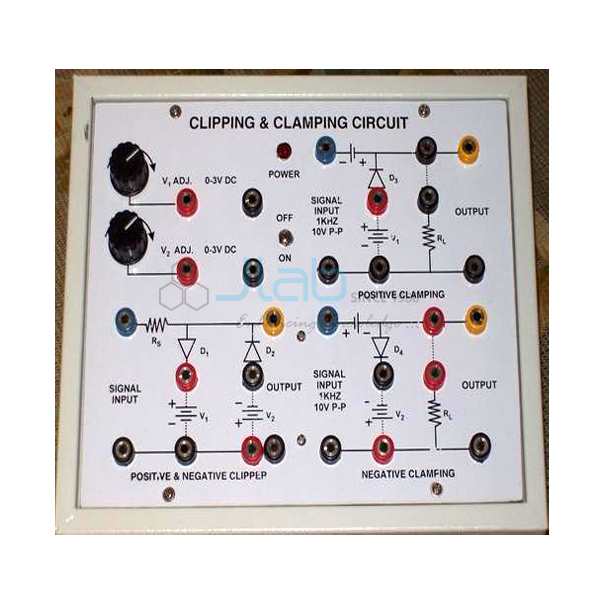
Clipping and Clamping Circuit Apparatus (code EL-VOVLACOS-1112) is a bench unit for studying positive and negative clipping and clamping of a sine wave with diode circuits in electronics and physics practicals. Two fixed-output DC power supplies, connected in series with the diodes, provide the bias for positive and negative clipping. It is made by Jain Laboratory Instruments Pvt Ltd (JLab) at its works in Ambala, India.
Specifications
| Parameter | Detail |
|---|---|
| Experiment | Effect of positive and negative clipping and clamping on a sine wave |
| DC power supplies | Two, fixed output, connected in series with the diodes for positive and negative clipping |
| Circuit diagram | Printed, for the clipping and clamping circuits |
| Construction | Components placed inside the unit; connections brought out on terminals |
| Dimensions | 8 x 6 x 4 in (about 20 x 15 x 10 cm) |
| Also listed | Audio function generator, type TE-93 (marked optional); C.R.O., type TE-97 |
| Quality check | Each apparatus is visually inspected before dispatch |
| Pack quantity | Each (sold individually) |
| Minimum order quantity | 10 units |
| Dispatch time | Usually 7–10 working days |
| Product code | EL-VOVLACOS-1112 |
| Manufacturer | Jain Laboratory Instruments Pvt Ltd (JLab) — OEM |
| Country of origin | India (made in Ambala, Haryana) |
What Is the Clipping and Clamping Apparatus Used For?
A clipper is a diode circuit that removes the part of a waveform lying above or below a chosen level; a clamper keeps the shape of the waveform but shifts the whole of it up or down by adding a DC level. In a biased clipper the cut-off sits at roughly the bias voltage plus the diode’s forward drop, and the direction of the diode decides whether the positive or the negative peaks are removed. In a clamper a capacitor charges through the diode to nearly the peak of the input, so the output is the same sine wave moved until one peak rests near the reference: a positive clamper lifts it, a negative clamper pushes it down. Students feed a sine wave from an audio signal generator, view input and output on an oscilloscope set to DC coupling (AC coupling would hide the clamping shift) and sketch the traces.
These are standard wave-shaping circuits: clippers protect inputs from voltage spikes, and clamping, also called DC restoration, is used for example to restore the DC level of a video signal in a television receiver. The apparatus fits diode-application practicals in B.Sc. physics and electronics, diploma and engineering basic electronics labs, and ITI electronics courses. Switch off before changing connections on the terminals and keep the unit dry.
What to Specify When Ordering
- Signal source and oscilloscope — say whether you want the audio function generator (type TE-93, listed as optional) and the C.R.O. (type TE-97) supplied, or whether your lab already has them.
- Supply values — the two DC supplies are listed as fixed output without their voltages; ask for them if your worksheet uses set clipping levels.
- Quantity — the minimum order is 10 units.
- Companion diode apparatus — the rectifier and diode-characteristics units linked below can go on the same enquiry.
Frequently Asked Questions
What can students study with this apparatus?
Positive and negative clipping and positive and negative clamping of a sine wave, comparing the input and output waveforms on an oscilloscope, using the circuits drawn on the printed diagram.
What is the difference between clipping and clamping?
Clipping cuts off the part of the wave beyond a set level, so the shape changes. Clamping leaves the shape unchanged and moves the whole wave up or down by a DC level.
Are a function generator and an oscilloscope included?
The listing names an audio function generator, type TE-93, marked optional, and a C.R.O., type TE-97. Confirm in your enquiry whether you want them supplied; both a sine-wave source and an oscilloscope are needed to see the clipped and clamped waveforms.
At what voltages does the unit clip?
That depends on the two fixed-output DC supplies in series with the diodes. The listing does not state their values, so ask JLab for them before you plan the readings.
Who manufactures this apparatus?
Jain Laboratory Instruments Pvt Ltd, trading as JLab, builds it at its works in Ambala, Haryana, India and quotes for it directly.
OEM Manufacturer
JLab is the trading name of Jain Laboratory Instruments Pvt Ltd, a maker of electronic lab instruments in India for physics and electronics teaching, incorporated in 2017 and located on Hargolal Road, Ambala, Haryana. The clipping and clamping unit is assembled at JLab’s own works, not sourced from a trader, so universities, polytechnics, dealers and importers buy it factory-direct; every unit is visually checked before it is packed, and repeat orders go straight to the manufacturer. The company’s GSTIN is 06AADCJ9848D1ZE and its Legal Entity Identifier is 549300DTGS77DGYD6N03. JLab exports worldwide and ships to buyers in every region — Fiji in Oceania, Bolivia in South America, Uganda in East Africa, Gabon in Central Africa and Hong Kong in East Asia are some examples. For institutional purchasing, see the JLab lab tenders page.
Related Diode and Waveform Apparatus
- Half Wave, Full Wave and Rectifier Apparatus — the next diode experiment: efficiency and ripple factor of half-wave, full-wave and bridge rectifiers, with filters.
- Semiconductor Diode and PN Junction Diode Apparatus — forward and reverse characteristics of the PN junction diode used in these circuits.
- A.F. Oscillator Function Generator Cum Digital — a variable audio-frequency signal source for the sine-wave input.
- Dual Trace Oscilloscope — a dual-channel scope for showing input and output waveforms together.
- RC Circuit Transient Response — RC low-pass and high-pass wave-shaping circuits.
Browse the Verification of Various Laws and Conservation of Signal range or all Scientific Instrument apparatus.
Request a Quote
Quotes come direct from the manufacturer. Use the Add To Cart enquiry button, or send the quantity (minimum 10 units), whether the function generator and C.R.O. are needed, and your delivery location through the contact page.
Last updated: 9 October 2026