BH Curve Apparatus with Different Material Manufacturer,Supplier and Exporter in India
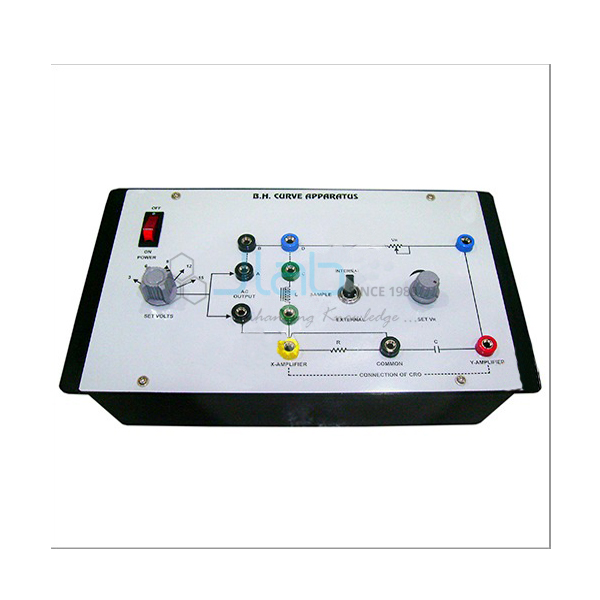
Product Code : EL-VOVLACOS-1107
Jlab Export is a leading BH Curve Apparatus with Different Material Manufacturer,and suppliers in India
The BH Curve Apparatus with Different Material is a bench unit for tracing the hysteresis (B–H) curves of magnetic materials on an oscilloscope. Its built-in AC supply gives 3 to 15 V AC, chosen with a band switch. The BH curve circuit is printed on the panel, with its components connected there and the input and output brought out to terminals. A provision for an external inductance lets other coils and cores be tested. The B.H. Curve Apparatus instead plots the curve of a sample coil fixed inside its cabinet.
Specifications
| Experiment | Tracing hysteresis (B–H) curves of magnetic materials |
| AC supply | 3–15 V AC, output selected with a band switch |
| Power supply | 230 V AC, 50 Hz (110 V on request) |
| Circuit diagram | BH curve circuit, printed on the panel |
| Components | Connected on the panel |
| External inductance | Provision for connecting one |
| Connections | Input and output brought out on terminals |
| Oscilloscope | 10 MHz CRO, for displaying the loop |
| Dimensions | 16 x 8 x 3 inches (about 41 x 20 x 8 cm) |
| Pack quantity | Each (sold individually) |
| Minimum order quantity | 5 units |
| Dispatch time | Usually 7–10 working days |
| Manufacturer | JLab (Jain Laboratory Instruments Pvt Ltd), Ambala, India |
How the Loop Is Traced
In the usual CRO method, a small resistor in the primary circuit gives a voltage in step with the magnetising current, and so with H. That voltage drives the X input of the oscilloscope.
The secondary coil gives a voltage that follows the rate of change of flux. An RC integrator turns it into a voltage in step with B, which drives the Y input.
With the CRO in X–Y mode, the spot traces the whole loop on every AC cycle. Stepping up the band switch shows the loop growing towards saturation.
Reading the Loop
| Feature | What it shows |
|---|---|
| Saturation | The tips of the loop, where B barely rises as H increases |
| Retentivity | The flux density left when H falls back to zero |
| Coercivity | The reverse H needed to bring B back to zero |
| Loop area | The energy lost as heat in each cycle (hysteresis loss) |
Soft iron gives a narrow loop and suits transformer cores. Hard steel gives a wide loop and suits permanent magnets. The unit runs from the mains, so switch off before changing connections at the terminals.
Frequently Asked Questions
Which material samples can be tested?
The apparatus is meant for comparing the loops of different magnetic materials, and an external inductance can be joined at its terminals. Name the cores or materials your syllabus uses, such as soft iron or steel. We will tell you which samples we can supply with the unit.
Is an oscilloscope needed with the apparatus?
Yes, the loop is shown on a CRO used in X–Y mode. A 10 MHz CRO is named for use with this apparatus. Say on your enquiry whether you need the oscilloscope too, and we will include it in our offer.
What does the area of a B–H hysteresis loop represent?
The area inside the loop is the energy turned into heat in each unit volume of the material during one cycle of magnetisation. This waste is called hysteresis loss. A material with a small loop loses little energy, which is why soft iron is used in transformer cores.
What is the difference between retentivity and coercivity?
Retentivity is the flux density a material keeps after the magnetising field is removed. Coercivity is the reverse field needed to bring that flux density back to zero. A good permanent magnet needs both to be high.
Why does the loop look tilted or distorted on the screen?
A distorted loop often means the integrator time constant is too short for the supply frequency, so the Y signal is not a true measure of B. Badly set X and Y gains also squash the shape. A loop that is only a thin line means the drive is too low, so raise the band switch.
Related Magnetism and Oscilloscope Products
- B.H. Curve Apparatus (sample coil inside the cabinet)
- Cathode Ray Oscilloscope
- Dual Trace Oscilloscope
For a quote, use Add To Cart or send us a message through the contact page.
Last updated: 26 November 2026