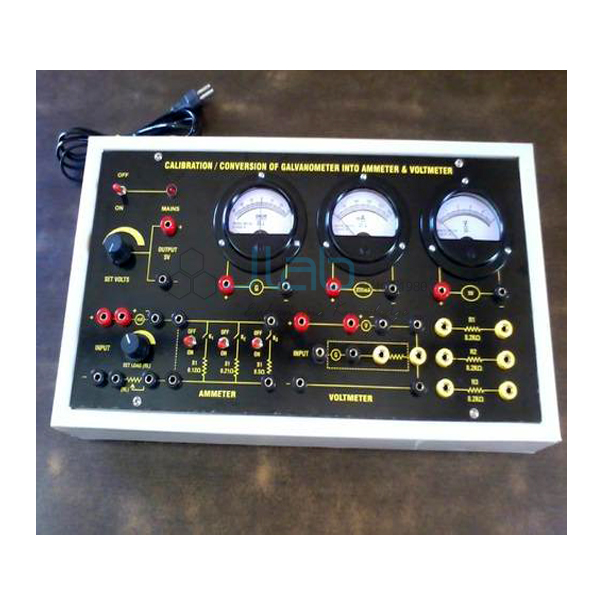
Ohm's Law Apparatus Manufacturer,Supplier and Exporter in India
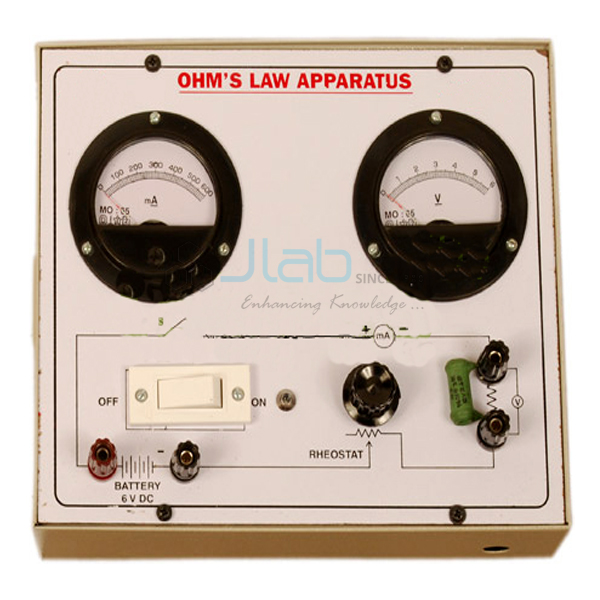
Product Code : EL-VOVLACOS-1104
Jlab Export is a leading Ohm's Law Apparatus Manufacturer,and suppliers in India
Ohm's Law Apparatus (code EL-VOVLACOS-1104) is a self-contained board for showing that voltage across a resistance rises in step with the current through it (V = IR), built for science and physics labs in schools, colleges and technical institutes. A printed circuit diagram, separate voltage and current moving coil meters and a wire-wound potentiometer for smooth voltage control are mounted together, with terminals for a 6 V battery, a wire-wound resistance and the power supply. It is made by Jain Laboratory Instruments Pvt Ltd (JLab) at its works in Ambala, India.
Specifications
| Parameter | Detail |
|---|---|
| Purpose | To verify Ohm’s law, V = IR |
| Voltage meter | Moving coil meter |
| Current meter | Moving coil meter |
| Potentiometer | One, wire-wound |
| Circuit diagram | Printed |
| Terminal connections | For a 6 V battery, one wire-wound resistance and the power supply |
| Quality check | Each board is visually inspected before dispatch |
| Pack quantity | Each (sold individually) |
| Minimum order quantity | 10 units |
| Dispatch time | Usually 7–10 working days |
| Product code | EL-VOVLACOS-1104 |
| Manufacturer | Jain Laboratory Instruments Pvt Ltd (JLab) — OEM |
| Country of origin | India (made in Ambala, Haryana) |
How Does It Compare with Other JLab Ohm’s Law Boards?
| Model | Meters | Voltage control and supply | Other listed details |
|---|---|---|---|
| This board (EL-VOVLACOS-1104) | Two moving coil meters (voltage, current) | Wire-wound potentiometer; terminals for a 6 V battery and power supply | Printed circuit diagram; terminals for a wire-wound resistance |
| Ohm's Law Apparatus | Two moving coil meters | Wire-wound potentiometer; 6 V battery terminals | Listed with the same description as this board |
| Ohms Law apparatus | DC voltmeter and DC current meter | Low-wattage built-in rheostat | Demonstrates how current, voltage and resistance depend on one another |
| Ohms Law Series & Parallel Circuits | — | Built-in continuously variable regulated DC supply | Also covers series and parallel circuits |
Pick this board when you want potentiometer control and the freedom to use either a 6 V battery or a bench supply; the rheostat model suits a simpler set-up, and the series and parallel board suits labs that want its built-in supply. Because two listings carry the same description, ask JLab whether they differ before ordering.
What Is the Ohm’s Law Board Used For?
Wired as a voltage divider, the wire-wound potentiometer lets the applied voltage be raised smoothly from close to zero, which gives evenly spaced readings for a clean graph — an advantage over simply switching cells in and out. Students record voltage and current at each setting, calculate V/I and plot the V–I graph; a constant ratio and a straight line through the origin show that the resistance obeys Ohm’s law. The same board can introduce the idea of non-ohmic behaviour if the teacher compares the result with a filament lamp or diode, whose graphs curve. It is suitable science lab equipment for class 12 physics and the class 10 electricity chapter, and for first-year engineering, polytechnic and ITI labs.
What to Specify When Ordering
- Quantity — the minimum order is 10 units.
- Supply — state whether you will run it on a 6 V battery or want a DC supply or battery eliminator quoted.
- Accessories — confirm with JLab whether the wire-wound resistance is supplied, and list any spare resistances.
Frequently Asked Questions
Why does this board use a potentiometer?
The wire-wound potentiometer acts as a variable voltage divider, so the voltage across the resistance can be set smoothly over its range and students get well-spaced readings for the V–I graph.
Can it run without a battery?
Yes, terminals are provided for a power supply as well as a 6 V battery, so a suitable DC source or battery eliminator can be used.
Is this the same as the other Ohm’s Law Apparatus in the range?
The two listings carry the same description: two moving coil meters, a wire-wound potentiometer, a printed diagram and the same terminals. Ask JLab to confirm whether they differ, and quote this product code to order this one.
What information is needed for an export quotation?
The quantity, destination country and port or city, delivery terms such as FOB or CIF, packing or labelling needs, and any tender reference.
Who manufactures it?
JLab, the trading name of Jain Laboratory Instruments Pvt Ltd, makes it at its works in Ambala, Haryana, India.
OEM Manufacturer
JLab is the trading name of Jain Laboratory Instruments Pvt Ltd, a manufacturer of school and college physics apparatus in India, incorporated in 2017 and based on Hargolal Road, Ambala, Haryana. This board is produced in JLab’s own works instead of being traded, so institutions, dealers and importers buy from the maker itself, every unit is visually checked before dispatch, and repeat orders are handled by the same team. JLab is registered under CIN U29309HR2017PTC069123 and holds MSME Udyam registration UDYAM-HR-01-0003849 as a manufacturing enterprise. It exports worldwide and ships to buyers in every region — for example Egypt in North Africa, Qatar in the Middle East, South Korea in East Asia, Laos in Southeast Asia and Greece in Southern Europe. Tender details are on the JLab lab tenders page.
Related Electrical Measurement Apparatus
- Ohms Law apparatus — a version with a DC voltmeter, DC current meter and built-in rheostat.
- Conversion of Galvanometer Into a Voltmeter and Current Meter — shows how meters like these are made from a galvanometer.
- Resistances in Series and Parallel Apparatus — the follow-on experiment on combining resistances.
- Digital Multimeter — for cross-checking the analogue meter readings.
See the full Verification of Various Laws and Conservation of Signal range or all Scientific Instrument apparatus.
Request a Quote
Quotes come direct from the manufacturer. Use the Add To Cart enquiry button, or send the quantity (minimum 10 units), your preferred supply option, and the delivery location through the contact page.
Last updated: 9 October 2026