Study of Stefan's Law Manufacturer,Supplier and Exporter in India
Product Code : EL-VOVLACOS-1114
Jlab Export is a leading Study of Stefan's Law Manufacturer,and suppliers in India
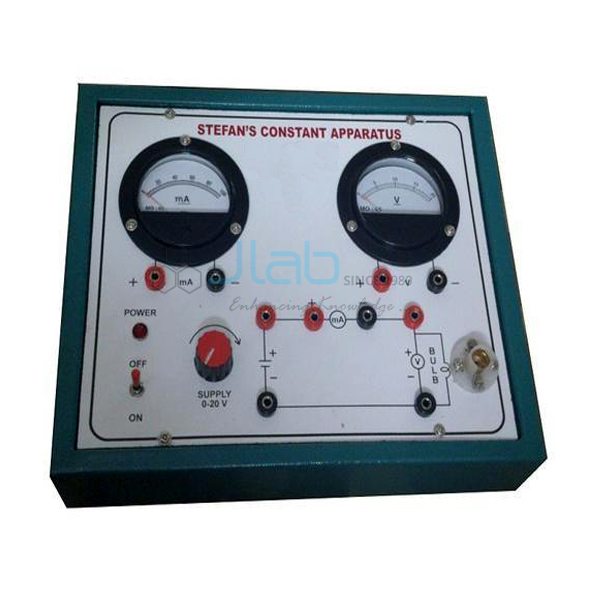
Study of Stefan's Law (code EL-VOVLACOS-1114) is a bench apparatus for verifying Stefan’s law of thermal radiation with an electric bulb, in which the filament of a 6 V bulb is the hot radiating body. An inbuilt variable power supply drives the bulb, and a voltmeter and current meter give the filament’s power and resistance at each setting. It is made by Jain Laboratory Instruments Pvt Ltd (JLab) at its works in Ambala, India.
Specifications
| Parameter | Detail |
|---|---|
| Experiment | Verification of Stefan’s law using an electric bulb |
| Radiating body | One 6 V bulb (its filament) |
| Meters | Voltmeter and current meter |
| Power supply | Inbuilt variable power supply |
| Power measurement | From the voltage across and current through the filament |
| Temperature measurement | Indirect: filament resistance is calculated, then converted with a standard resistance versus temperature relationship |
| Quality check | Each apparatus is visually inspected before dispatch |
| Pack quantity | Each (sold individually) |
| Minimum order quantity | 10 units |
| Dispatch time | Usually 7–10 working days |
| Product code | EL-VOVLACOS-1114 |
| Manufacturer | Jain Laboratory Instruments Pvt Ltd (JLab) — OEM |
| Country of origin | India (made in Ambala, Haryana) |
How Does It Compare with Other JLab Stefan’s Law Apparatus?
| Model | Hot body | How temperature and power are found (as listed) |
|---|---|---|
| This apparatus (EL-VOVLACOS-1114) | Filament of a 6 V electric bulb | Power from filament voltage and current; temperature from filament resistance via a resistance–temperature relationship |
| Stefan Constant Kit | Two black copper radiation plates with a heater element between them | Thermometers for temperature; built-in power supply with AC voltmeter and ammeter for heater power |
| Stefan Boltzmann Apparatus | Copper test disc inside a hemisphere heated by hot water from a tank | Temperature sensors on the hemisphere and test disc; determines the Stefan–Boltzmann constant |
Choose the bulb apparatus to verify the fourth-power law itself with nothing more than electrical readings. The Stefan constant kit and the hemisphere apparatus are built to determine the Stefan–Boltzmann constant from measured temperatures, the latter as a heat-transfer lab set-up.
What Is the Stefan’s Law Apparatus Used For?
Stefan’s law (the Stefan–Boltzmann law) states that the power radiated by a hot body is proportional to the fourth power of its absolute temperature. A glowing bulb filament is a convenient test body: once it is hot and steady, almost all the electrical power fed to it leaves as radiation, so the power equals voltage times current. The filament resistance, voltage divided by current, rises with temperature, and comparing it with the resistance at room temperature through a standard table for the filament metal (normally tungsten) gives the filament temperature. Students raise the supply in steps, record voltage and current at each step, and plot the logarithm of power against the logarithm of temperature; a straight line with a slope close to four verifies the law.
The experiment belongs to the thermal radiation topic of senior secondary physics and is a standard B.Sc. physics practical. Take the room-temperature resistance at a very low current so the filament does not warm up, allow each reading to settle before noting it, and do not run the bulb above its rated voltage.
What to Specify When Ordering
- Spare bulbs — state how many spare 6 V bulbs you want with the order.
- Resistance–temperature table — ask JLab whether a table for the filament is supplied with the apparatus or should be taken from your practical manual.
- Quantity — the minimum order is 10 units.
Frequently Asked Questions
How does this apparatus verify Stefan’s law?
It measures the electrical power of a bulb filament at several supply settings and finds the filament temperature from its resistance. A log–log plot of power against temperature with a slope close to four confirms the law.
How is the filament temperature found without a thermometer?
From its resistance. The resistance is calculated from the voltage and current readings and converted to temperature with a standard resistance versus temperature relationship.
What bulb does it use?
One 6 V bulb. Order spares with the apparatus so the experiment can continue if a bulb fails.
Who manufactures this apparatus?
Jain Laboratory Instruments Pvt Ltd (JLab), at its works in Ambala, Haryana, India.
OEM Manufacturer
JLab is the trading name of Jain Laboratory Instruments Pvt Ltd, a physics lab instruments manufacturer in India, incorporated in 2017 and working from Hargolal Road, Ambala, Haryana. The Stefan’s law apparatus is built in JLab’s own works instead of being bought from a trading house, so schools, colleges, dealers and importers order factory-direct; each unit is visually inspected before it ships, and repeat orders and spare bulbs are supplied by the manufacturer. JLab exports worldwide and ships to buyers in every region — among them Argentina in South America, Finland in Northern Europe, the USA in North America, Myanmar in Southeast Asia and Ivory Coast in West Africa. Tender buyers can find details on the JLab lab tenders page.
Related Radiation and Electrical Apparatus
- Stefan Constant Kit — a self-contained kit with black copper radiation plates for the Stefan constant.
- Stefan Boltzmann Apparatus — a hemisphere and copper-disc set-up for determining the Stefan–Boltzmann constant.
- Ohm's Law Apparatus — practice in finding resistance from voltage and current readings.
See the full Verification of Various Laws and Conservation of Signal range or all Scientific Instrument apparatus.
Request a Quote
Quotes come direct from the manufacturer. Use the Add To Cart enquiry button, or send the quantity (minimum 10 units), the number of spare bulbs and your delivery location through the contact page.
Last updated: 9 October 2026