Charging and Discharging of Condenser Manufacturer,Supplier and Exporter in India
Product Code : EL-VOVLACOS-1105
Jlab Export is a leading Charging and Discharging of Condenser Manufacturer,and suppliers in India
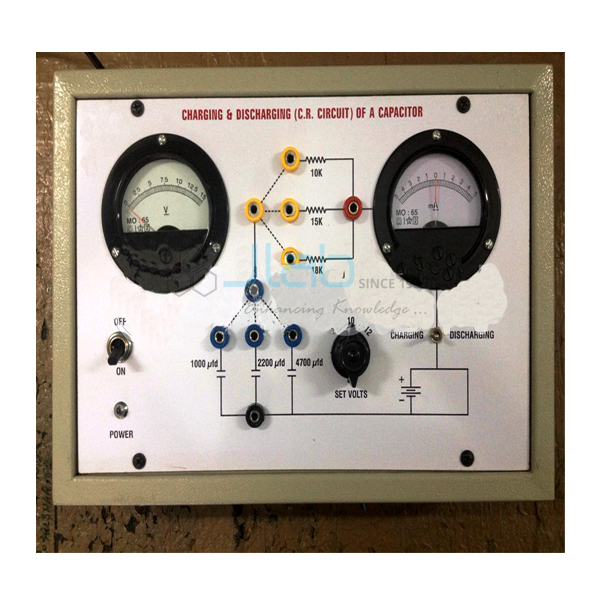
Charging and Discharging of Condenser (code EL-VOVLACOS-1105) is a bench apparatus for studying the RC time constant of a condenser (capacitor) charging and discharging through a resistance, used in physics and electrical labs. It has a DC power supply with a selector switch for different voltages, a microammeter, a printed circuit diagram, and terminals for the set of resistors and capacitors supplied with it. It is made by Jain Laboratory Instruments Pvt Ltd (JLab) at its works in Ambala, India.
Specifications
| Parameter | Detail |
|---|---|
| Experiment | RC time constant, using various sets of resistances and capacitors |
| Power supply | DC, with a selector switch for different voltages |
| Meter | One microammeter |
| Circuit diagram | Printed |
| Terminals | For connecting different values of resistance and capacitance |
| Supplied with | A set of resistors and capacitors |
| Dimensions | 8 x 6 x 3 inches (about 20 x 15 x 8 cm) |
| Quality check | Each apparatus is visually inspected before dispatch |
| Pack quantity | Each (sold individually) |
| Minimum order quantity | 10 units |
| Dispatch time | Usually 7–10 working days |
| Product code | EL-VOVLACOS-1105 |
| Manufacturer | Jain Laboratory Instruments Pvt Ltd (JLab) — OEM |
| Country of origin | India (made in Ambala, Haryana) |
How Does It Compare with Other JLab Condenser Experiments?
| Model | What it studies | Listed features |
|---|---|---|
| This apparatus (EL-VOVLACOS-1105) | RC time constant with various R and C sets | Selectable-voltage DC supply; microammeter; set of resistors and capacitors; terminals for other values |
| Charging and Discharging of a Condenser | Charging of a condenser; voltage–time and charging current–time graphs to find the time constant | See its own listing for the board details |
| Flashing and Quenching of Neon | Charge and discharge time of a condenser, shown by a flashing neon lamp | High-voltage DC supply; paper capacitors selected by toggle switches; one neon lamp |
Choose this apparatus when students should measure the decaying current on a microammeter and work out RC for several resistor–capacitor pairs; the neon flasher shows the same charging idea as a visible relaxation oscillator.
What Is the Condenser Charging and Discharging Apparatus Used For?
When a condenser charges through a resistance, the current starts at its highest value and falls away exponentially as the condenser voltage rises; on discharge the current flows the other way and again decays. The time constant, equal to the product of resistance and capacitance, sets the pace: after one time constant the current has fallen to about 37% of its starting value and, on charging, the condenser voltage has reached about 63% of the supply. Students select a supply voltage, connect an R–C pair at the terminals, and read the microammeter at regular intervals with a stopwatch; plotting the current against time, or its logarithm against time, gives the time constant to compare with R × C. Repeating with other pairs from the set shows how larger resistance or capacitance slows the process.
This is a standard capacitor experiment for senior-secondary physics projects, B.Sc. physics, engineering physics and diploma electrical labs. Discharge the condenser by shorting its terminals through a resistance before changing connections.
What to Specify When Ordering
- Quantity — the minimum order is 10 units.
- Component values — ask for the resistor and capacitor values in the supplied set and the supply voltages on the selector switch if your practical sheet needs them.
- Timing — a stopwatch for readings is a separate item that can be added to the enquiry.
Frequently Asked Questions
What is the RC time constant and how is it found here?
It is the product of resistance and capacitance, the time for the current to fall to about 37% of its initial value. Students record microammeter readings against time and read the time constant from the graph.
Are resistors and capacitors included?
Yes, the apparatus comes with a set of resistors and capacitors, and terminals let you connect other values. The listing does not state the values, so request them with your quotation.
What supply voltages are available?
The built-in DC power supply has a selector switch for different voltages; the exact steps are not listed, so ask JLab if you need particular values.
How large is the apparatus?
It measures 8 x 6 x 3 inches (about 20 x 15 x 8 cm).
Who manufactures this apparatus?
Jain Laboratory Instruments Pvt Ltd (JLab), at its works in Ambala, Haryana, India.
OEM Manufacturer
JLab is the trading name of Jain Laboratory Instruments Pvt Ltd, a manufacturer of physics and electronics lab apparatus in India, incorporated in 2017 and situated on Hargolal Road, Ambala, Haryana. This apparatus is made in JLab’s own works and not resold from a trader, so colleges, schools, dealers and importers buy direct; each unit is visually inspected before dispatch, and repeat orders and replacement components are handled by the manufacturer. JLab exports worldwide and ships to buyers in every region — for example Egypt in North Africa, Ireland in Western Europe, Mexico in North America, Australia in Oceania and Guatemala in Central America and the Caribbean. See the JLab lab tenders page for tender supply.
Related Capacitor and RC Apparatus
- Charging and Discharging of a Condenser — plots voltage and current against time to find the time constant.
- Flashing and Quenching of Neon — condenser charge and discharge timed by a neon lamp.
- RC Circuit Transient Response — RC circuits as low-pass and high-pass filters.
- Stop Watch — a digital stopwatch for timing the readings.
See the full Verification of Various Laws and Conservation of Signal range or all Scientific Instrument apparatus.
Request a Quote
Quotes come direct from the manufacturer. Use the Add To Cart enquiry button, or send the quantity (minimum 10 units), any component values you need, and your delivery location through the contact page.
Last updated: 9 October 2026