Flashing and Quenching of Neon Manufacturer,Supplier and Exporter in India
Product Code : EL-VOVLACOS-1106
Jlab Export is a leading Flashing and Quenching of Neon Manufacturer,and suppliers in India
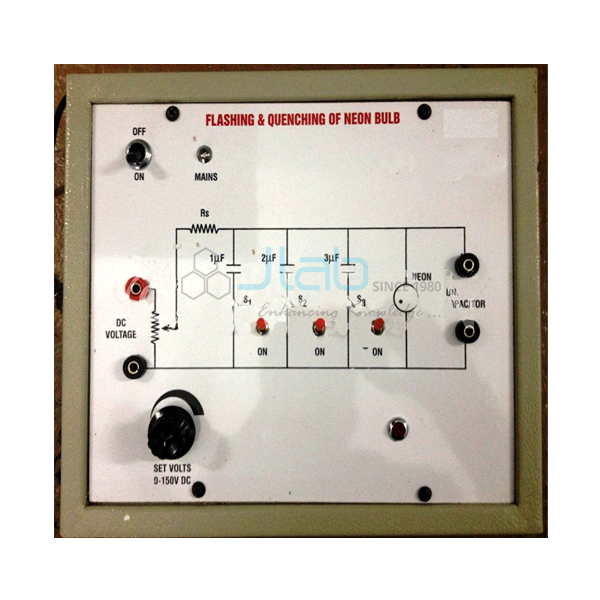
Flashing and Quenching of Neon (code EL-VOVLACOS-1106) is a neon-lamp apparatus for calculating the charge and discharge time of a condenser (capacitor), used in physics and electronics labs. A high-voltage DC power supply of 100 V DC at 30 mA charges one of three paper-type capacitors, chosen with toggle switches, and a neon lamp flashes each time the condenser discharges. It is made by Jain Laboratory Instruments Pvt Ltd (JLab) at its works in Ambala, India.
Specifications
| Parameter | Detail |
|---|---|
| Experiment | Calculation of the charge and discharge time of a condenser |
| Power supply | High-voltage DC, 100 V DC / 30 mA |
| Capacitors | Three, paper type, selected with toggle switches |
| Indicator | One neon lamp |
| Dimensions | 8 x 6 x 3 inches (about 20 x 15 x 8 cm) |
| Quality check | Each apparatus is visually inspected before dispatch |
| Pack quantity | Each (sold individually) |
| Minimum order quantity | 10 units |
| Dispatch time | Usually 7–10 working days |
| Product code | EL-VOVLACOS-1106 |
| Manufacturer | Jain Laboratory Instruments Pvt Ltd (JLab) — OEM |
| Country of origin | India (made in Ambala, Haryana) |
What Is the Neon Flashing and Quenching Apparatus Used For?
A neon lamp does not conduct until the voltage across it reaches its striking (flashing) voltage; once lit, it keeps conducting until the voltage drops to a lower extinction (quenching) voltage. Connected across a charging condenser, it forms a simple relaxation oscillator: the condenser charges from the supply, the lamp strikes and flashes as the condenser discharges through it, the lamp quenches, and the cycle repeats. The time between flashes depends on the circuit resistance and capacitance and on the supply, striking and extinction voltages, so it is a direct, visible measure of how fast the condenser charges.
Students switch in each of the three paper capacitors in turn, time a counted number of flashes with a stopwatch, and work out the period; a larger capacitance gives slower flashing. Comparing the periods with the capacitance shows the proportionality between charging time and capacitance. The experiment is used in B.Sc. physics and electronics practicals, engineering physics labs and senior-secondary project work. Because the supply is 100 V DC, switch off before touching the terminals and let the condenser discharge first.
What to Specify When Ordering
- Quantity — the minimum order is 10 units.
- Component values — ask JLab for the capacitance of each paper capacitor and the charging resistance if your worksheet needs them.
- Stopwatch — available as a separate item for timing the flashes.
Frequently Asked Questions
What does “flashing and quenching” mean?
Flashing is the moment the neon lamp strikes and glows as the condenser discharges through it; quenching is when the voltage falls to the extinction level and the lamp goes out. The interval between flashes gives the charge and discharge time.
How many capacitors does the apparatus have?
Three paper-type capacitors, each selected with a toggle switch, so the flash rate can be compared for different capacitances.
What power supply is built in?
A high-voltage DC power supply rated 100 V DC at 30 mA, enough to strike the neon lamp. Treat the terminals as live while it is switched on.
How does it differ from the Charging and Discharging of Condenser apparatus?
That apparatus measures the decaying current on a microammeter with a selectable DC supply and a set of resistors and capacitors. This one shows the charging time through the flashing rate of a neon lamp.
Who manufactures this apparatus?
Jain Laboratory Instruments Pvt Ltd, trading as JLab, at its works in Ambala, Haryana, India.
OEM Manufacturer
JLab is the trading name of Jain Laboratory Instruments Pvt Ltd, a physics and electronics apparatus manufacturer in India, incorporated in 2017 and based on Hargolal Road, Ambala, Haryana. The neon flashing apparatus is wired and assembled at JLab’s own works, not bought from a trader, so colleges, schools, dealers and importers buy it factory-direct; each unit is visually inspected before dispatch, and repeat orders and replacement lamps are handled by the manufacturer. JLab exports worldwide and ships to buyers in every region — for example Sudan in North Africa, Ghana in West Africa, Fiji in Oceania, South Korea in East Asia and Mexico in North America. Tender information is on the JLab lab tenders page.
Related Condenser and RC Apparatus
- Charging and Discharging of Condenser — RC time constant with a microammeter and a set of resistors and capacitors.
- Charging and Discharging of a Condenser — voltage–time and current–time graphs to find the time constant.
- RC Circuit Transient Response — RC circuits as low-pass and high-pass filters.
- Stop Watch — a digital stopwatch for timing the flashes.
See the full Verification of Various Laws and Conservation of Signal range or all Scientific Instrument apparatus.
Request a Quote
Quotes come direct from the manufacturer. Use the Add To Cart enquiry button, or send the quantity (minimum 10 units), any component values you need confirmed, and your delivery location through the contact page.
Last updated: 9 October 2026