Conversion of Galvanometer Into a Voltmeter and Current Meter Manufacturer,Supplier and Exporter in India
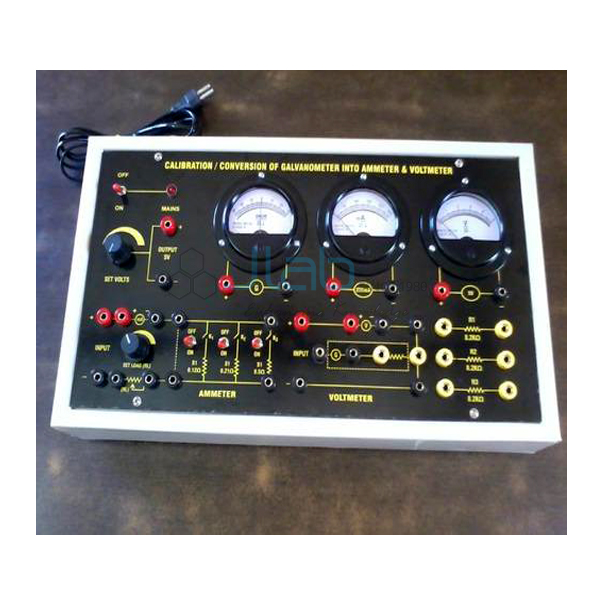
Product Code : EL-VOVLACOS-1108
Jlab Export is a leading Conversion of Galvanometer Into a Voltmeter and Current Meter Manufacturer,and suppliers in India
Conversion of Galvanometer Into a Voltmeter and Current Meter (code EL-VOVLACOS-1108) is a panel apparatus for converting a galvanometer into a voltmeter and into a current meter (ammeter), a standard practical in senior-secondary and college physics. It has a regulated DC power supply of 0–10 V DC at 500 mA, two round meters — a voltmeter and a galvanometer — and three sets of resistances on the panel, with all connections on terminals. It is made by Jain Laboratory Instruments Pvt Ltd (JLab) at its works in Ambala, India.
Specifications
| Parameter | Detail |
|---|---|
| Experiments | Conversion of a galvanometer into a voltmeter and into a current meter |
| Power supply | DC regulated, 0–10 V DC / 500 mA |
| Meters | Two round meters: one voltmeter and one galvanometer |
| Resistances | Three sets, mounted on the panel |
| Connections | Supplies, meters and resistances brought out on terminals |
| Dimensions | 10 x 8 x 3 inches (about 25 x 20 x 8 cm) |
| Quality check | Each apparatus is visually inspected before dispatch |
| Pack quantity | Each (sold individually) |
| Minimum order quantity | 10 units |
| Dispatch time | Usually 7–10 working days |
| Product code | EL-VOVLACOS-1108 |
| Manufacturer | Jain Laboratory Instruments Pvt Ltd (JLab) — OEM |
| Country of origin | India (made in Ambala, Haryana) |
What Is the Galvanometer Conversion Apparatus Used For?
A galvanometer gives full-scale deflection for only a very small current, so on its own it cannot measure ordinary voltages or currents. Adding a high resistance in series turns it into a voltmeter: the series resistance equals the desired full-scale voltage divided by the galvanometer’s full-scale current, minus the galvanometer’s own resistance. Adding a low resistance (a shunt) in parallel turns it into an ammeter, because most of the current bypasses the coil. Students usually first find the galvanometer resistance by the half-deflection method and its figure of merit, calculate the series resistance and the shunt, wire them from the resistance sets on the panel, and then check the converted meter against the voltmeter while varying the regulated supply.
These are prescribed experiments in the class 12 physics practical syllabus and appear in first-year B.Sc., engineering physics and diploma labs, so the apparatus is practical physics lab equipment for CBSE and state-board schools as well as colleges. Keep the supply at its lowest setting when connecting the galvanometer, and raise it slowly, so the sensitive coil is not overloaded.
What to Specify When Ordering
- Quantity — the minimum order is 10 units.
- Meter and resistance details — ask for the galvanometer’s resistance and full-scale current and the values in the three resistance sets if your worksheet uses fixed ranges.
- Companion items — a decade resistance box or a separate galvanometer can be added to the same enquiry.
Frequently Asked Questions
How is a galvanometer converted into a voltmeter?
By connecting a suitable high resistance in series with it. The resistance is chosen so that the required full-scale voltage drives exactly the galvanometer’s full-scale current, allowing for the coil’s own resistance.
How is it converted into a current meter?
By connecting a low-value shunt resistance in parallel, so that only the galvanometer’s full-scale current flows through the coil when the required total current flows in the circuit.
What is supplied on the panel?
A regulated DC power supply of 0–10 V DC at 500 mA, a round voltmeter, a round galvanometer and three sets of resistances, with every connection on terminals.
How does it differ from the Conversion of Galvanometer into an Ammeter apparatus?
That apparatus is listed for finding the galvanometer resistance by half deflection, its figure of merit, and conversion into an ammeter with calibration. This one covers conversion into both a voltmeter and a current meter, with its own regulated supply and comparison voltmeter.
Who manufactures this apparatus?
Jain Laboratory Instruments Pvt Ltd, trading as JLab, makes it at its works in Ambala, Haryana, India.
OEM Manufacturer
JLab is the trading name of Jain Laboratory Instruments Pvt Ltd, a physics and electrical lab equipment manufacturer in India, incorporated in 2017 and based on Hargolal Road, Ambala, Haryana. This apparatus is assembled at JLab’s own works and not sourced from a trader, so schools, colleges, dealers and importers buy it straight from the maker; each unit is visually inspected before dispatch, and repeat orders are handled by the manufacturer. The company holds MSME Udyam registration UDYAM-HR-01-0003849 as a manufacturing enterprise and Importer-Exporter Code 3317504552. JLab exports worldwide and ships to buyers in every region — for example Mexico in North America, North Macedonia in Southern Europe, Botswana in Southern Africa, Germany in Western Europe and Saudi Arabia in the Middle East. Tender details are on the JLab lab tenders page.
Related Galvanometer and Meter Apparatus
- Conversion of Galvanometer into an Ammeter — half-deflection resistance, figure of merit and ammeter conversion with calibration.
- Galvanometer — a sensitive moving-coil current detector for bridge and potentiometer practicals.
- Decade Resistance Box — a switched resistance box for setting series and shunt resistances.
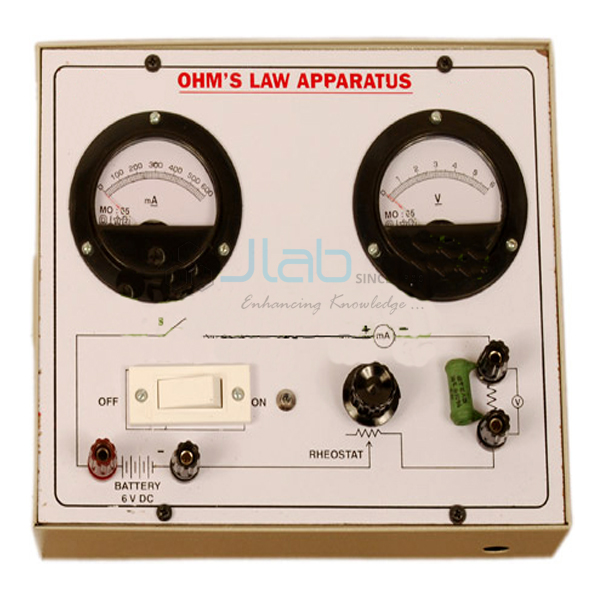
- Ohm's Law Apparatus — voltage and current meters with a wire-wound potentiometer for verifying V = IR.
See the full Verification of Various Laws and Conservation of Signal range or all Scientific Instrument apparatus.
Request a Quote
Quotes come direct from the manufacturer. Use the Add To Cart enquiry button, or send the quantity (minimum 10 units), any meter ranges you need, and your delivery location through the contact page.
Last updated: 9 October 2026