LCR Impedance Circuit Manufacturer,Supplier and Exporter in India
Product Code : EL-VOVLACOS-1110
Jlab Export is a leading LCR Impedance Circuit Manufacturer,and suppliers in India
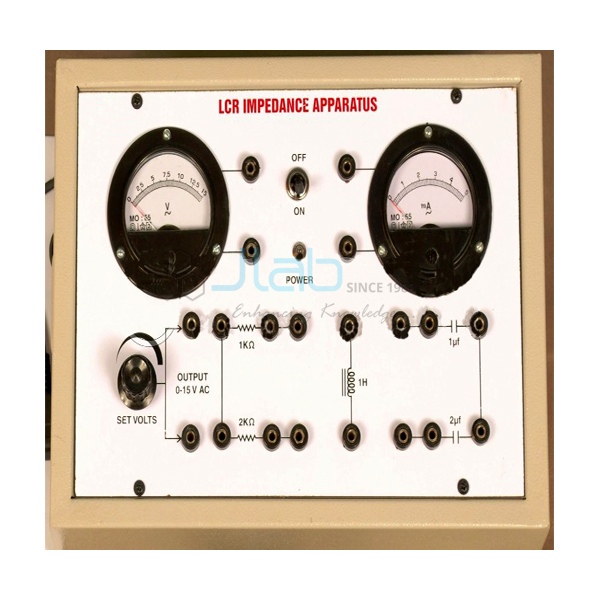
LCR Impedance Circuit (code EL-VOVLACOS-1110) is a bench apparatus for calculating the AC power factor of a resistance, capacitor and inductance connected in series across an AC supply, used in physics and electrical engineering labs. It has an AC power supply listed at 100 V with a band switch for selection, two AC moving coil meters for voltage and current, and one resistance, one capacitor and one inductance wired with connections on terminals. It is made by Jain Laboratory Instruments Pvt Ltd (JLab) at its works in Ambala, India.
Specifications
| Parameter | Detail |
|---|---|
| Experiment | AC power factor of a series LCR circuit |
| Power supply | AC, 100 V, selected with a band switch |
| Meters | Two AC moving coil meters, for voltage and current |
| Components | One resistance, one capacitor and one inductance, connected |
| Connections | Brought out on terminals |
| Dimensions | 10 x 8 x 4 inches (about 25 x 20 x 10 cm) |
| Quality check | Each apparatus is visually inspected before dispatch |
| Pack quantity | Each (sold individually) |
| Minimum order quantity | 10 units |
| Dispatch time | Usually 7–10 working days |
| Product code | EL-VOVLACOS-1110 |
| Manufacturer | Jain Laboratory Instruments Pvt Ltd (JLab) — OEM |
| Country of origin | India (made in Ambala, Haryana) |
How Does It Compare with Other JLab AC Circuit Apparatus?
| Model | What it studies | Listed features |
|---|---|---|
| This apparatus (EL-VOVLACOS-1110) | Power factor of a series LCR circuit at the supply frequency | Band-switched AC supply; two AC moving coil meters; one R, one C and one L on terminals |
| LCR Resonance Apparatus Series and Parallel | Current against frequency in series and parallel LCR circuits; resonant frequency and sharpness | One R, one C and one L on terminals; two AC moving coil meters; audio frequency function generator |
| Measurement of Peak, Average and RMS Value of an AC Signal | Peak, average and RMS values of an AC signal | Sine wave generator; step-down transformer; printed circuit diagram |
Choose this apparatus for impedance and power-factor work at the fixed supply frequency; choose the resonance apparatus when students must vary the frequency to find resonance.
What Is the LCR Impedance Circuit Used For?
In a series LCR circuit the same current flows through all three components, but the voltages across them are not in step: the resistor’s voltage is in phase with the current, the inductor’s leads it and the capacitor’s lags it. The circuit’s opposition to current, the impedance, is therefore the square root of the resistance squared plus the square of the difference between inductive and capacitive reactance, not the simple sum. The power factor — the cosine of the phase angle — equals the resistance divided by the impedance, or the voltage across the resistor divided by the supply voltage, and shows what fraction of the apparent power is actually used. Students set the supply with the band switch, read the total voltage and current, measure the voltage across each component at the terminals, then calculate impedance and power factor and draw the phasor diagram.
The experiment supports the alternating current chapter of class 12 physics and is a regular practical in B.Sc. physics, engineering electrical-technology labs, polytechnic and ITI electrician courses. Switch off the AC supply before changing any connection.
What to Specify When Ordering
- Quantity — the minimum order is 10 units.
- Component values — ask JLab for the resistance, capacitance and inductance values and the band-switch steps if your worksheet needs them.
- Extra meter — a multimeter for measuring the voltage across each component can be added to the enquiry.
Frequently Asked Questions
What does this LCR circuit measure?
It is used to calculate the AC power factor of a resistance, capacitor and inductance in series, from the voltage and current readings and the voltages across the components.
What supply and meters are fitted?
An AC power supply listed at 100 V with a band switch for selection, and two AC moving coil meters for voltage and current.
Are the component values stated?
The listing gives one resistance, one capacitor and one inductance with terminals, but not their values. Request them with your quotation if you need to compare measured and calculated results.
How does it differ from the LCR Resonance Apparatus?
The resonance apparatus adds an audio frequency function generator so the frequency can be varied to find resonance in series and parallel circuits. This apparatus works at the supply frequency and focuses on impedance and power factor.
Who manufactures it?
Jain Laboratory Instruments Pvt Ltd (JLab), at its works in Ambala, Haryana, India.
OEM Manufacturer
JLab is the trading name of Jain Laboratory Instruments Pvt Ltd, a manufacturer of physics and electrical engineering lab equipment in India, incorporated in 2017 and based on Hargolal Road, Ambala, Haryana. The LCR impedance circuit is built at JLab’s own works rather than bought in, so colleges, schools, dealers and importers buy it factory-direct; each unit is visually inspected before dispatch, and repeat orders are handled by the manufacturer. JLab exports worldwide and ships to buyers in every region — for example Iceland in Northern Europe, Laos in Southeast Asia, Oman in the Middle East, Canada in North America and Ecuador in South America. The JLab lab tenders page has tender details.
Related AC Circuit Apparatus
- LCR Resonance Apparatus Series and Parallel — resonance curves for series and parallel LCR circuits.
- Measurement of Peak, Average and RMS Value of an AC Signal — the AC values that the meters read.
- LCR Meter — for measuring the inductance, capacitance and resistance of the components.
- Digital Multimeter — for reading the voltage across each component.
See the full Verification of Various Laws and Conservation of Signal range or all Scientific Instrument apparatus.
Request a Quote
Quotes come direct from the manufacturer. Use the Add To Cart enquiry button, or send the quantity (minimum 10 units), any component values you need, and your delivery location through the contact page.
Last updated: 9 October 2026