Tambours Manufacturer,Supplier and Exporter in India
Product Code : EL-PALE-2361
Jlab Export is a leading Tambours Manufacturer,and suppliers in India
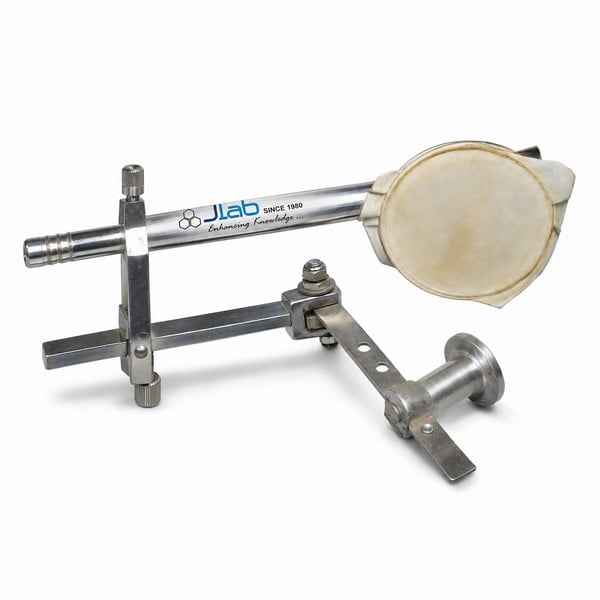
A tambour is a shallow capsule closed by a rubber membrane. Air pressure in a tube joined to it moves the membrane, and a lever resting on the membrane writes the movement on a kymograph. Three types are made. The student tambour has a 40 mm tie-on diaphragm, the large tambour a 75 mm diaphragm, and the Marey tambour comes in 22 mm or 28 mm.
Specifications
| Student tambour | 40 mm tie-on diaphragm, stainless steel capillary lever |
| Large tambour | 75 mm diameter diaphragm for large displacement of air, stainless steel capillary lever |
| Marey tambour | 22 mm or 28 mm diameter, stainless steel capillary lever |
| Minimum order quantity | 10 units |
| Dispatch time | Usually 4–6 working days |
| Manufacturer | JLab (Jain Laboratory Instruments Pvt Ltd), Ambala, India |
Breathing and Pulse Practicals in Class
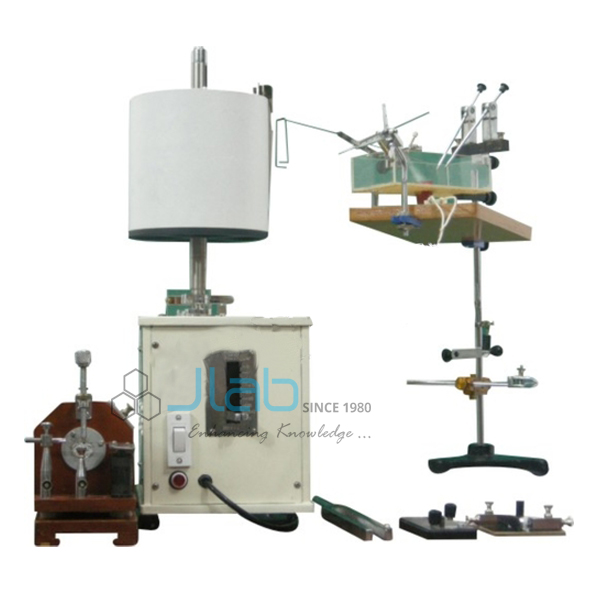
For a breathing practical, a Pneumograph Stethograph round the chest is joined by rubber tube to the large tambour. Its lever writes each breath on a Student Electrical Kymographs drum turning at a slow speed. Students compare quiet breathing, speaking, swallowing and breath holding.
A smaller Marey tambour picks up quicker, smaller movements, so teachers use it to show how a pressure change travels along a closed air line. Every human practical stays non-invasive.
Frequently Asked Questions
Which tambour size should I choose?
The large 75 mm tambour suits big air movements such as breathing. The Marey tambour, at 22 mm or 28 mm, follows small, quick changes. The 40 mm student tambour sits between them and serves most class work.
Why does the lever stay still while air is moving?
Usually there is a leak. Check that the membrane is tied on tight with no tears and that every rubber tube joint is sealed. A kinked tube also stops the pressure reaching the tambour.
How tight should the membrane be?
Stretch it evenly and firmly with no wrinkles. A slack membrane moves the lever late and too far, while one stretched very tight gives a small trace. Retie it when the rubber goes soft.
What replaced tambours in modern labs?
Pressure transducers with electronic recorders do the same job and store the data. Tambours stay in teaching because students can see each step, from air pressure to lever to trace.
Other Recording Accessories
For a quote, use Add To Cart or send us a message through the contact page.
Last updated: 12 November 2026