Thin Section of Minerals Manufacturer,Supplier and Exporter in India
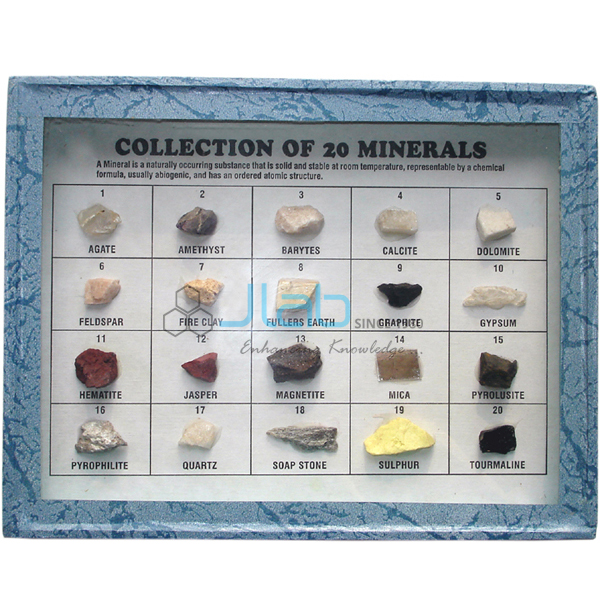
Product Code : EL-ERAM-4343
Jlab Export is a leading Thin Section of Minerals Manufacturer,and suppliers in India
Thin Section of Minerals (code EL-ERAM-4343) is a set of 20 thin-section slides of minerals for optical mineralogy and geology practicals. Each section is mounted on a glass slide under a cover fixed with transparent glue, ready for study under the microscope, and the listed subjects range from quartz and feldspars to ore minerals such as galena and pyrite. It is made by Jain Laboratory Instruments Pvt Ltd (JLab) at its works in Ambala, India.
Get a quote: use the Add To Cart enquiry button below, or send your quantity and destination through the contact page.
Specifications
| Parameter | Detail |
|---|---|
| Contents | Set of 20 thin-section slides |
| Mounting | Glass slides with covers fixed by transparent glue |
| Subjects listed | Amethyst, barytes, beryl, chalcopyrite, chromite, coquina, fluorite, galena, jasper, labradorite, lapis lazuli, laterite, magnetite, microcline, muscovite, orthoclase, pyrite, pyrolusite, smoky quartz, tourmaline |
| Use | Observation under the microscope |
| Quality check | Each set is visually inspected before dispatch |
| Pack quantity | Set of 20 slides |
| Minimum order quantity | 10 units |
| Dispatch time | Usually 7–10 working days |
| Product code | EL-ERAM-4343 |
| Manufacturer | Jain Laboratory Instruments Pvt Ltd (JLab) — OEM |
| Country of origin | India (made in Ambala, Haryana) |
How Does It Compare with Other JLab Thin-Section Sets?
| Set | Slides | Subjects listed | Mounting stated |
|---|---|---|---|
| This set (EL-ERAM-4343) | 20 | Minerals, from amethyst to tourmaline | Glass slides and covers with transparent glue |
| Thin Section of Rocks | 20 | Igneous, sedimentary and metamorphic rocks, from anthracite to slate | Not stated |
| Thin Section of Rocks & Minerals | 20 | Igneous, sedimentary and metamorphic rocks (rock list as in the rocks set) | Glass slides and covers with transparent glue |
Pick this set when students are learning to recognise individual minerals; the rock sets suit lessons on rock types and textures.
What Is the Thin Section of Minerals Set Used For?
Optical mineralogy teaches students to name a mineral from how it behaves in polarised light, and a slide set of known minerals is the reference for that skill. Transparent minerals in the set each show a characteristic picture under a polarising microscope: quartz gives low grey-to-white interference colours, muscovite gives bright, vivid ones, fluorite stays dark under crossed polars at every stage position, microcline shows cross-hatched “tartan” twinning, labradorite shows fine parallel twin bands, and tourmaline changes colour strongly as the stage is turned. The ore minerals — galena, pyrite, chalcopyrite, magnetite, chromite and pyrolusite — are opaque, so they look black in transmitted light, which is itself a clue and a useful bridge to ore microscopy.
Note that coquina, laterite and lapis lazuli in the list are strictly rocks rather than single minerals, which makes them good discussion examples of the difference. The set supports B.Sc. and M.Sc. geology, earth science and mining courses, and teacher-training labs. Hold slides by their edges and store them flat in a slide box.
What to Specify When Ordering
- Set type — minerals (this set), rocks, or rocks and minerals.
- Mineral list — the listing ends with “etc.”, so ask for the current list if a syllabus names particular minerals.
- Quantity — the minimum order is 10 units.
- A polarising microscope or hand-specimen collections, if needed, on the same enquiry.
Frequently Asked Questions
How many slides are in the set, and how are they mounted?
Twenty slides. Each thin section is mounted on a glass slide with a cover fixed in place by transparent glue.
Which minerals are included?
The twenty subjects in the specification table, from amethyst to tourmaline. The original list ends with “etc.”, so confirm the exact slides in your quotation when particular minerals are required.
Can it be used with an ordinary microscope?
Yes, for colour, shape and cleavage, but the identification features such as interference colours, extinction and twinning need a polarising microscope with crossed polars.
Why do some slides look black?
Galena, pyrite, chalcopyrite, magnetite, chromite and pyrolusite are opaque minerals, so no light passes through them in a transmitted-light microscope.
What is the minimum order and dispatch time?
10 units, usually dispatched within 7–10 working days after visual inspection; export transit is added on top.
What details does an export quotation need?
Quantity, destination country and port or city, delivery terms such as FOB or CIF, packing or labelling needs and any tender reference.
Who manufactures the set?
JLab (Jain Laboratory Instruments Pvt Ltd) prepares it at its works in Ambala, Haryana, India.
OEM Manufacturer
JLab is the trading name of Jain Laboratory Instruments Pvt Ltd, an Indian manufacturer of geology and science teaching equipment, incorporated in 2017 and working from Hargolal Road, Ambala, Haryana. The mineral slides are produced at JLab’s own works, not resold from a trader, so universities, colleges, dealers and importers buy direct; each set is checked by eye before packing, and repeat orders are made by the same manufacturer. JLab exports worldwide and ships to buyers in every region, with Congo in Central Africa, Guatemala in Central America and the Caribbean, Morocco in North Africa, Slovenia in Southern Europe and South Africa in Southern Africa as examples. Tender buyers can use the JLab lab tenders page.
Related Mineralogy Items
- Laboratory Polarising Microscope — monocular model with a graduated rotating stage for thin-section work.
- Thin Section of Rocks — 20 slides of igneous, sedimentary and metamorphic rocks.
- Collection of 10 Rocks — hand specimens of rock-forming minerals such as olivine, quartz and biotite.
- Rocks and Minerals Test Kit — Mohs hardness minerals with streak, magnetism and acid tests.
See all items in Rocks and Minerals or the Educational Rock and Minerals category.
Request a Quote
Quotes come direct from the manufacturer. Use the Add To Cart enquiry button on this page, or send the number of sets (minimum 10 units), any minerals your course requires and the delivery location through the contact page.
Last updated: 9 October 2026