Zinc Metal Granular Manufacturer,Supplier and Exporter in India
Product Code : EL-RE-5140
Jlab Export is a leading Zinc Metal Granular Manufacturer,and suppliers in India
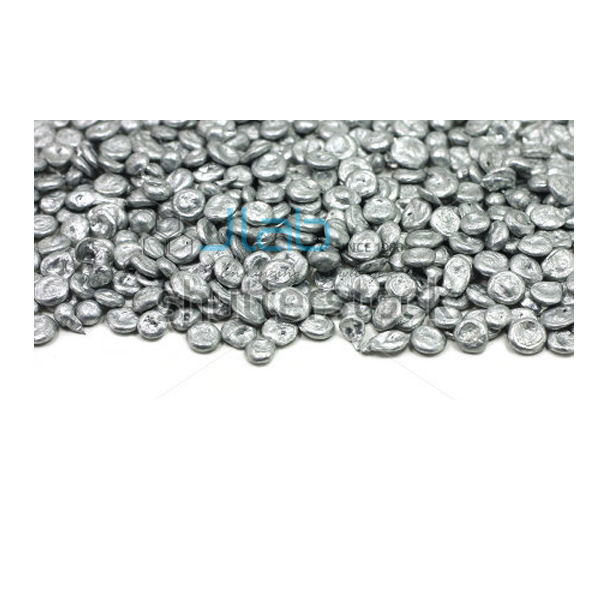
Granulated zinc is zinc metal in small irregular lumps and the usual starting point for making hydrogen in a school or college lab. These granules are of high purity. Their rough surface lets dilute acid attack the metal at a steady rate, quicker than a smooth zinc sheet and far gentler than zinc dust.
Specifications
| Metal | Zinc |
| Form | Granules (small irregular lumps) |
| Purity | High purity |
| Minimum order quantity | 10 units |
| Dispatch time | Usually 3–5 working days |
| Manufacturer | JLab (Jain Laboratory Instruments Pvt Ltd), Ambala, India |
Practicals with Granulated Zinc
To prepare hydrogen, the granules go into the middle bulb of a Kipp Gas Generator or a flask with a Thistle Funnel (Borosilicate, 300 mm), and dilute acid is let in. The gas is collected over water in a Gas Jar with Cover. A lighted splint at the mouth of the jar gives the squeaky pop that identifies hydrogen.
Granules dropped into blue Copper Sulphate solution show displacement: a brown coat of copper forms on the zinc and the blue colour fades. In rate-of-reaction work, students time the hydrogen given off as they change the acid strength or its temperature, with fresh granules of equal mass each time.
Frequently Asked Questions
Why is granulated zinc used to prepare hydrogen?
Granules give a large, rough surface, so the reaction with dilute acid starts quickly and then runs at a pace that is easy to control. Zinc dust reacts too fast, and a smooth sheet gives only a slow stream of gas.
Why does very pure zinc give hydrogen slowly, and how is it speeded up?
Very pure zinc reacts only slowly with dilute acid. A few drops of copper sulphate solution leave specks of copper on the granules. Hydrogen then forms easily on the copper, so the gas comes off faster.
How is the hydrogen collected and tested?
Hydrogen hardly dissolves in water and is lighter than air, so it is collected over water or in an upside-down jar. Bring a lighted splint to the mouth of the jar: a squeaky pop shows that the gas is hydrogen.
Which acid should be used with zinc granules?
Dilute hydrochloric acid or dilute sulphuric acid. Both give hydrogen with zinc. Concentrated sulphuric acid and nitric acid give other gases instead, so school practicals use only the dilute acids.
What mistakes do students make when preparing hydrogen?
Testing the first bubbles, which are mostly air from the apparatus, is the usual one. Others are loose joints and a thistle funnel stem that ends above the acid, so gas escapes through it. Keep flames away from the generator itself.
Other Metals and Zinc Salts
- Zinc Strip (rectangular electrode with terminal)
- Zinc Sulphate (analytical reagent)
- Copper Turning
For a quote, use Add To Cart or send us a message through the contact page.
Last updated: 6 November 2026