Simple Cell Manufacturer,Supplier and Exporter in India
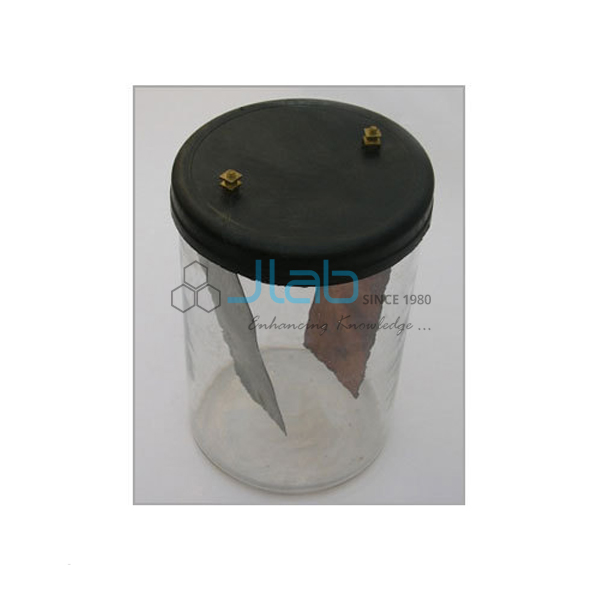
Product Code : EL-RE-5131
Jlab Export is a leading Simple Cell Manufacturer,and suppliers in India
Zinc and copper plates standing in dilute sulphuric acid make the simple cell, the first cell most physics and chemistry students build. This one has a glass jar of 150 x 100 mm and zinc and copper plates of 150 x 50 mm, each with a terminal. It gives about one volt and shows polarisation as hydrogen bubbles gather on the copper.
Specifications
| Jar | Glass, 150 x 100 mm |
| Plates | Zinc and copper, 150 x 50 mm |
| Connections | Terminal on each plate |
| Minimum order quantity | 10 units |
| Dispatch time | Usually 4–6 working days |
| Manufacturer | JLab (Jain Laboratory Instruments Pvt Ltd), Ambala, India |
Experiments with the Simple Cell
The teacher pours dilute sulphuric acid into the jar, and students stand the two plates apart in it. A meter from the Voltmeters range across the terminals shows the voltage, with copper as the positive terminal and zinc as the negative.
Students then join a small bulb with Connecting Leads and close a Plug Key. Within minutes the bulb dims as bubbles coat the copper plate, and brushing the bubbles off brings the light back for a while. A Daniell Cell run beside it keeps a steadier voltage, which shows why depolarised cells replaced the simple cell.
Polarisation and Local Action
Polarisation comes from the hydrogen released at the copper. The bubbles add resistance and set up an opposing voltage, so the output falls. Local action comes from impurities in ordinary zinc. They form tiny cells on the zinc surface, so the zinc dissolves even when no current is drawn.
Frequently Asked Questions
What voltage does the simple cell give?
About one volt when it is first set up with fresh acid and clean plates. The reading falls once current flows, because hydrogen collects on the copper plate.
Which plate is positive?
The copper plate is the positive terminal and the zinc plate is the negative one. Zinc goes into the acid as zinc ions and leaves electrons behind, and these flow through the outer circuit to the copper.
Why does the bulb dim after a few minutes?
Hydrogen gas forms a layer of bubbles on the copper plate. The layer adds internal resistance and sets up a voltage that opposes the cell, so the current falls. This effect is called polarisation.
Why does the zinc wear away when no current is drawn?
Ordinary zinc contains traces of other metals such as iron and lead. They form tiny cells with the acid on the zinc surface, so zinc dissolves and hydrogen bubbles off the zinc itself. Lift the plates out whenever the cell is not in use.
How should the cell be cleaned after use?
Rinse the plates and the jar in plenty of water and dry them. Before the next practical, rub the plates with fine sandpaper so that clean metal faces the acid.
Other Cells and Cell Parts
For a quote, use Add To Cart or send us a message through the contact page.
Last updated: 6 November 2026