Travelling Microscope Manufacturer,Supplier and Exporter in India
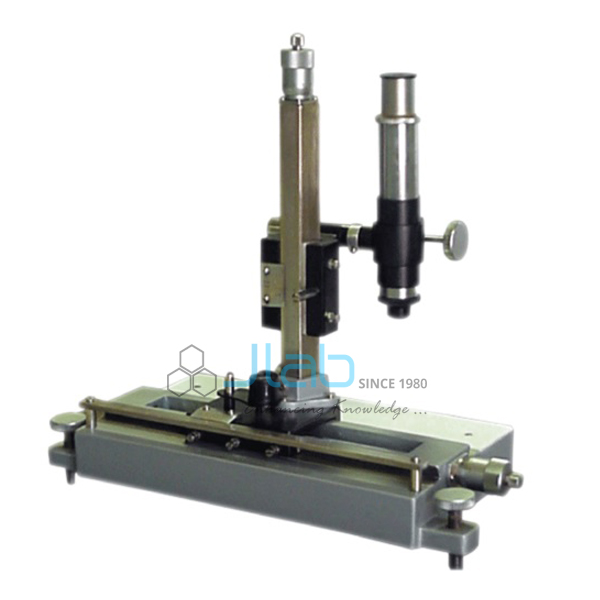
Product Code : EL-RE-5119
Jlab Export is a leading Travelling Microscope Manufacturer,and suppliers in India
Mounted on two rails fixed to a rigid bed, this travelling microscope measures small lengths by sighting one edge of an object and then the other. It slides along the rails for coarse setting, and a screw moves it finely. Fine cross-hairs in the eyepiece mark each point, and the position is read on a vernier scale.
Specifications
| Mounting | Microscope on two rails fixed to a rigid bed |
| Coarse movement | Sliding along the rails |
| Fine movement | Screw |
| Reading | Vernier scale |
| Eyepiece | Fine cross-hairs |
| Minimum order quantity | 1 unit |
| Dispatch time | Usually 7–10 working days |
| Manufacturer | JLab (Jain Laboratory Instruments Pvt Ltd), Ambala, India |
Physics Practicals with the Travelling Microscope
For surface tension by capillary rise, students focus on the cut end of one of the Capillary Tubes and set the cross-hair on one edge of the bore, then on the opposite edge. The difference of the two vernier readings gives the bore diameter, and turning the tube through a right angle gives a second value to average.
In the Newton’s rings experiment, the microscope travels across the ring pattern formed in a Newtons Ring Apparatus. Students read the diameters of several dark rings to find the wavelength of sodium light. Teachers use the same practical to show how backlash in the screw creeps into careless readings.
Frequently Asked Questions
How do I find the least count of the vernier?
Divide the value of one main-scale division by the number of divisions on the vernier, or subtract one vernier division from one main-scale division. Work it out from the scales on your microscope before the first reading, and record every reading to that step.
What is backlash error, and how do I avoid it?
Backlash is the slack in the screw that lets it turn a little before the microscope moves. Approach every setting from the same side, turning the fine screw one way only, so the slack is always taken up in the same direction.
How do I remove parallax with the cross-hairs?
Focus the eyepiece first until the cross-hairs look sharp, then focus on the object. Move your eye slightly from side to side. If the cross-hairs seem to shift against the image, refocus until they stay fixed on it.
Why is it called a travelling microscope?
The whole microscope travels along its rails between two settings. The distance it moves, read on the vernier scale, equals the length between the two points sighted, so it measures lengths too small for a rule.
How does this model differ from carriage-type travelling microscopes?
This one rides on two rails fixed to a rigid bed, with coarse sliding and a fine screw. Carriage types carry the microscope on vertical and horizontal carriages, so they also measure heights such as an apparent depth.
Other Length Measuring Instruments
- Travelling Microscope (vertical and horizontal carriages)
- Travelling Microscope (two slow-motion knobs)
- Spherometer
- Vernier Caliper
For a quote, use Add To Cart or send us a message through the contact page.
Last updated: 6 November 2026