Digital Spirometer Manufacturer,Supplier and Exporter in India
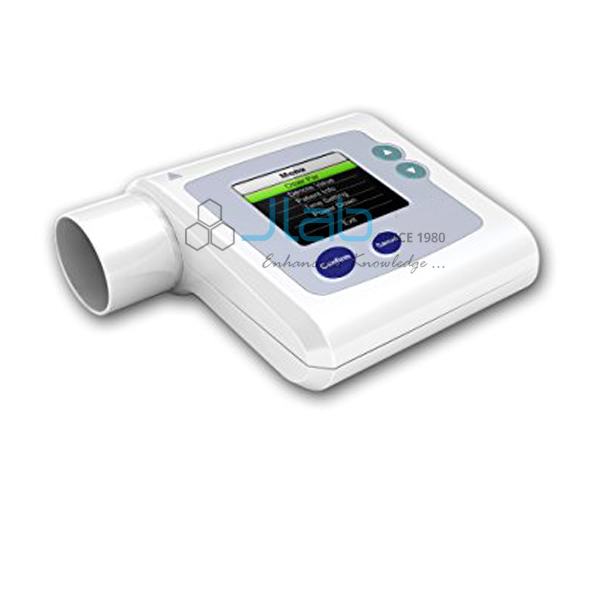
Product Code : EL-RE-5123
Jlab Export is a leading Digital Spirometer Manufacturer,and suppliers in India
One forced breath into this digital spirometer gives FVC, FEV1 and PEF, and the 1.8 inch colour screen draws the flow-volume and volume-time curves of that breath. Test data is kept in flash memory. Operation is simple and each test is quick, so a whole practical group can be tested in one session.
Specifications
| Measurements | FVC, FEV1, PEF and PEF25 |
| Curves shown | Flow-volume and volume-time |
| Display | 1.8 inch TFT colour, 160 x 128 pixels |
| Data storage | Flash memory |
| Operation | Simple, with a quick test |
| Minimum order quantity | 1 unit |
| Dispatch time | Usually 7–10 working days |
| Manufacturer | JLab (Jain Laboratory Instruments Pvt Ltd), Ambala, India |
Lung Function Practicals for Students
In a first-year physiology practical, each student wears a Disposable Nose Clip and takes the deepest breath possible. The student then blows out as hard and fast as possible until no more air comes. The screen gives FVC, FEV1 and PEF, and students work out FEV1/FVC as a percentage. Groups compare readings taken sitting and standing, or before and after exercise, and plot them against height.
A useful extension is VC, the full volume a person can breathe out slowly after filling the lungs completely. Students measure it on the water-sealed Spirometer and compare it with their forced value.
Reading the Two Curves
The volume-time curve rises steeply at first and then levels off. Its height where it flattens is the FVC, and its height at one second is the FEV1. The flow-volume curve climbs to a sharp peak, the PEF, early in the breath and then falls away almost in a straight line. A rounded peak or a notch in the line usually means a weak start or a cough, and the blow should be repeated.
Frequently Asked Questions
How many blows should each student make?
At least three good blows, with a short rest between them. Results come from the strongest efforts, and the two highest FVC values and the two highest FEV1 values should be close. If they are far apart, the student blows again.
What is the FEV1/FVC ratio?
It is the share of the forced breath that comes out in the first second. Divide FEV1 by FVC and multiply by 100 to give a percentage. Healthy young adults blow out most of their FVC within that first second.
What is PEF, and why does it vary so much between blows?
PEF is the fastest flow reached during the blow, and it comes almost at once. It depends on how hard the student blasts out at the start, so a hesitant start lowers PEF while FVC hardly changes. Record the highest PEF from the good blows.
Can the results be kept after the test?
Yes. The spirometer has flash memory for test data, so results can be kept and checked after the test instead of being copied down at once.
How is it different from a water-sealed spirometer?
A water-sealed spirometer collects the breath under a floating bell and shows volume only. This digital model measures the flow of the breath as it passes and works out FVC, FEV1 and PEF at once, with both curves on its screen.
Other Spirometers and Respirometers
For a quote, use Add To Cart or send us a message through the contact page.
Last updated: 20 November 2026