Hydrostatic Balance Manufacturer,Supplier and Exporter in India
Product Code : EL-RE-5136
Jlab Export is a leading Hydrostatic Balance Manufacturer,and suppliers in India
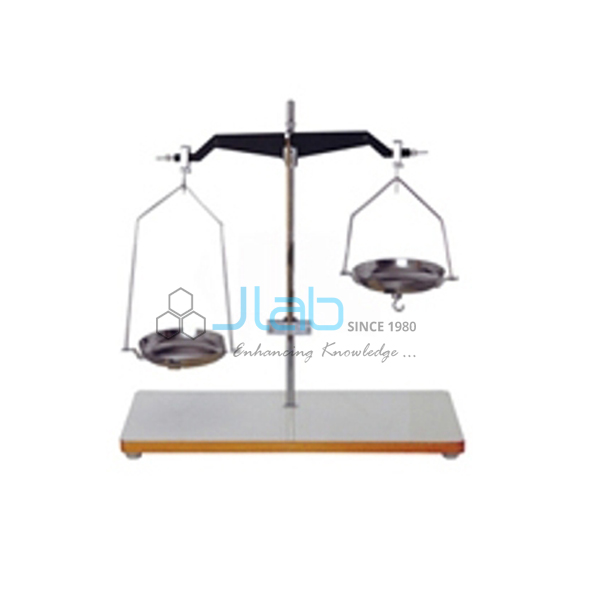
Weighing a solid first in air and then in water is the job of this hydrostatic balance. It is built like an analytical balance without a case. One extra pan hangs through a smaller frame and has a hook underneath, so a solid can be hung by a thread into water. The pans are detachable, and the balance stands on a polished wooden base.
Specifications
| Type | Beam balance like an analytical balance, without casing |
| Extra pan | Suspended through a smaller frame, with a hook underneath |
| Pans | Detachable |
| Base | Polished wooden base |
| Use | Specific gravity experiments |
| Minimum order quantity | 1 unit |
| Dispatch time | Usually 7–10 working days |
| Manufacturer | JLab (Jain Laboratory Instruments Pvt Ltd), Ambala, India |
Archimedes Principle Practicals
Students weigh a solid hung from the hook in air, using a set from the Physical Weight Boxes (Brass C.P) range. They then lower it fully into water in a Beaker, clear of the sides and bottom, and weigh it again.
To test Archimedes’ principle, the water the solid pushes out is caught from a Eureka Can (Overflow Cans Plastic) and weighed. The loss in weight of the solid equals the weight of that water. With a glass sinker, the balance also gives the relative density of a liquid such as salt solution, and students check it with a Specific Gravity Bottle.
Frequently Asked Questions
Why does one pan hang through a smaller frame?
The shorter frame leaves room under that pan for a beaker of water. The solid hangs from the hook below the pan into the water, and the balance weighs it there just as it weighs a load in air.
Why must air bubbles be removed from the solid?
Bubbles stuck to the solid add to its volume and buoy it up. The loss of weight then comes out too large and the relative density too small. Wet the solid first and brush off any bubbles before taking the reading.
Why should the solid not touch the beaker?
If it touches the side or bottom, the beaker carries part of its weight and the reading is wrong. Hang it on a fine thread so it is fully under water and clear of the glass.
How is relative density worked out?
Divide the weight in air by the loss of weight in water. For a solid weighing W1 in air and W2 in water, relative density is W1 / (W1 - W2). It has no unit, because it compares two weights.
How do I check the balance before weighing?
Stand it on a level bench and check that, with both pans empty, the pointer swings equally either side of the centre mark. If it does not, note the error and allow for it in each weighing.
Other Density and Buoyancy Apparatus
For a quote, use Add To Cart or send us a message through the contact page.
Last updated: 6 November 2026