Blaine Air Permeability Apparatus Manufacturer,Supplier and Exporter in India
Product Code : EL-CACTE-9454
Jlab Export is a leading Blaine Air Permeability Apparatus Manufacturer,and suppliers in India
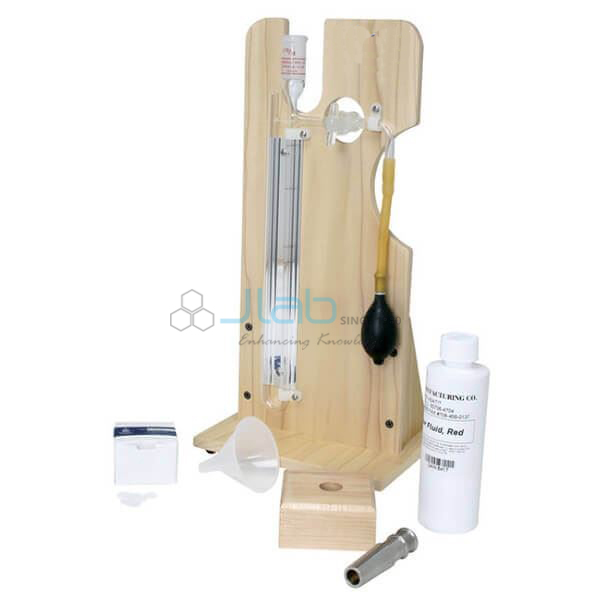
Air permeability is the usual way to measure how fine a cement is ground. This variable-flow apparatus gives fineness as specific surface, the total surface area in square centimetres per gram of cement. Air is drawn through a packed bed of cement in a 12.5 mm cell. The time the manometer liquid takes to fall between two marks gives the result.
Specifications
| Type | Variable flow air permeability |
| Permeability cell | 12.5 mm I.D. |
| Manometer | U-type, on a stand, with built-in stop cock |
| Cell parts | Perforated disc, plunger, rubber stopper |
| Rubber tube | 30 cm long |
| Filter paper discs | Packet of 12 |
| Also supplied | Bottle of 100 ml |
| Result | Specific surface in cm²/g |
| Minimum order quantity | 10 units |
| Dispatch time | Usually 4–6 working days |
| Manufacturer | JLab (Jain Laboratory Instruments Pvt Ltd), Ambala, India |
Lab Exercises on Cement Fineness
Before the test, students find the density of the cement with a Le Chatelier Flask, because the mass of the bed depends on it. They lay a filter disc on the perforated disc, add the weighed cement, cover it with a second filter disc and press the bed down with the plunger. With the cell in place, they draw the liquid up the manometer, close the stop cock and time its fall with a Stop Watch.
Groups can compare two grades of cement, or the same cement before and after extra grinding. Checking the same samples on Test Sieves shows why the permeability method tells fine cements apart better than a sieve residue does.
How the Flow Time Gives Fineness
A finer cement has more particle surface in the same bed. That surface resists the air, so the liquid falls more slowly and the flow time is longer. At a set bed porosity and temperature, the specific surface is proportional to the square root of the flow time. The constant for the cell comes from a reference cement of known fineness.
Frequently Asked Questions
What does the Blaine apparatus measure?
It measures fineness as specific surface: the total surface area of the cement particles in one gram, in cm²/g. Finer cement reacts faster with water, so fineness affects early strength and the rate of heat release.
Why is the cement density needed?
The bed is packed to a set porosity, and the mass that fills the cell at that porosity depends on the density of the cement. Measuring the density first gives the right mass to weigh out for each test.
How is the apparatus calibrated?
Run a reference cement of known specific surface through the same cell and manometer. Its flow time gives the apparatus constant, which is then used to work out the specific surface of each test cement from its own flow time.
What comes in the set?
The set has a 12.5 mm permeability cell with a perforated disc and plunger, and a U-type manometer on a stand with a built-in stop cock. A rubber stopper, a 30 cm rubber tube, a packet of 12 filter paper discs and a 100 ml bottle come with it.
Other Cement Testing Apparatus
- Blaine Fineness Apparatus (stainless steel cell and plunger)
- Vicat Apparatus
- Cement Sampler
For a quote, use Add To Cart or send us a message through the contact page.
Last updated: 5 November 2026