Jolting Apparatus Manufacturer,Supplier and Exporter in India

Product Code : EL-CACTE-9466
Jlab Export is a leading Jolting Apparatus Manufacturer,and suppliers in India
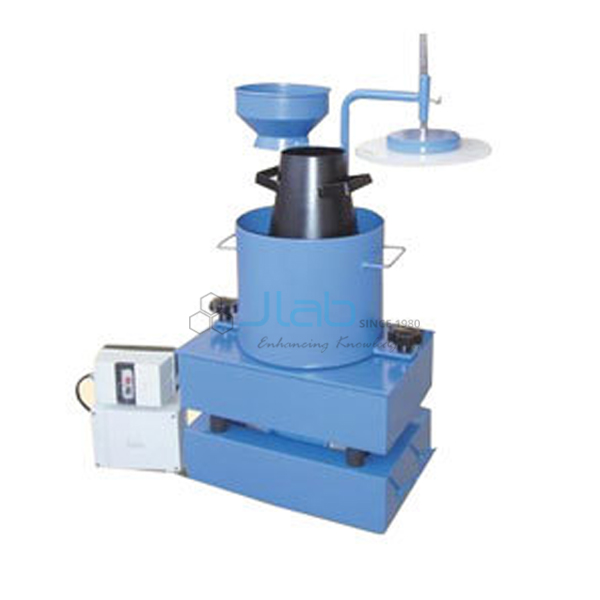
A jolting apparatus compacts cement mortar in a mould by lifting a table and letting it drop onto a stop, again and again. A motor turns a cam at 60 rev/min, so the table falls once a second, and a stroke counter stops the machine after 60 jolts. It comes with a mould and hopper.
Specifications
| Cam speed | 60 rev/min |
| Jolt count | Stroke counter with micro-switch stops the machine after 60 jolts |
| Table | Rectangular, on two support arms to a spindle 800 mm from the table centre |
| Impact | Plane-faced lug falling on a stop with a rounded top |
| Drive | Motor and gearbox through V-belt and pulleys to the cam |
| Mould fixing | Mould and hopper clamp to the table, locating pins for the mould compartments |
| Supplied with | Mould and hopper |
| Option | Digital preset counter |
| Power supply | 230 V, single phase AC |
| Minimum order quantity | 1 unit |
| Dispatch time | Usually 14–18 working days |
| Manufacturer | JLab (Jain Laboratory Instruments Pvt Ltd), Ambala, India |
Mortar Prism Practicals with Jolting
Students mix mortar in the Cement Mortar Mixer and clamp the mould, with its hopper, to the table. They place a first layer of mortar in each compartment, level it and switch on, and the counter stops the table after 60 jolts. A second layer gets another 60 jolts, and the surplus is struck off once the hopper is lifted away.
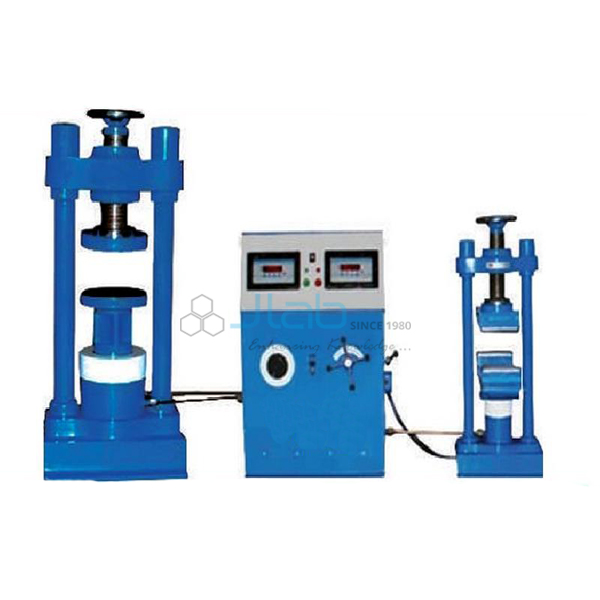
Prisms are often cast in a Prism Mould Three Gang. After curing they are first broken in bending, and each half is then crushed on the Compression Testing Machine. Comparing the strengths with vibrated cubes from the Mortar Cube Vibrating Machine shows students that each test method gives its own figures.
Frequently Asked Questions
How does jolting compact the mortar?
Each time the cam lets the table fall, the lug strikes the stop, and the sudden halt shakes air out of the mortar. Repeated jolts settle it into the corners of the mould, and the fixed drop and count give the same compaction every time.
Why does the machine stop after 60 jolts?
The stroke counter with its micro-switch counts the jolts and switches off the motor at 60. A layer cannot be over- or under-compacted by the operator, so every mould gets the same treatment. A digital preset counter is available as an option.
Why must the mould be filled straight after mixing?
The cement starts to react as soon as water is added, and the mortar slowly stiffens. A delay changes how well the jolts compact it and can lower the strength. Fill both layers and finish the jolting without a break.
Why are the support arms so long?
The table hangs on two arms from a spindle 800 mm from its centre, so it swings through a shallow arc and lands almost flat on the stop. That keeps the drop much the same across the whole mould.
How are the prisms handled before demoulding?
Wipe off the mortar left on the mould edges and label the mould. Keep it covered in moist air, undisturbed, until the next day. Then demould the prisms carefully and place them in water to cure until the test age.
Other Mortar Strength Test Apparatus
For a quote, use Add To Cart or send us a message through the contact page.
Last updated: 5 November 2026