Compression Testing Machine Manufacturer,Supplier and Exporter in India

Product Code : EL-CACTE-9443
Jlab Export is a leading Compression Testing Machine Manufacturer,and suppliers in India
A compression testing machine crushes a specimen between two steel platens and shows the load at which it fails. JLab builds it for compressive strength tests on cement, brick and concrete, mostly on cement, concrete and mortar cubes. It comes in manually (hand) operated, semi automatic and electrically cum manually operated versions.
Specifications
| Tests | Compressive strength of cement, brick and concrete |
| Specimens | Cement, concrete and mortar cubes |
| Versions | Manually (hand) operated, semi automatic, electrically cum manually operated |
| Minimum order quantity | 1 unit |
| Dispatch time | Usually 14–18 working days |
| Manufacturer | JLab (Jain Laboratory Instruments Pvt Ltd), Ambala, India |
Cube and Brick Tests for Students
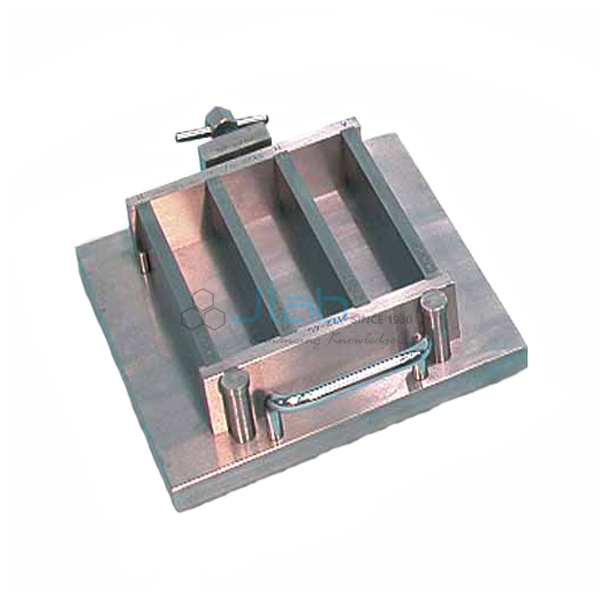
Concrete cubes are the main practical. Students cast them in Cube Moulds, cure them in water and crush them at 7 and 28 days. Compressive strength is the failure load divided by the loaded area, so a 150 mm cube carries its load on 22,500 mm².
Cement strength is tested on mortar cubes. The mortar is mixed in a Cement Mortar Mixer and compacted in its moulds on a Mortar Cube Vibrating Machine before curing. For bricks, students fill the frog with mortar, let it harden and load the brick flat, frog upward, between the platens.
Frequently Asked Questions
How is compressive strength calculated from the test?
Divide the failure load in newtons by the loaded area in mm². The answer is in N/mm², which is the same as MPa. For a 150 mm cube the loaded area is 22,500 mm².
Why are concrete cubes tested at 7 and 28 days?
Concrete keeps gaining strength as the cement hydrates. The 28 day result is the usual reference strength for a mix. The 7 day result is an early check, often about two thirds of the 28 day value for ordinary cement.
Can the machine test bricks and mortar as well as concrete?
Yes. It is built for compressive strength tests on cement, brick and concrete, with cement, concrete and mortar cubes as the usual specimens. Bricks are tested flat with the frog filled with mortar.
Which version suits a teaching lab?
A hand operated machine needs no power and suits a lab that tests a few cubes a week. An electrically cum manually operated machine saves effort on larger batches and keeps a hand pump for fine control. A semi automatic machine pumps by motor while the operator sets the pace.
Compression Testing Machines by Type
- Compression Testing Machine for Concrete (hand operated, 1000 kN)
- Semi Automatic Compression Testing Machine
- Cube Testing Machine (electric and hand pumping)
- Compression Testing Machine Digital (digital and dial readouts)
For a quote, use Add To Cart or send us a message through the contact page.
Last updated: 5 November 2026