Kelly Ball Penetration Apparatus Manufacturer,Supplier and Exporter in India

Product Code : EL-CACTE-9456
Jlab Export is a leading Kelly Ball Penetration Apparatus Manufacturer,and suppliers in India
Kelly ball testing gives a quick measure of how workable fresh Portland cement concrete is, from the depth a heavy ball sinks into it under its own weight. The ball is a cylinder with a rounded bottom and a handle, weighing 15 kg in all. A frame guides the handle and acts as the depth reference.
Specifications
| Ball and handle | Cylinder with a ball-shaped bottom, 15 kg together |
| Handle | Graduated in mm |
| Reading | Penetration to the nearest 0.5 mm |
| Frame | Strip frame that guides the handle and is the depth reference |
| Test | Workability of Portland cement concrete |
| Relation to slump | Twice the reading roughly equals the slump |
| Minimum order quantity | 10 units |
| Dispatch time | Usually 4–6 working days |
| Manufacturer | JLab (Jain Laboratory Instruments Pvt Ltd), Ambala, India |
Workability Practicals on Fresh Concrete
A class can mix a trial batch in the Laboratory Concrete Mixer and spread it in a deep tray or form with a level top. The frame is set on the surface, and the ball is lowered until it just touches the concrete, then released. When it stops sinking, students read the handle scale against the frame. They take three readings well apart from each other and from the sides, then average them.
The same batch goes straight into the Slump Test Apparatus. Students compare the slump with twice their Kelly ball figure and see how close the two come for their mix. A second batch with more water shows both readings rising together.
Frequently Asked Questions
How does a Kelly ball reading compare with slump?
Twice the penetration is roughly equal to the slump of the same concrete. The ratio shifts with the aggregate and the mix, so labs often check it on a few batches of their own materials before relying on it.
Why choose this test over a slump test?
It is simpler and much faster. There is no cone to fill in layers and rod, so one person can lower the ball, release it and read the depth in a short time. That suits repeat checks while concreting is under way.
Can the ball be used on concrete already placed?
Yes, on concrete in a form, a wheelbarrow or a tray, as long as the layer is deep and the ball is kept well clear of the sides. Concrete close to a side wall is held back and gives a lower reading.
How fine are the readings?
The handle is graduated in millimetres, and the penetration is recorded to the nearest 0.5 mm. The frame rests on the concrete surface and stays still, so the scale shows how far the ball has sunk below that surface.
Does the surface need preparing first?
Strike the concrete level and pick a spot free of loose stones. Do not tamp or vibrate that area, because compacted concrete resists the ball and gives a reading that no longer reflects the mix as delivered.
Other Concrete Testing Apparatus
- Vee Bee Consistometer
- Compaction Factor Apparatus
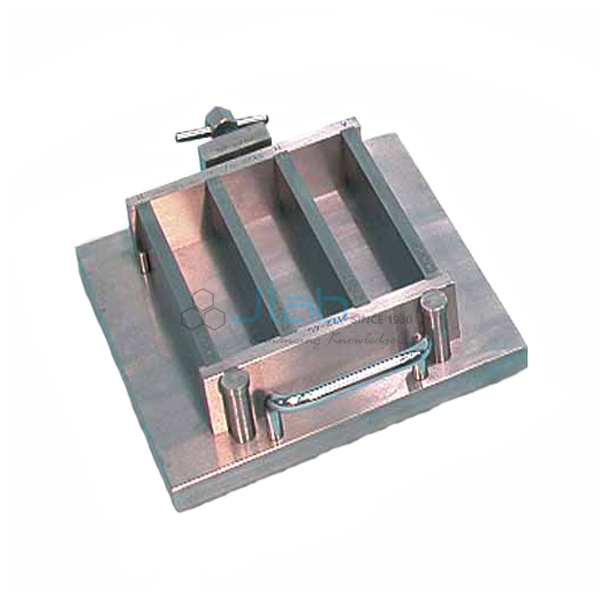
- Cube Moulds (for casting concrete test cubes)
For a quote, use Add To Cart or send us a message through the contact page.
Last updated: 5 November 2026