Cylindrical Mould Manufacturer,Supplier and Exporter in India

Product Code : EL-CACTE-9451
Jlab Export is a leading Cylindrical Mould Manufacturer,and suppliers in India
Cylindrical moulds are used to cast concrete cylinders for compressive strength testing. They come in two sizes, 100 mm dia x 200 mm high and 150 mm dia x 300 mm high. Each cast iron mould splits lengthwise into two halves and is supplied with a base plate and a top plate.
Specifications
| Sizes | 100 mm dia x 200 mm high and 150 mm dia x 300 mm high |
| Material | Cast iron |
| Construction | Split into two parts lengthwise |
| Supplied with | Base plate and top plate |
| Use | Casting concrete cylinders for compressive strength tests |
| Minimum order quantity | 10 units |
| Dispatch time | Usually 4–6 working days |
| Manufacturer | JLab (Jain Laboratory Instruments Pvt Ltd), Ambala, India |
Casting and Testing Cylinders: Lab Practicals
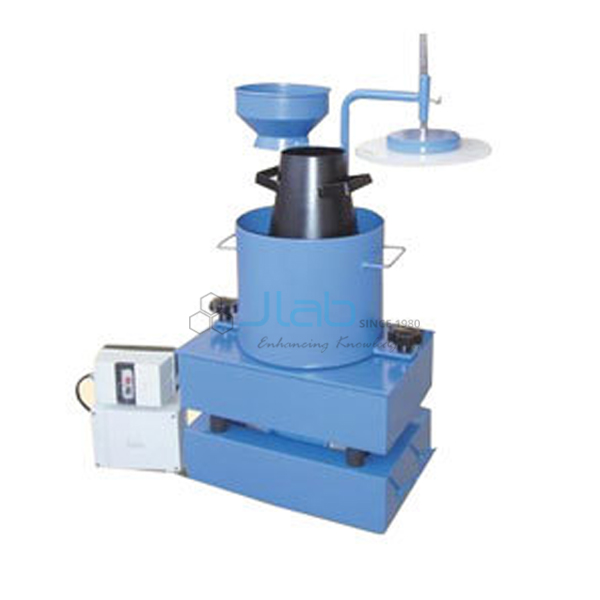
Students oil the inside of the mould, clamp the two halves on the base plate and fill it in layers, rodding each layer. Concrete for the class is usually mixed in a Laboratory Concrete Mixer. Next day the halves are opened, the cylinder is lifted out and it goes into a curing tank.
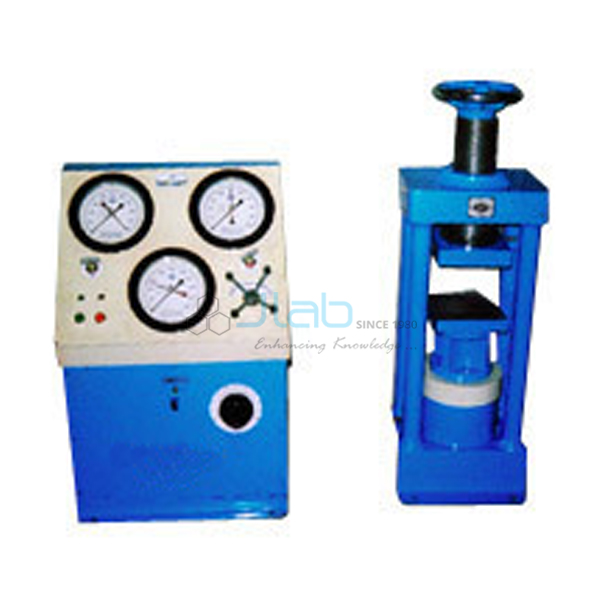
Before crushing, the ends must be flat and square, so many labs cap them. The cylinders are then loaded on a Compression Testing Machine. Cylinders can also be laid on their side and split along a diameter in the split tensile test. The results are then set beside cubes cast in Cube Moulds from the same batch.
Frequently Asked Questions
Which size should I choose, 100 x 200 or 150 x 300 mm?
Both are twice as tall as they are wide. The 150 x 300 mm mould is the usual choice and suits normal aggregate sizes. The 100 x 200 mm mould uses less concrete and suits mixes with smaller aggregate.
How is cylinder strength calculated?
Divide the failure load by the end area, πd²/4. For the 150 mm cylinder that area is about 17,671 mm², and for the 100 mm cylinder about 7,854 mm². The result in N/mm² equals MPa.
Why do cylinders give lower results than cubes?
A cylinder is twice as tall as it is wide, so the platens restrain less of it and it fails at a lower stress. A cube of the same concrete is held by the platens over most of its height and reads higher. The two results are not interchangeable.
Why is the mould split into two halves?
So the hardened cylinder can be taken out without being knocked or pulled. The halves are unclamped and opened away from the concrete, which leaves the sides and edges undamaged.
How is a cylinder tested for split tensile strength?
The cylinder is laid on its side between the platens, with a thin packing strip along the top and the bottom. Load is applied until it splits along the vertical diameter. Tensile strength is 2P/(πLd), where P is the failure load, L the length and d the diameter.
Other Moulds for Concrete and Cement
- Beam Moulds (flexural strength)
- Briquette Mould
- Prism Mould Three Gang
For a quote, use Add To Cart or send us a message through the contact page.
Last updated: 5 November 2026