Chemical Balance (Brass Beam) Manufacturer,Supplier and Exporter in India

Product Code : EL-MI-2132
Jlab Export is a leading Chemical Balance (Brass Beam) Manufacturer,and suppliers in India
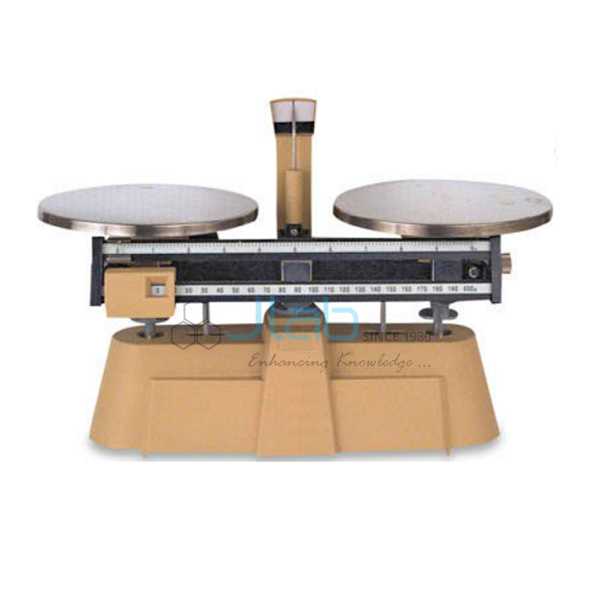
A chemical balance is a two-pan beam balance for weighing chemicals and samples to a fraction of a milligram. This one has a capacity of 200 g and a sensitivity of 0.2 mg. Its short lacquered brass beam swings on agate knife edges, and the balance stands in a teak wood case with a front slider and panel doors.
Specifications
| Capacity | 200 g |
| Sensitivity | 0.2 mg |
| Beam | Short lacquered brass beam, 50 divisions engraved on each side |
| Rider scale | Each division equals 1/5 mg (0.2 mg) |
| Knife edges and bearings | Agate |
| Pans | Inverse stainless steel, 70 mm diameter, detachable, hung from double hooks |
| Base | Laminate-topped wooden base with levelling screws |
| Case | Teak wood, with front slider and panel doors |
| Overall size (l x b x h) | 365 x 265 x 455 mm |
| Weights | Supplied without weights |
| Minimum order quantity | 5 units |
| Dispatch time | Usually 7–10 working days |
| Manufacturer | JLab (Jain Laboratory Instruments Pvt Ltd), Ambala, India |
Weighing Practicals in the Chemistry Lab
Preparing a standard solution is the first quantitative practical for most chemistry students. They weigh a solid such as oxalic acid in a Weighing Bottle by difference. The brass masses come from an Analytical Weight Boxes Brass Wt(A Grade) set, and the rider gives the last milligrams. The solid is then washed into a Volumetric Flask and made up to the mark.
Teachers also use the balance to show how a beam balance works. Students find the resting point of the empty beam. They then move the rider one division along the beam and see how far the resting point shifts for an extra 0.2 mg.
Frequently Asked Questions
Which weights need to be ordered with this balance?
The balance comes without weights. Order an analytical weight box for the gram masses and a fractional set, such as the Fractional Weight Set Analytical, for the milligram masses. The rider on the engraved beam takes care of the final fraction.
How should the balance be packed or moved without harming the knife edges?
Take off the detachable pans and the rider and pack them separately, so nothing swings on the agate knife edges in transit. After the move, stand the balance on a firm bench, level it again with the levelling screws and check the zero before weighing.
Where should the balance stand in the lab?
On a firm, level bench away from doors, windows, fans and heat, where draughts and vibration cannot disturb the beam. Keep it away from dust and chemical fumes, and close the case doors when it is not in use.
How is a chemical balance different from a physical balance?
A chemical balance is far more sensitive. This one responds to 0.2 mg, the level quantitative chemistry needs. A physical balance weighs in much coarser steps and suits general physics work. The chemical balance also sits in a closed case so air currents do not upset the reading.
Why must the case doors be closed when I take a reading?
Moving air pushes on the pans and makes the pointer drift, which matters on a balance that responds to a fraction of a milligram. Close the front slider and panel doors, wait for the pointer to settle, then read it.
Why should I not touch the weights or put chemicals straight on the pan?
Moisture and grease from fingers add mass to the weights and slowly corrode them, so always lift them with forceps. Chemicals can attack the pan and are hard to recover from it. Weigh them in a weighing bottle or on a watch glass instead.
Other Laboratory Balances
For a quote, use Add To Cart or send us a message through the contact page.
Last updated: 15 November 2026