Diffraction Grating Manufacturer,Supplier and Exporter in India
Product Code : EL-SLE-4743
Jlab Export is a leading Diffraction Grating Manufacturer,and suppliers in India
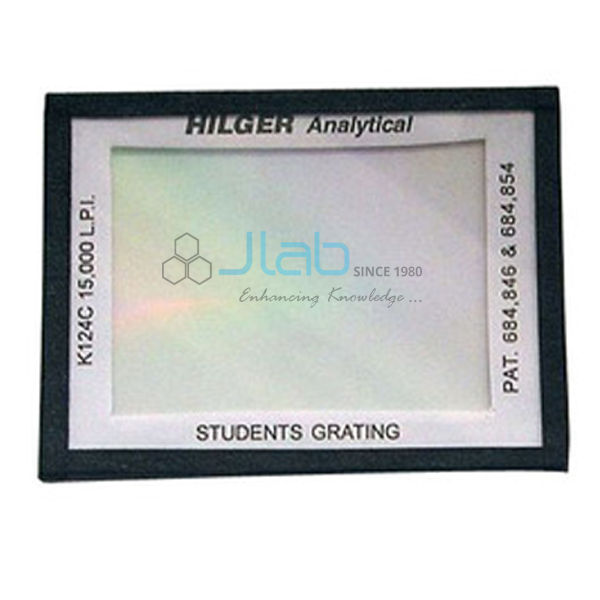
Diffraction Grating (code EL-SLE-4743) is a physics laboratory tool that separates incident light into its colours, used in school and college optics practicals. It is offered with 300 or 600 lines per mm, or as a student-type grating with 1500 lines per inch, each mounted between glass plates for protection. It is made by Jain Laboratory Instruments Pvt Ltd (JLab) at its works in Ambala, India.
Specifications
| Parameter | Detail |
|---|---|
| Function | Separates the colours in an incident ray of light |
| Line densities | 300 lines per mm; 600 lines per mm; 1500 lines per inch (student type, about 59 lines per mm) |
| Mounting | Between glass plates |
| Quality check | Each grating is visually inspected before dispatch |
| Pack quantity | Each (sold individually) |
| Minimum order quantity | 10 units |
| Dispatch time | Usually 7–10 working days |
| Product code | EL-SLE-4743 |
| Manufacturer | Jain Laboratory Instruments Pvt Ltd (JLab) — OEM |
| Country of origin | India (made in Ambala, Haryana) |
How Does It Compare with Other JLab Gratings?
| Item | Lines | Listed details |
|---|---|---|
| This grating (EL-SLE-4743) | 300 or 600 per mm; 1500 per inch (student type) | One grating per mount, between glass plates |
| Diffraction Grating (three-section) | 100, 300 and 600 per mm | Three gratings on one mount, between glass plates |
Choose this listing when each student or group needs a single grating of a known line density. The three-section grating lets a class compare line densities side by side on one slide.
What Is a Diffraction Grating Used For?
A diffraction grating is a surface ruled with many equally spaced parallel lines. Light passing through the gaps is diffracted and the waves interfere, so bright beams appear only at angles where the path difference from neighbouring lines is a whole number of wavelengths — the grating equation, d sin θ = nλ, where d is the line spacing. Because the angle depends on wavelength, white light is spread into a spectrum in each order, with violet nearest the centre and red farthest out. A grating with more lines per mm has a smaller spacing and spreads the colours through larger angles; the coarse 1500 lines-per-inch student grating gives closely spaced orders that are easy to see by eye.
In school, gratings bring the diffraction topic of class 12 wave optics to life: students look at a filament or discharge lamp through the grating to see its spectrum, or shine a laser through it onto a screen and calculate the wavelength from the spot spacing. In college labs the 300 and 600 lines-per-mm gratings are used on a spectrometer table to measure the wavelengths of sodium or mercury lines. As optics lab equipment, handle gratings by the edges, keep the glass free of fingerprints, and store them in a closed box away from dust.
What to Specify When Ordering
- Line density — 300 lines per mm, 600 lines per mm or the 1500 lines-per-inch student type, with the quantity of each.
- Mount size — if the grating has to fit a particular spectrometer table or holder, give the dimensions.
- Quantity — the minimum order is 10 gratings.
- Light source and spectrometer — add a sodium vapour lamp, prisms or a spectrometer to the same enquiry if needed.
Frequently Asked Questions
What line densities are available?
300 lines per mm, 600 lines per mm, and a student-type grating with 1500 lines per inch, which is about 59 lines per mm.
Which grating should a school buy?
For viewing spectra by eye and simple laser work, the 1500 lines-per-inch student type is easy to use. For measuring wavelengths on a spectrometer, the 300 or 600 lines-per-mm gratings spread the spectrum through larger angles.
How is the grating protected?
It is mounted between glass plates, which keep the ruled surface from being touched or scratched during class use.
Can it be used to measure the wavelength of light?
Yes. Measure the angle of a bright order on a spectrometer, or the spacing of laser spots on a screen, and apply the grating equation using the known line spacing.
What size is the mount?
The listing does not state the mount size or viewing area. Ask JLab when you enquire, especially if it must fit an existing holder.
What should be included in an export enquiry?
The quantity of each line density, the destination country and port or city, preferred delivery terms (for example FOB or CIF), packing or labelling needs, and a tender reference if relevant.
Who manufactures this diffraction grating?
Jain Laboratory Instruments Pvt Ltd (JLab), at its works in Ambala, Haryana, India.
OEM Manufacturer
JLab is the trading name of Jain Laboratory Instruments Pvt Ltd, an optics and physics teaching-equipment manufacturer in India, incorporated in 2017 and based on Hargolal Road, Ambala, Haryana. The grating is produced at JLab’s own works, not sourced from a trading house, so schools, colleges, dealers and importers buy it factory-direct; each grating is visually inspected before dispatch, and repeat orders in any line density are handled by the manufacturer. JLab exports worldwide and ships to buyers in every region — for example North Macedonia in Southern Europe, Iceland in Northern Europe, Malaysia in Southeast Asia, Guyana in South America and Gambia in West Africa. Tender details are on the JLab lab tenders page.
Related Optics Equipment
- Spectrometer — the optical instrument for measuring spectra in prism and grating experiments.
- Prism Glass — clear glass prisms in right-angle and equilateral forms for comparing dispersion by refraction.
- Sodium Vapour Lamp — a sodium light source for wavelength measurements.
- Diffraction Grating (three-section) — three line densities on one glass mount.
More school physics apparatus is in the School Lab Equipment range.
Request a Quote
Quotes come direct from the manufacturer. Use the Add To Cart enquiry button on this page, or send the quantity (minimum 10 units) of each line density, any mount size you need, and your delivery location through the contact page.
Last updated: 4 October 2026