Digital Penetrometer Manufacturer,Supplier and Exporter in India
Product Code : EL-ELA-5302
Jlab Export is a leading Digital Penetrometer Manufacturer,and suppliers in India
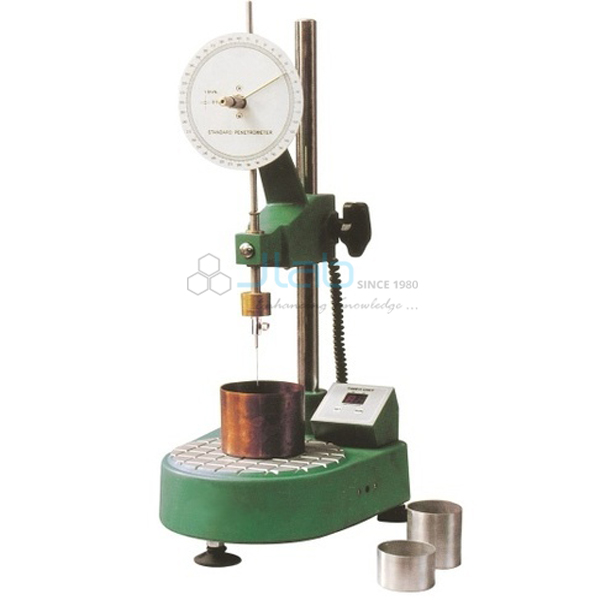
Digital Penetrometer (code EL-ELA-5302) is a penetration tester used to determine the penetrative strength of different materials in teaching and testing labs. Its head is mounted on a perpendicular rod and can be set to the height of the sample. It is made by Jain Laboratory Instruments Pvt Ltd (JLab) at its works in Ambala, India.
Specifications
| Parameter | Detail |
|---|---|
| Type | Digital penetrometer |
| Test | Penetration test on different materials |
| Determines | Penetrative strength of the material |
| Construction | Head mounted on a perpendicular rod |
| Height adjustment | Head adjustable for height on the rod |
| Quality check | Each penetrometer is visually inspected before dispatch |
| Pack quantity | Each (sold individually) |
| Minimum order quantity | 10 units |
| Dispatch time | Usually 7–10 working days |
| Product code | EL-ELA-5302 |
| Manufacturer | Jain Laboratory Instruments Pvt Ltd (JLab) — OEM |
| Country of origin | India (made in Ambala, Haryana) |
What Is the Digital Penetrometer Used For?
A penetration test shows how strongly a material resists being pierced: a tip is pressed into the sample and the result indicates how firm or soft the material is. Students can use it to compare the penetrative strength of different samples in the material testing and civil lab equipment of engineering colleges, polytechnics and ITI/TVET workshops.
Set the head on the rod to suit the height of the specimen, keep the specimen level and steady under the tip, and repeat the test at several points before comparing materials. Wipe the tip clean between samples.
What to Specify When Ordering
- The materials you plan to test, so that JLab can confirm a suitable tip and range.
- Measuring range, resolution and power supply — ask for these details in your enquiry, as they are not given in this listing.
- Quantity — the minimum order is 10 units, supplied individually.
Frequently Asked Questions
What does the digital penetrometer measure?
It determines the penetrative strength of a material in a penetration test. This listing gives no measuring range or resolution, so ask JLab for those figures.
Can the head be adjusted for samples of different heights?
Yes. The head is mounted on a perpendicular rod and can be adjusted for height to suit the specimen.
How is it different from the Cone Penetrometer?
The Cone Penetrometer is listed specifically for finding the liquid limit of soils. This digital penetrometer is described more generally, for penetration tests on different materials.
Who manufactures this penetrometer?
Jain Laboratory Instruments Pvt Ltd (JLab) builds it at its own works in Ambala, Haryana, India, and quotes for it directly.
OEM Manufacturer
JLab is the trading name of Jain Laboratory Instruments Pvt Ltd, a manufacturer of laboratory apparatus and engineering lab equipment in India, incorporated in 2017 and located on Hargolal Road, Ambala, Haryana. The penetrometer is produced in JLab’s own works rather than sourced from a trader, so colleges, dealers and importers order it factory-direct, and repeat orders are handled by the manufacturer itself. JLab exports worldwide and ships to buyers in every region — for example Lebanon in the Middle East, Mongolia in East Asia, Angola in Central Africa, Senegal in West Africa and New Zealand in Oceania. For institutional purchasing, see the JLab lab tenders page.
Other Penetration Test Apparatus
- Cone Penetrometer — listed for determining the liquid limit of soils.
- Penetration of Bituminous Material, Grease, Petrolatum, Waxes, Gel — a dial-type penetration tester for bitumen, greases and waxes.
- Kelley Ball Penetration Apparatus — used to judge the workability of concrete.
See more items in the Educational Laboratory Apparatus range or the wider Laboratory Apparatus range.
Request a Quote
Quotes come straight from the manufacturer. Use Add To Cart, or send the quantity (minimum 10 units), the materials to be tested and your destination through the contact page.
Last updated: 9 October 2026