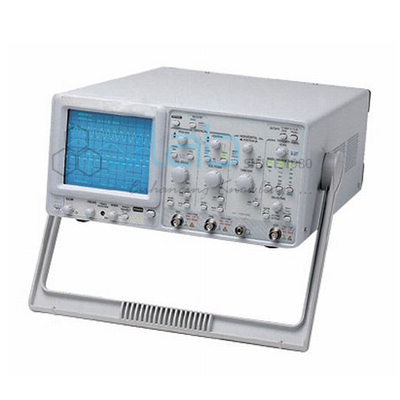
Digital Storage Oscilloscope Manufacturer,Supplier and Exporter in India
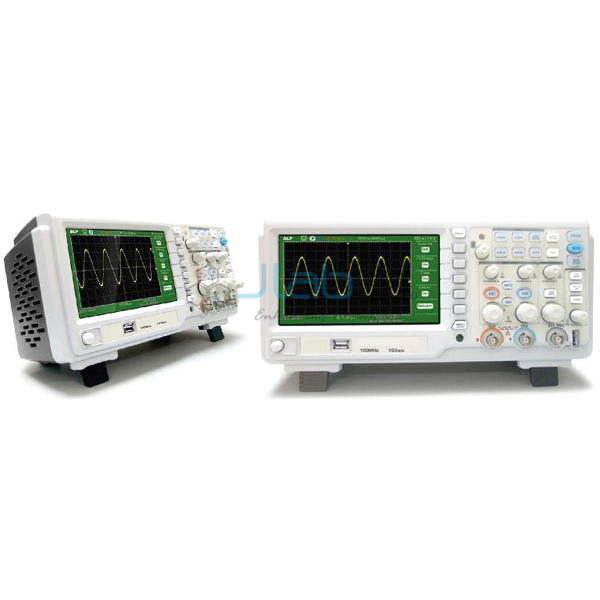
Product Code : EL-DSO-1536
Jlab Export is a leading Digital Storage Oscilloscope Manufacturer,and suppliers in India
Digital Storage Oscilloscope (code EL-DSO-1536) is a dual-channel DSO offered in 100 MHz, 200 MHz and 300 MHz bandwidth versions, used to capture, store and analyse waveforms in electronics labs and on test benches. A colour TFT LCD keeps the trace clear and stable. It is made by Jain Laboratory Instruments Pvt Ltd (JLab) at its works in Ambala, India.
Specifications
| Parameter | Detail |
|---|---|
| Bandwidth versions | 100 MHz, 200 MHz and 300 MHz |
| Channels | Two (dual channel) |
| Real-time sampling rate | 2 GSa/s |
| Memory depth | 24k |
| Display | Colour TFT LCD for a clear, stable waveform |
| Trigger modes | Edge, pulse, video, slope, alternative and delay |
| Interfaces | USB host/device on the front and back panels; GPIB |
| Waveform functions | Digital filter, waveform recorder and pass/fail test |
| Automatic measurement | 32 parameters |
| Cursor measurement | Manual, track and auto modes |
| FFT | Channel waveform and its FFT shown together on a split screen |
| Operation | Pop-up menus; multilingual user interface and online help |
| Size | Compact and easy to carry |
| Quality check | Each oscilloscope is visually inspected before dispatch |
| Pack quantity | Each (sold individually) |
| Minimum order quantity | 10 units |
| Dispatch time | Usually 7–10 working days |
| Product code | EL-DSO-1536 |
| Manufacturer | Jain Laboratory Instruments Pvt Ltd (JLab) — OEM |
| Country of origin | India (made in Ambala, Haryana) |
How Does It Compare with Other JLab Digital Storage Oscilloscopes?
| Model | Bandwidth | Channels | Sampling rate | Other details |
|---|---|---|---|---|
| This oscilloscope (EL-DSO-1536) | 100, 200 or 300 MHz | Two | 2 GSa/s real-time | 24k memory depth; colour TFT LCD |
| 70 MHz Digital Storage Oscilloscope | 70 MHz | Two | 2 GSa/s real-time | 24k memory depth; 7 inch colour TFT LCD |
| Digital Storage Oscilloscope Dual Channel | 60 MHz | Two | 500 MSa/s real-time | 4K memory depth; 5.7 inch colour TFT LCD |
| 200 MHz Digital Storage Oscilloscope | 200 MHz | Four, independent | 2 GS/s | 7 inch screen; automatic board calibration with temperature change |
| 300 MHz Digital Storage Oscilloscope | 300 MHz | Four, independent | 2 GS/s | 7 inch screen; board auto-calibration as the temperature changes |
Choose this oscilloscope when two channels are enough and your signals call for more than 70 MHz of bandwidth. The 70 MHz model covers lower-frequency teaching work, the Dual Channel model is the 60 MHz option, and the four-channel 200 MHz and 300 MHz models are the ones to pick when three or four signals have to be viewed at the same time.
What Is This Dual-Channel DSO Used For?
A digital storage oscilloscope samples the input voltage, converts it into numbers and holds the record in memory, so a waveform can be frozen, measured and studied after the event — including a single transient that an analogue CRO would show for only an instant. In B.Tech, diploma and polytechnic electronics and communication labs, physics departments and R&D or service benches it is used to look at amplifier, oscillator, rectifier and logic waveforms, to read amplitude, frequency and period, and to compare the timing or phase of two related signals on its two inputs.
Several built-in tools go beyond a basic trace. The split-screen FFT view shows a signal’s frequency content beside its time-domain waveform, which helps when tracking down hum, harmonics or switching noise. The digital filter cleans unwanted frequency components from a noisy trace, the waveform recorder keeps captured waveforms for later review, and the pass/fail test gives a quick go/no-go result when the same signal has to be checked again and again.
What to Specify When Ordering
- Bandwidth version — pick the one that sits comfortably above the fastest signals your students or engineers will measure.
- Quantity — for example one instrument per lab bench, plus any for staff or project work.
- Other bench instruments — a signal source such as the function generator linked below is a separate item that can be quoted on the same enquiry.
- Tender and shipping details — a tender reference, and any packing or labelling the consignment needs.
Frequently Asked Questions
Which bandwidth version should I order?
The one whose bandwidth is well above the highest frequency you want to view. As a signal approaches an oscilloscope’s rated bandwidth its displayed amplitude falls and fast edges look slower than they really are. For audio, power-supply and basic digital circuits the 100 MHz version leaves plenty of headroom; the 200 MHz and 300 MHz versions suit faster logic edges and RF stages.
What does a 2 GSa/s real-time sampling rate mean?
The oscilloscope can take up to two billion samples per second in a single acquisition, so even a fast one-off event is drawn from many points captured in one pass rather than rebuilt from repeated sweeps of a repetitive signal.
Why does a 24k memory depth matter?
Memory depth is the number of sample points kept from each acquisition. The deeper the memory, the longer the time window the scope can record before it has to lower its sample rate, which helps when you zoom in on detail inside a long capture.
What do the trigger modes do?
Triggering decides where the oscilloscope starts each capture so the trace stands still. Edge triggers on a voltage crossing, pulse on a pulse of a set width, video on television sync signals and slope on the rise or fall time of an edge. Alternative triggering lets each channel trigger from its own signal, so two unrelated waveforms can both be held steady.
Should I choose this model or a four-channel oscilloscope?
Two channels cover most teaching experiments, such as comparing the input and output of an amplifier or filter. The four-channel 200 MHz and 300 MHz models are better when a clock and several data or control lines must be timed against one another on one screen.
What should an export enquiry include?
The bandwidth version and quantity, the destination country and the port or city of delivery, your preferred delivery terms (for example FOB or CIF), any packing or labelling instructions and, for a tender, its reference number.
Who manufactures this oscilloscope?
JLab, the trading name of Jain Laboratory Instruments Pvt Ltd, builds it at its works in Ambala, Haryana, India, and quotes for it directly as the maker.
OEM Manufacturer
JLab is the trading name of Jain Laboratory Instruments Pvt Ltd, an Indian manufacturer of electronics lab equipment, test instruments and science apparatus, incorporated in 2017 and based on Hargolal Road, Ambala, Haryana. This oscilloscope is produced at JLab’s own works and not bought in from a trader, so engineering colleges, polytechnics, dealers and importers order straight from the maker, and repeat orders are handled by the same team that builds the instrument. The company is registered under CIN U29309HR2017PTC069123 and holds MSME Udyam registration UDYAM-HR-01-0003849 (manufacturing enterprise). Beyond India, JLab exports worldwide and ships to buyers in every region — for example Lesotho in Southern Africa, Germany in Western Europe, Mexico in North America, Angola in Central Africa and Sweden in Northern Europe. Institutions buying through a tender can find details on the JLab lab tenders page.
Related Test Instruments
- 70 MHz Digital Storage Oscilloscope — the dual-channel 70 MHz model with the same trigger modes and analysis functions.
- Digital Storage Oscilloscope Dual Channel — a 60 MHz two-channel DSO with a 5.7 inch colour screen.
- 200 MHz Digital Storage Oscilloscope — four independent channels at 200 MHz.
- 300 MHz Digital Storage Oscilloscope — four independent channels at 300 MHz.
- Function Generator 5 MHz with Frequency Counter — a signal source with sine, triangle, square, pulse and ramp outputs and a built-in counter.
- Spectrum Analyzer 1GHz with Tracking Generator — for frequency-domain measurements, with a built-in tracking generator.
Browse the full Digital Storage Oscilloscopes range or all Electronics Lab Equipments.
Request a Quote
To ask for a quotation, use the Add To Cart enquiry button on this page or write to JLab through the contact page, stating the bandwidth version, how many instruments you need and the city or port they should be delivered to.
Last updated: 22 October 2026