To Perform Block Rotor Test of Three Phase Induction Manufacturer,Supplier and Exporter in India
Product Code : EL-DSO-10311
Jlab Export is a leading To Perform Block Rotor Test of Three Phase Induction Manufacturer,and suppliers in India
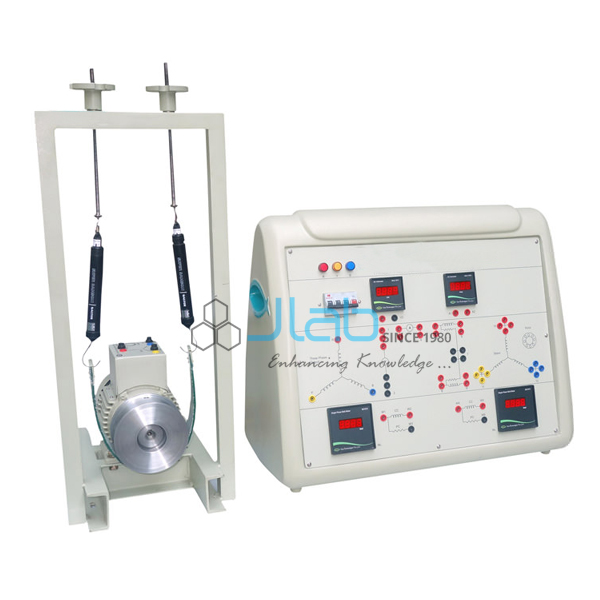
To Perform Block Rotor Test of Three Phase Induction (code EL-DSO-10311) is a Mars experimental set-up for finding the efficiency of a three-phase induction motor by the open-circuit (no-load) and short-circuit (blocked-rotor) tests. A tapered wooden panel carries its meters and a DOL starter. JLab (Jain Laboratory Instruments Pvt Ltd, Ambala, India) supplies it to schools, colleges and dealers.
Specifications
| Parameter | Detail |
|---|---|
| Brand | Mars |
| Purpose | Efficiency of a three-phase induction motor by open-circuit and short-circuit (blocked-rotor) tests |
| Ammeters | Three, 5 A AC, 96 x 96 mm, with input terminals |
| Voltmeter | One, 500 V AC, 96 x 96 mm, with input terminals |
| Wattmeters | Two single-phase wattmeters, 2000 W, 96 x 96 mm, with input terminals |
| RPM meter | One, 48 x 96 mm, on the front panel |
| Starter | Direct-on-line air-break starter, for motors up to 3 HP, three phase |
| Input protection | Miniature circuit breaker, 400 V / 10 A, on the input side |
| Front panel | Circuit diagram printed on a Bakelite sheet, with instrument connecting terminals |
| Panel box | Portable wooden panel box, tapered for a better viewing angle |
| Dimensions | 470 x 460 x 620 mm (L x B x H) |
| Power requirement | Three-phase 415 V AC |
| Standard accessories | 16 single-point patch cords; instruction manual; 3 HP three-phase induction motor with loading arrangement; 4 electrical wires (1.5 mm thick, 1.5 m long) for connecting an external single-phase supply |
| Quality check | Each set-up is visually inspected before dispatch |
| Pack quantity | Each (sold individually) |
| Minimum order quantity | 10 units |
| Dispatch time | Usually 7–10 working days |
| Product code | EL-DSO-10311 |
| Supplied by | Jain Laboratory Instruments Pvt Ltd (JLab), Ambala, India |
What Is the Blocked Rotor Test Set-up Used For?
The no-load and blocked-rotor tests are the standard indirect way of finding an induction motor’s losses and efficiency without running it at full load. In the no-load test the motor runs uncoupled at rated voltage, so the input power goes mainly into core loss and friction and windage. In the blocked-rotor test the rotor is held still and a reduced voltage drives rated current, so the input power is almost entirely copper loss. Together the readings give the motor’s equivalent-circuit parameters, from which efficiency and the circle diagram are worked out in B.Tech and diploma electrical machines practicals. The two wattmeters measure three-phase input power by the two-wattmeter method, and the RPM meter and loading arrangement let students follow speed and slip under load.
What to Specify When Ordering
- Quantity — the number of set-ups for your electrical machines lab.
- Other machines and supplies — a three-phase variac or other machine sets from the list below are separate items that can be quoted on the same enquiry.
- Tender and shipping details — tender reference, destination and any packing or labelling requirements.
Frequently Asked Questions
Why is the blocked-rotor test done at reduced voltage?
At standstill an induction motor draws a very large current at full voltage. Lowering the voltage until rated current flows protects the windings from overheating, and at that low voltage the core loss is small enough for the measured power to be taken as copper loss.
Why are there two wattmeters?
Total power in a three-wire three-phase circuit can be measured with two wattmeters — the two-wattmeter method — by adding their readings. At the low power factor of a no-load or blocked-rotor test, one reading can become negative and is then subtracted.
Is a motor supplied with the set-up?
Yes. The standard accessories include a 3 HP three-phase induction motor with loading arrangement, 16 single-point patch cords, the instruction manual and four 1.5 m wires for connecting an external single-phase supply.
What supply does it need?
A three-phase 415 V AC supply. A 400 V / 10 A miniature circuit breaker protects the input side.
What should an export enquiry include?
The quantity, the destination country and the port or city of delivery, the delivery terms you prefer (for example FOB or CIF), any packing or labelling instructions and the tender reference, if any.
Who supplies this set-up?
JLab (Jain Laboratory Instruments Pvt Ltd, Ambala, India) supplies this Mars set-up and quotes for it directly.
Supplier
JLab is the trading name of Jain Laboratory Instruments Pvt Ltd, incorporated in 2017 and based on Hargolal Road, Ambala, Haryana. Alongside the laboratory equipment it makes itself, JLab supplies selected items such as this Mars electrical machines set-up to engineering colleges, polytechnics, dealers and importers, and handles the quotation and shipment. JLab exports worldwide and ships to buyers in every region — for example Tunisia in North Africa, Jordan in the Middle East, Niger in West Africa, Colombia in South America and the Maldives in South Asia. Tender information is on the JLab lab tenders page.
Related Electrical Machines Equipment
- A.C. Squirrel Cage Induction Motor 3 Hp with D.O.L — a 3 HP, 415 V squirrel cage motor set with a control desk.
- Thyristor/IGBT Controlled AC Motor With VVVF Control — a set-up for starting and controlling an AC motor through a thyristor/IGBT drive.
- Variac Single & Three Phase — a variable AC source in single-phase and three-phase versions.
- Three Phase Transformer 3Kva 440Vac Air Cooled — a 3 kVA delta-star transformer with banana terminals.
Browse the Digital Storage Oscilloscopes section where this set-up is listed, or all Electronics Lab Equipments.
Request a Quote
Use the Add To Cart button on this page or the contact page to ask for a quotation, giving the number of set-ups and the delivery destination.
Last updated: 22 October 2026