Grinder Tool Manufacturer,Supplier and Exporter in India

Product Code : EL-TOMLE-10019
Jlab Export is a leading Grinder Tool Manufacturer,and suppliers in India
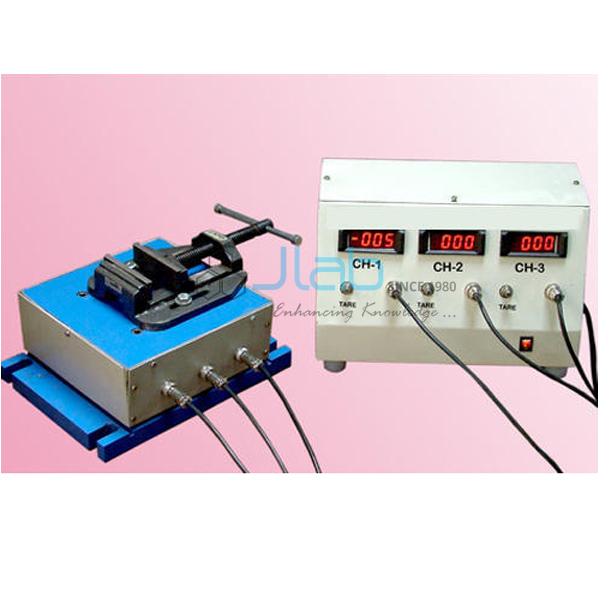
Built for surface grinding, this two-force dynamometer shows how hard the wheel loads the work as depth of cut, feed and speed change. Two octagonal rings carry the strain gauges. A two-channel digital indicator reads both forces together, each from 0 to 200 kg.
Specifications
| Type | Two-force grinding dynamometer |
| Sensing unit | Two octagonal rings with strain gauges |
| Force range | 0 to 200 kg in each coordinate direction |
| Indicator | Two-channel digital, reads both forces together |
| Zero setting | Balancing potentiometers |
| Front plate | Polycarbonate |
| Mechanical unit size | 300 x 300 mm |
| Machine needed | Surface grinding machine |
| Power supply | 230 V, single phase, 50 Hz, stabilised |
| Minimum order quantity | 1 unit |
| Dispatch time | Usually 7–10 working days |
| Manufacturer | JLab (Jain Laboratory Instruments Pvt Ltd), Ambala, India |
Grinding Force Experiments in the Workshop
The unit is fixed to the table of a High Precision Surface Grinder or a Reciprocating Spindle Surface Grinder, with the job clamped on top. Students take passes at several down-feeds while the table speed stays fixed. They then repeat the series at other table speeds and cross feeds, noting both forces for every pass.
In surface grinding the normal force, pressing wheel and work together, is usually larger than the tangential force along the cut. Students work out the ratio of the two for each setting and plot it. Repeating a series just after the wheel has been dressed shows how a glazed wheel pushes the forces up. The job thickness before and after each series can be read with an External Micrometer.
Frequently Asked Questions
Which two forces does it measure?
The force on the work splits into two parts. The tangential part acts along the direction of wheel travel at the contact, and the normal part presses wheel and work together. The two channels read both at once.
How is the specific grinding energy found?
Convert the tangential force reading from kg to newtons and multiply it by the wheel surface speed to get the grinding power. Divide that by the volume of metal removed each second, from depth of cut, width and table speed. The figure is far higher than in turning.
Why is its force range lower than the milling unit?
Grinding takes very thin cuts, so the forces are much smaller than in milling or turning. The 0 to 200 kg range keeps the readings large enough to show small changes in down-feed.
Is it suited to classroom demonstrations?
Yes. It is a simple set-up meant for showing grinding forces to students of tool design. The digital indicator shows both forces live, so a group can watch them change as the down-feed is raised.
Dynamometers for Other Machining Operations
- Tool Dynamometers (all four versions)
- Milling Tool (three forces in milling)
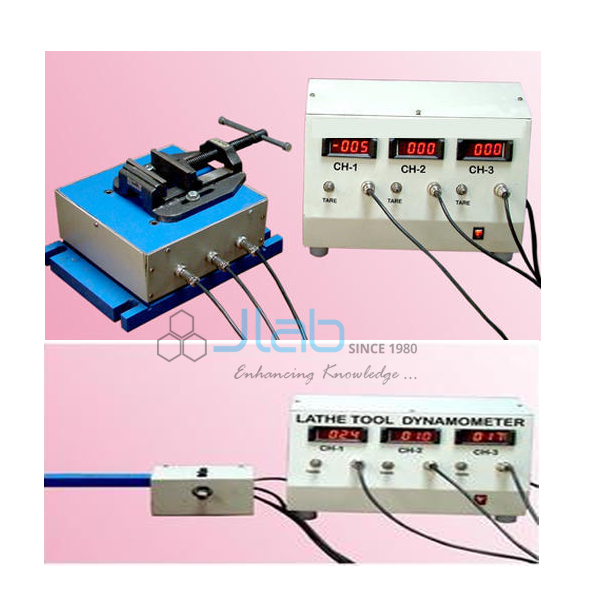
- Lathe Tool (vertical and horizontal turning forces)
- Drilling Tool (drill thrust and torque)
For a quote, use Add To Cart or send us a message through the contact page.
Last updated: 6 November 2026