Milling Tool Manufacturer,Supplier and Exporter in India
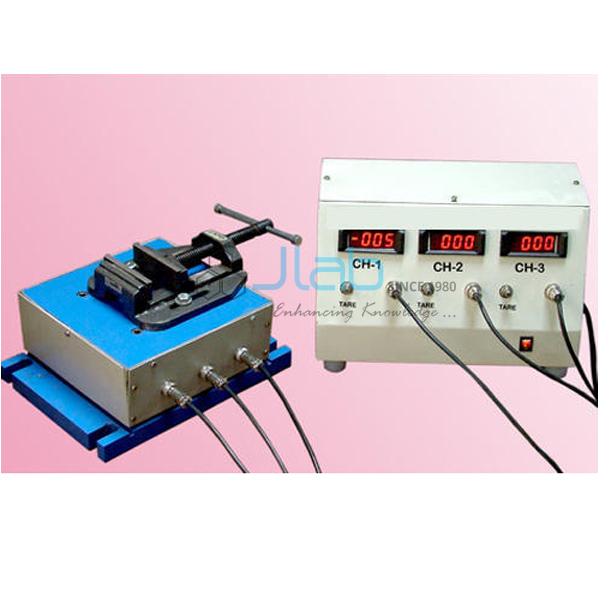
Product Code : EL-TOMLE-10018
Jlab Export is a leading Milling Tool Manufacturer,and suppliers in India
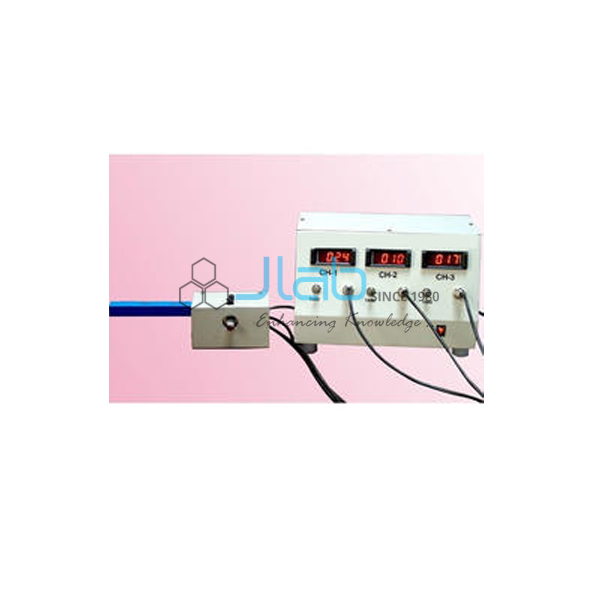
This milling tool dynamometer reads the cutting forces in three directions while a cutter works the job. A set of octagonal rings with strain gauges sits between two mild steel plates. A three-channel digital indicator shows all three forces at once, each from 0 to 500 kg.
Specifications
| Type | Three-component milling tool dynamometer |
| Sensing unit | Octagonal rings with strain gauges, between two mild steel plates |
| Force range | 0 to 500 kg in each coordinate direction |
| Indicator | Three-channel digital, reads all three forces together |
| Zero setting | Balancing potentiometers |
| Front plate | Polycarbonate |
| Mechanical unit size | 300 x 300 mm |
| Machine needed | Milling machine with automatic feed and tooling |
| Power supply | 230 V, single phase, 50 Hz, stabilised |
| Minimum order quantity | 1 unit |
| Dispatch time | Usually 7–10 working days |
| Manufacturer | JLab (Jain Laboratory Instruments Pvt Ltd), Ambala, India |
How the Octagonal Ring Sensor Works
When the cutter pushes on the job, the top plate loads the octagonal rings and they deform very slightly. The strain gauges fixed to the rings change their resistance in step with that strain. The indicator turns each signal into a force in kg, with one channel for each direction. Before a cut, the balancing potentiometers set every channel to zero with the job clamped but not yet cut.
Milling Force Practicals for Students
The dynamometer is bolted to the table of a Universal Milling Machine, which has the automatic table feed it needs. The job is clamped on its top plate. Students mount a cutter on a Milling Arbor and take cuts at three or four table feeds while speed and depth stay fixed. They repeat the series for depth of cut and then for spindle speed, noting all three forces each time.
Plots of force against feed and depth show how the load grows with the chip area. Cutting the same pass on two job materials shows the effect of material. Teachers can also compare up-milling and down-milling on one job, since the vertical force pushes the job down in one and tends to lift it in the other. An External Micrometer checks the depth of cut actually taken.
Frequently Asked Questions
What do the three channels show?
Each channel reads the force along one coordinate direction of the machine table. On a typical set-up these are the feed force, the cross force and the vertical force, all read at the same moment.
What machine and power supply does it need?
It needs a milling machine with an automatic feed arrangement and the tooling for the cut. The indicator runs on a stabilised 230 V, single-phase, 50 Hz supply.
How much force can it read?
Up to 500 kg in each coordinate direction. Plan the depth of cut and feed for the job material so that the peak reading stays inside that range, and start with light cuts.
Why is the indicator zeroed before every cut?
Clamping the job puts a small load on the rings, and the bridge output can drift with temperature. Zeroing with the balancing potentiometers just before the cut means the reading shows the cutting force alone.
Other Tool Dynamometers
- Tool Dynamometers (overview of the four types)
- Lathe Tool (two forces in orthogonal turning)
- Grinder Tool (two forces in surface grinding)
- Drilling Tool (thrust and torque)
For a quote, use Add To Cart or send us a message through the contact page.
Last updated: 6 November 2026