Static and Dynamic Balancing Apparatus Manufacturer,Supplier and Exporter in India

Product Code : EL-TOMLE-10007
Jlab Export is a leading Static and Dynamic Balancing Apparatus Manufacturer,and suppliers in India
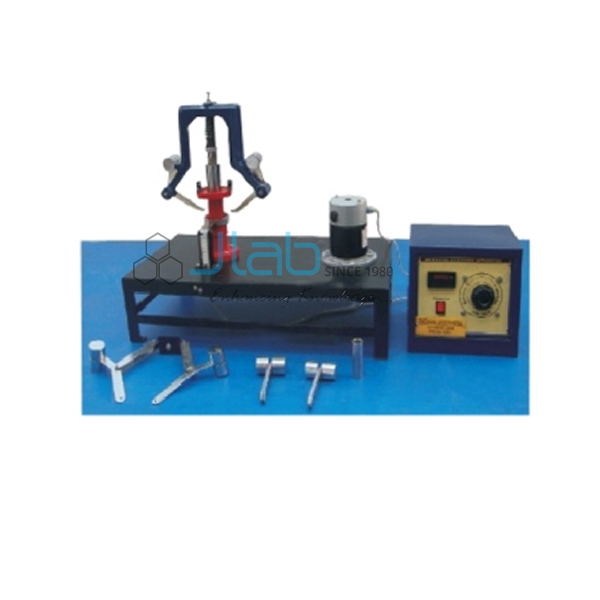
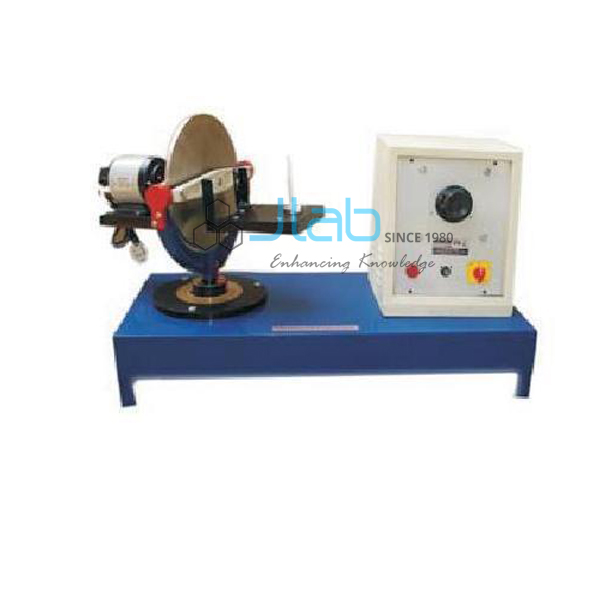
On this apparatus students balance a rotating mass system, first statically and then dynamically. A stainless steel shaft in a rectangular frame carries four stainless steel blocks of different eccentric mass. The blocks clamp at chosen angles and positions, and a variable-speed FHP motor spins the shaft to check the result.
Specifications
| Shaft | Stainless steel, fixed in a rectangular frame |
| Balancing weights | 4 stainless steel blocks with different eccentric masses |
| Block mounting | Clamping arrangement |
| Scales | Angular and longitudinal |
| Static test | Cord and container, read in number of steel balls |
| Dynamic test | Frame suspended on chains, shaft run by the motor |
| Drive motor | FHP, variable speed, with speed controller |
| Electricity | 0.5 kW, 220 V, single phase |
| Minimum order quantity | 1 unit |
| Dispatch time | Usually 14–18 working days |
| Manufacturer | JLab (Jain Laboratory Instruments Pvt Ltd), Ambala, India |
How the Two Balance Tests Work
For the static test, each block is clamped on the shaft in turn and its pull is matched by a cord and container. Steel balls go into the container, and the number needed gives that block’s relative out-of-balance value, m r. The shaft is statically balanced when the vector sum of m r for all four blocks is zero.
Dynamic balance also needs the couples to cancel, because the blocks sit in different planes along the shaft. Students draw a moment polygon from the m r l values to find each block’s angle and axial position. They set the blocks on the angular and longitudinal scales and run the motor. With the frame hanging on its chains, a balanced shaft runs with little shake.
Practicals in the Theory of Machines Lab
The standard practical is to balance a rotor carrying four masses. Students draw the force and moment polygons to scale on a sheet pinned to a Drawing Board, using a Steel Rule for lengths and a Protractor for angles. A second exercise moves one block off its balanced position and runs the shaft at rising speeds. The frame shakes harder as the speed goes up, because the out-of-balance force grows with the square of speed.
Frequently Asked Questions
What is the difference between static and dynamic balance?
A shaft is in static balance when the sum of m r for its masses is zero, so it rests in any angular position. Dynamic balance also needs the sum of the couples m r l to be zero. Masses in different planes can rock a shaft even when it is statically balanced.
Why is the frame hung on chains?
Chains let the frame move freely, so any unbalanced force or couple from the spinning shaft shows up as visible swinging. When the four blocks are set correctly, the frame stays almost still while the shaft runs.
How is the motor speed set for the dynamic check?
Start slowly with the speed controller and raise the speed in steps. Unbalance shows more as the speed rises, so a correctly balanced set of blocks should stay steady across the whole speed range of the FHP motor.
Other Theory of Machines Apparatus
- Static and Dynamic Balancing Apparatus (steel shaft version)
- Whirling of Shaft Apparatus
- Flywheel Apparatus
For a quote, use Add To Cart or send us a message through the contact page.
Last updated: 6 November 2026