Slip and Creep Measurement Apparatus Manufacturer,Supplier and Exporter in India
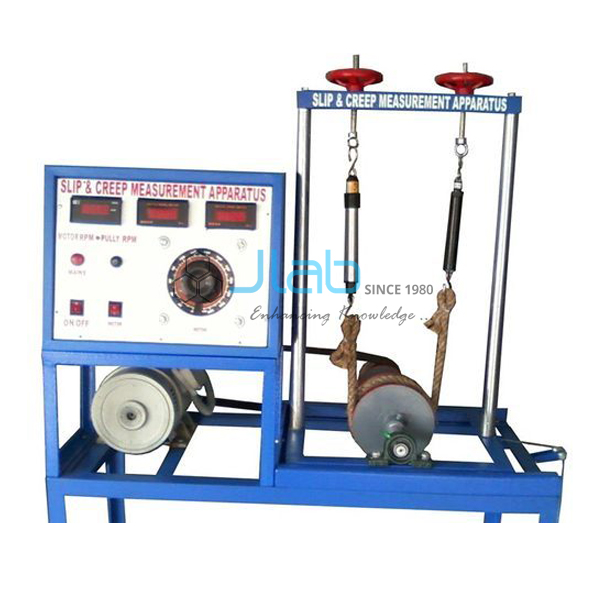
Product Code : EL-TOMLE-10014
Jlab Export is a leading Slip and Creep Measurement Apparatus Manufacturer,and suppliers in India
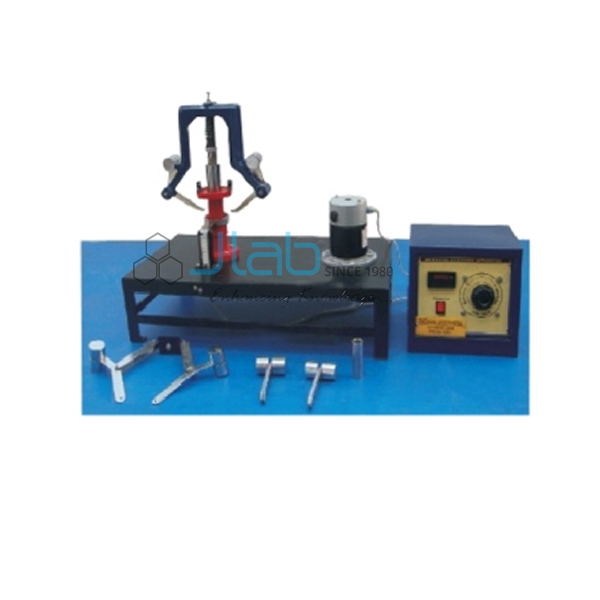
Three flat belts, of fabric, canvas and rubber, are run in turn over two pulleys of equal diameter on this apparatus. A 1 HP, 1500 RPM variable-speed DC motor drives the input pulley, and a brake drum with a spring balance loads the output shaft. A two-channel digital RPM indicator shows both pulley speeds.
Specifications
| Motor | DC, 1 HP, 1500 RPM, variable speed, set by dimmerstat |
| Pulleys | Driving and driven, equal diameter |
| Belts | Flat, fixed length: fabric, canvas and rubber |
| Belt tension | Driven pulley slides on the base with its bearing block |
| Loading | Brake drum with spring balance on the output shaft |
| Speed measurement | Two-channel digital RPM indicator |
| Also supplied | Stroboscope, speed controller unit |
| Power supply | 230 V AC, stabilised |
| Space | 1.5 x 1.5 m |
| Minimum order quantity | 1 unit |
| Dispatch time | Usually 14–18 working days |
| Manufacturer | JLab (Jain Laboratory Instruments Pvt Ltd), Ambala, India |
Slip, Creep and How They Are Measured
With equal pulleys and no losses, both shafts would turn at the same speed. In practice the driven pulley runs slower. Slip is the loss of speed when the belt moves over the pulley instead of gripping it. Creep comes from the different stretch of the tight and slack sides, so the belt shortens and lengthens a little as it passes round each pulley. Percentage slip is the drop in speed as a share of the driving speed.
Belt Drive Experiments for Students
Students find the coefficient of friction between the pulley and each belt material. They measure the power transmitted at different belt tensions and plot it against (T1 - T2) to get the tension characteristics. At a fixed tension they raise the brake load and plot (T1 - T2) against percentage slip, then read the creep zone from the graph. A last run raises the load at constant speed until slip just starts.
The Stroboscope freezes a mark on one pulley, so the class can watch the other drift as slip grows. Friction values found here can be compared with static results from the Machine Friction of Belts Apparatus, which tests vee, rope and flat belts on one pulley.
Frequently Asked Questions
What is the difference between slip and creep in a belt drive?
Slip is a loss of speed when the belt moves over the pulley because friction cannot hold it. Creep happens even without slip: the tight side stretches more than the slack side, so the belt changes length slightly as it passes round each pulley.
How is percentage slip worked out?
Read the driving and driven pulley speeds on the two-channel RPM indicator. With pulleys of equal diameter, percentage slip is the drop in speed divided by the driving speed and expressed as a percentage.
Why are three belt materials supplied?
Fabric, canvas and rubber belts grip the pulley differently, so each gives its own coefficient of friction and its own slip curve. Running all three on the same pulleys shows how belt material changes the power a drive can carry.
How is the initial belt tension changed?
The driven pulley sits on a bearing block that slides along the base. Moving it away from the driving pulley tightens the belt, and moving it closer slackens it, using the belt tightening arrangement.
Other Belt and Friction Apparatus
- Slip and Creep Measurement Apparatus (version with optional stroboscope)
- Rope Belt Friction Apparatus
For a quote, use Add To Cart or send us a message through the contact page.
Last updated: 6 November 2026