Dead Weight Pressure Gauge Tester Manufacturer,Supplier and Exporter in India
Product Code : EL-TOMLE-10016
Jlab Export is a leading Dead Weight Pressure Gauge Tester Manufacturer,and suppliers in India
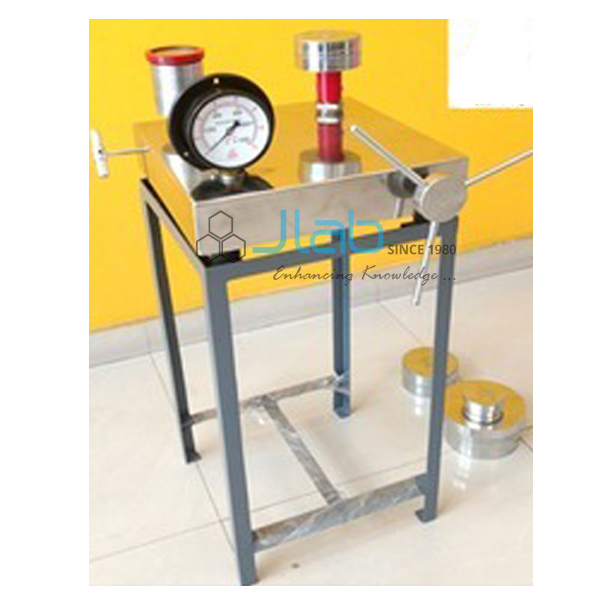
A dead weight tester produces a known oil pressure by loading a piston with weights, and that pressure is used to check a pressure gauge. This tester covers gauges up to 25 kg/cm², with machine oil as the pressure medium. It has a set of zinc iron weights, a Bourdon tube pressure gauge and nickel chrome plating against rust.
Specifications
| Capacity | Up to 25 kg/cm² |
| Pressure medium | Hydraulic, machine oil |
| Gauge fitted | Bourdon tube pressure gauge |
| Weights | Set of weights, zinc iron |
| Finish | Nickel chrome plated against rust |
| Layout | Components on a base plate |
| Minimum order quantity | 1 unit |
| Dispatch time | Usually 7–10 working days |
| Manufacturer | JLab (Jain Laboratory Instruments Pvt Ltd), Ambala, India |
How the Tester Sets a Pressure
Weights placed on the piston press on the oil below it. The oil pressure equals the total weight, piston included, divided by the piston area. That pressure reaches the gauge under test through the same oil, so its reading can be compared with a pressure fixed only by mass and area. The loaded piston is turned gently during each reading, so friction in its cylinder does not carry any of the load.
Gauge Calibration Practicals
In a polytechnic or engineering lab, students calibrate a Bourdon Gauge. They add weights in steps and note the reading at each step, first with rising and then with falling pressure. Its clear Perspex case lets them watch the curved tube move as the pressure changes. They plot gauge reading against true pressure and work out the error and hysteresis. The piston diameter is measured with a Vernier Caliper, so the pressure for each weight can also be checked by calculation.
Frequently Asked Questions
What is the working principle of a dead weight tester?
Pressure equals force divided by area. Known weights on a piston of known area give a known oil pressure, and Pascal’s law carries that pressure unchanged to the gauge connected to the same oil. The gauge reading is then compared with this true pressure.
Which gauges can be tested on it?
Pressure gauges up to 25 kg/cm², most often Bourdon tube gauges. The gauge under test is connected to the oil circuit, and the weights are chosen so the test points cover its scale from low to high.
Which oil should be used?
Machine oil is the pressure medium. Keep it clean and free of air, because trapped bubbles compress, let the piston sink and upset the readings. Top up the oil and clear any air before a calibration run.
Why is the piston turned during a reading?
Turning the loaded piston gently stops it sticking in its cylinder, so friction does not take part of the load. The full weight then acts on the oil, and the pressure matches the weight-over-area value.
How do I find the error of a gauge?
At each test point, the error is the gauge reading minus the true pressure set by the tester. Readings taken with rising and falling pressure show any hysteresis, and a plot of error against pressure shows whether the gauge needs adjusting.
Other Pressure Measuring Apparatus
For a quote, use Add To Cart or send us a message through the contact page.
Last updated: 6 November 2026