Epicyclic Gear Train Holding Torque Apparatus Manufacturer,Supplier and Exporter in India

Product Code : EL-TOMLE-10015
Jlab Export is a leading Epicyclic Gear Train Holding Torque Apparatus Manufacturer,and suppliers in India
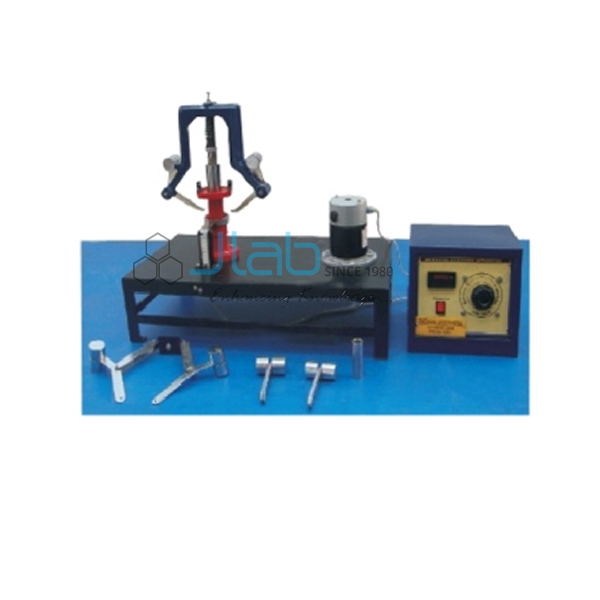
In this motorised unit a sun gear on the input shaft drives two planet gears that mesh with an annular gear. The planets ride on a common arm fixed to the output shaft. A loading arrangement and a rope brake let students measure the holding torque, along with the input and output torques.
Specifications
| Gear trains | External type with holding drum and handle, and a compact internal type |
| Layout | Sun gear on input shaft, two planet gears on a common arm, annular gear |
| Shaft supports | Bearing blocks for input and output shafts |
| Drive | Variable speed DC motor |
| Torque measurement | Rope brake for output and holding torque |
| Control panel | Digital ammeter and voltmeter, RPM indicator, speed controller |
| Power supply | 230 V AC, stabilised |
| Floor space | About 1.5 x 2 m |
| Minimum order quantity | 1 unit |
| Dispatch time | Usually 14–18 working days |
| Manufacturer | JLab (Jain Laboratory Instruments Pvt Ltd), Ambala, India |
Why a Holding Torque Is Needed
An epicyclic train has three members that carry torque: the input, the output and the member that is held. For the train to be in equilibrium the three torques must add to zero, T1 + T2 + T3 = 0, each taken with its sign. Measuring any two of them fixes the third. For the input torque, students multiply the voltmeter and ammeter readings, allow for motor losses and divide by the input speed in rad/s.
Practicals with the Epicyclic Train
Students first find the gear ratio between the input and output shafts, and between the input shaft and the holding drum, from the RPM indicator. The speeds can be cross-checked with a Stroboscope, and a tabular method using tooth numbers gives the same ratios on paper. Next they load the output with the rope brake and record input, output and holding torques to check that they balance. Many labs start with a simple epicyclic train built by hand on the Gear Trains Apparatus, which has a rotating arm for that purpose.
Frequently Asked Questions
What does the holding torque stand for on this unit?
It is the torque the holding drum must resist to keep the held member of the train still. Input, output and holding torques must balance, so the holding torque can be found from the other two or measured directly with the rope brake.
Why are two planet gears used?
Two planets share the tooth load, so each mesh carries less force. Spaced evenly round the sun, they also balance the radial forces on the sun and annular gears, so the shafts are not pushed sideways.
How is the gear ratio measured?
Run the motor at a steady speed, read the input and output speeds on the RPM indicator and divide one by the other. Repeat between the input shaft and the holding drum, and compare both results with ratios worked out from the tooth numbers.
Where are epicyclic gear trains used?
In automatic gearboxes, differentials, bicycle hub gears, hoists and machine-tool drives. They give large ratios in a small space, and holding a different member of the same train gives a different ratio.
What supply and space does it need?
A stabilised 230 V AC supply and a floor space of about 1.5 x 2 m. Apply the brake load gradually, and release it before switching the motor off.
Other Epicyclic Gear Apparatus
- Epicyclic Gear Apparatus (with 1 HP DC shunt motor)
- Epicyclic Gear Train Apparatus (internal type with spring balance arrangement)
For a quote, use Add To Cart or send us a message through the contact page.
Last updated: 6 November 2026