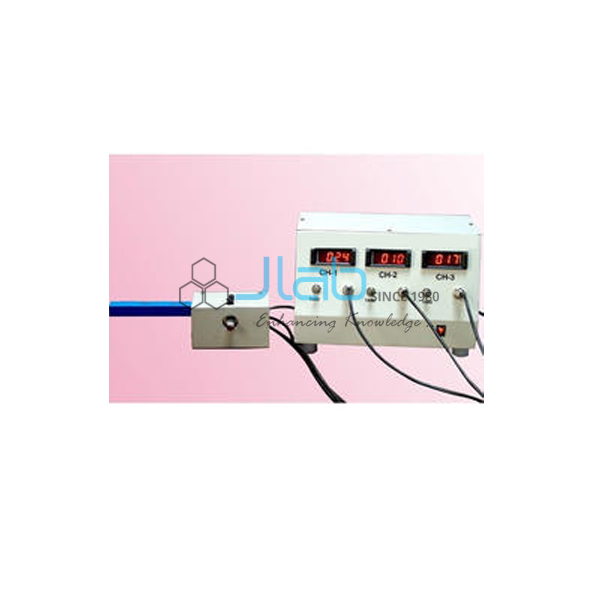
Coriolis Component of Acceleration Manufacturer,Supplier and Exporter in India
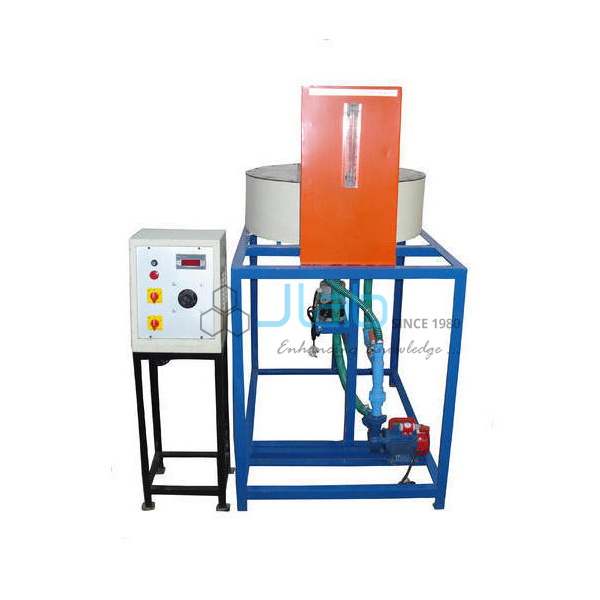
Product Code : EL-TOMLE-10013
Jlab Export is a leading Coriolis Component of Acceleration Manufacturer,and suppliers in India
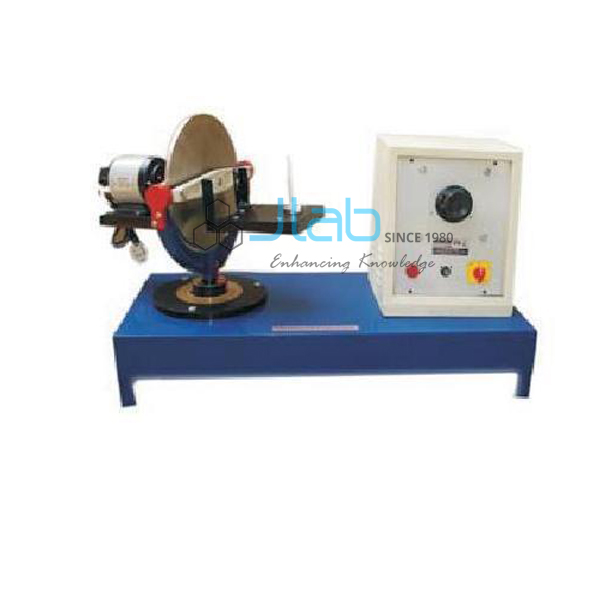
Water flowing out along a pair of rotating tubes stands in for a slider moving along a turning link in this apparatus. The rotating block carries two arms in opposite directions, each 300 mm long. A 0.5 HP swinging-field DC motor spins them and also works as a dynamometer, so the torque on the tubes can be read.
Specifications
| Principle | Hydraulic analogy of a rotating slider |
| Rotating arms | 2, in opposite directions, 9/6 mm dia., 300 mm long |
| Motor | Swinging field DC, 0.5 HP, also used as a torque dynamometer |
| Flow measurement | Rotameter |
| Water supply | Monoblock pump |
| Main tank | Fibreglass lined, Perspex window in the top cover |
| Control panel | Speed control unit, speed indicator, switches |
| Frame | Rigid support frame |
| Power supply | 230 V AC, single phase, stabilised |
| Floor space | 1.5 x 1.5 m |
| Minimum order quantity | 1 unit |
| Dispatch time | Usually 14–18 working days |
| Manufacturer | JLab (Jain Laboratory Instruments Pvt Ltd), Ambala, India |
Measuring the Coriolis Component
A slider moving at velocity v along a link that turns at ω has a Coriolis component of acceleration of 2 ω v, at right angles to the link. Here the water is the slider. Its velocity along each tube comes from the rotameter flow rate and the flow area of the tubes, and ω from the speed indicator. The Coriolis force on the moving water puts a torque on the rotor, read on the swinging-field motor and compared with the value worked out from 2 ω v.
Experiments at Different Speeds and Flows
Students hold the flow steady and step up the arm speed, recording the torque at each speed. Then they hold the speed and vary the flow. If the torque comes from the Coriolis effect, both plots are straight lines. For the calculation they measure the tube bore with a Vernier Caliper, and they check the speed indicator with a Stroboscope. The Perspex window lets the class watch the water while the arms turn.
Frequently Asked Questions
Why is a no-flow torque reading taken first?
With the pump off there is no sliding velocity, so the Coriolis component is zero. The motor torque then only covers bearing friction and air drag on the arms. That reading is taken off each later torque reading before it is compared with theory.
Why does the apparatus use water instead of a sliding block?
Water flowing along a rotating tube behaves like a slider moving along a turning link, and its speed is set and measured with the pump and rotameter. The Coriolis force of the moving water shows up as a torque on the rotor, which is easier to measure than the acceleration of a small block.
How is the torque measured?
The DC motor is a swinging-field type: its field casing is free to turn, so the reaction torque on the casing equals the torque driving the arms. Reading that reaction gives the torque applied to the rotating tubes.
What services does it need?
A stabilised 230 V single-phase AC supply and a floor space of 1.5 x 1.5 m. Fill the main tank with clean water before starting the pump, and bring the arms up to speed gradually with the speed control unit.
Other Dynamics of Machines Apparatus
- Coriolis Component of Acceleration (sister unit in the dynamics of machine range)
- Motorised Gyroscope Apparatus
- Universal Governor Apparatus
For a quote, use Add To Cart or send us a message through the contact page.
Last updated: 6 November 2026