Microprocessor Flame Photometer Manufacturer,Supplier and Exporter in India
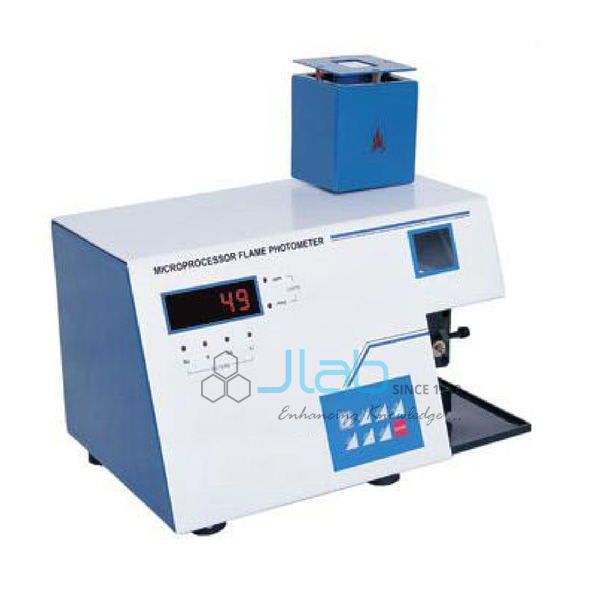
Product Code : EL-FP-2226
Jlab Export is a leading Microprocessor Flame Photometer Manufacturer,and suppliers in India
This flame photometer uses a microprocessor to calibrate, calculate and store results for sodium, potassium, calcium and lithium. The sample is drawn in by an atomiser, mixed with LPG and air and sprayed as a fine mist into the flame. A narrow-band filter passes the light each element gives off to a silicon photodiode, and results show in ppm or meq on a backlit LCD.
Specifications
| Elements | Sodium, potassium, calcium and lithium |
| Range | 0–100 ppm for each element |
| Sensitivity | Na, K and Li 0.5 ppm; Ca 15 ppm |
| Resolution | 0.1 ppm or meq |
| Filters | Na and K supplied, Ca and Li optional |
| Calibration | Up to 5 standards, least squares or quadratic curve fit, single-standard re-standardisation |
| Display | 20 x 4 line alphanumeric LCD, backlit |
| Flame and detector | LPG and dry oil-free air, auto ignition, axial flow atomiser, silicon photodiode |
| Gas safety | Automatic gas cut-off on power failure, flame failure alarm |
| Outputs and power | Printer port (Centronics parallel) and RS-232C, 230 V AC, 50 Hz |
| Minimum order quantity | 1 unit |
| Dispatch time | Usually 7–10 working days |
| Manufacturer | JLab (Jain Laboratory Instruments Pvt Ltd), Ambala, India |
Practicals in Clinical Biochemistry and Soil Labs
In clinical biochemistry practicals, students estimate sodium and potassium in serum. The serum is separated from clotted blood in a Centrifuge. Standards are made up from Sodium Chloride and Potassium Chloride in Volumetric Flasks, Class A Borosilicate Glass Plastic Stopper JLab, and the diluted serum is read against them. The instrument fits the curve and reports the result directly in meq.
Soil and agriculture labs use the same method for potassium and sodium in soil extracts, and environmental classes measure sodium in drinking and waste water. A printer or a computer on the RS-232C port keeps a record of each batch.
Frequently Asked Questions
Why does a flame photometer need a calibration curve?
The light given off is not exactly in step with concentration over the whole range, so readings must be compared with standards of known strength. This model fits a curve through up to 5 standards by least squares or quadratic fitting and reads each sample from it.
Do I have to run all the standards before every batch?
No. Once a full calibration is stored, the instrument can be re-standardised with a single standard to correct drift. Several calibration curves can be saved, so one set of standards serves repeat work on the same test.
What happens if the flame goes out or the power fails?
If the power fails, the gas is cut off automatically. If the flame goes out during work, a flame failure alarm sounds after a few seconds, so the operator can stop, relight and carry on.
Which filters come with it?
Sodium and potassium filters are supplied. Calcium and lithium filters are optional. The instrument can take four measurements from a single aspiration of the sample, and it stores both setups and sample data.
Why are serum and urine diluted before reading?
They hold far more sodium than the working range of the flame, and their proteins and salts change how the sample sprays. Dilution brings the reading onto the calibrated range and makes standards and samples behave alike in the flame.
What mistakes do students make in flame photometry practicals?
Common ones are reading before the flame has settled, not flushing the atomiser with distilled water between solutions and making standards in tap water, which already holds sodium. Glassware rinsed in tap water adds sodium too and pushes results up.
Other Analytical Instruments
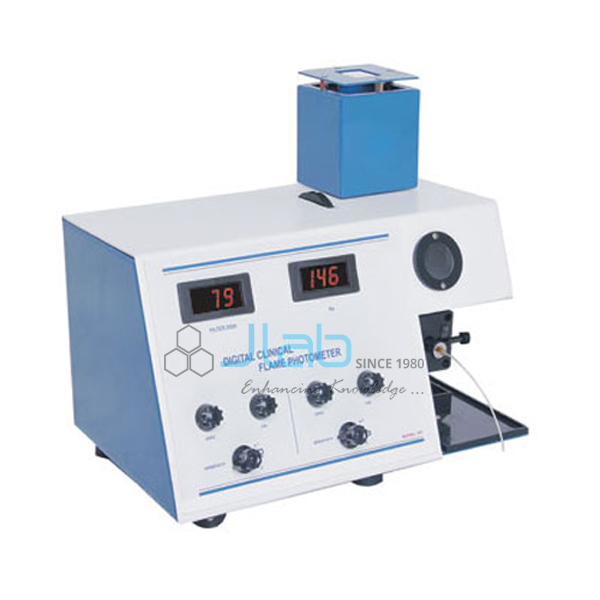
- Digital Flame Photometer (LED readout, dual-channel clinical version)
- Electronic Balance Analytical
- COD Digester
For a quote, use Add To Cart or send us a message through the contact page.
Last updated: 6 November 2026