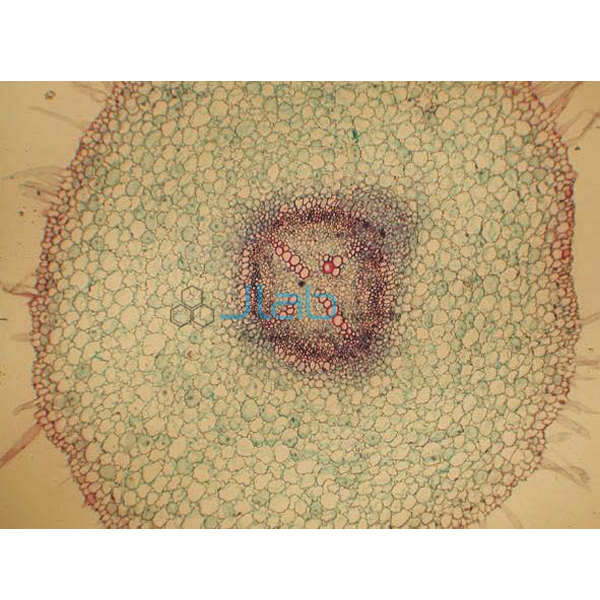
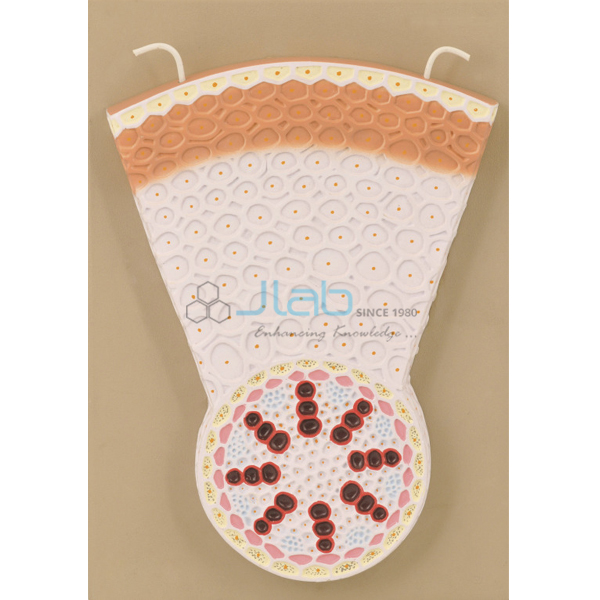
Monocot Stem T.S. Model Manufacturer,Supplier and Exporter in India

Product Code : EL-PE-7562
Jlab Export is a leading Monocot Stem T.S. Model Manufacturer,and suppliers in India
Monocot Stem T.S. Model (code EL-PE-7562) is a botany model of a monocot stem in transverse section that shows how the vascular bundles are arranged. It is used to teach stem anatomy in class 11 biology and college botany, where students must tell a monocot stem from a dicot stem at a glance. Jain Laboratory Instruments Pvt Ltd (JLab) produces it at its works in Ambala, India.
Specifications
| Parameter | Detail |
|---|---|
| Subject | Monocot stem |
| View | Transverse section (T.S.) |
| Key feature shown | Vascular bundles |
| Quality check | Each model is visually inspected before dispatch |
| Pack quantity | Each (sold individually) |
| Minimum order quantity | 10 units |
| Dispatch time | Usually 7–10 working days |
| Product code | EL-PE-7562 |
| Manufacturer | Jain Laboratory Instruments Pvt Ltd (JLab) — OEM |
| Country of origin | India (made in Ambala, Haryana) |
What Is the Monocot Stem Model Used For?
The vascular bundles are the quickest way to identify a monocot stem such as maize. Instead of forming a ring, they are scattered through the ground tissue, so there is no clear boundary between cortex and pith; the bundles near the edge are smaller than those in the centre, each is enclosed in a sheath of sclerenchyma, and each is closed — it has no cambium, which is why monocot stems do not normally thicken by secondary growth. Phloem parenchyma is absent and water-containing cavities are present within the bundles. Teachers use the model to explain these points before the class 11 practical on stem sections, and it is equally useful for revision in college botany.
What to Specify When Ordering
- Order quantity — the minimum is 10 units.
- Whether you also need the dicot stem T.S. model for a monocot–dicot comparison.
- Any size, material or labelling requirement from your tender.
Frequently Asked Questions
What does the Monocot Stem T.S. Model show?
A monocot stem cut crosswise, with its vascular bundles. Further details, such as which tissues are labelled, are not given in the listing; JLab can confirm them on request.
Why are monocot vascular bundles called closed?
Because there is no cambium between the xylem and phloem. Without it the bundle cannot add new tissue, unlike the open bundles of a dicot stem.
How is this different from the dicot stem model?
The dicot stem model shows bundles in a ring around a pith; this model covers the monocot stem, in which the bundles lie scattered through the ground tissue.
Who makes it?
JLab, the trading name of Jain Laboratory Instruments Pvt Ltd, at its own works in Ambala, Haryana, India.
OEM Manufacturer
JLab — Jain Laboratory Instruments Pvt Ltd — is a school and college biology equipment manufacturer in India, incorporated in 2017, with its base on Hargolal Road, Ambala, Haryana. The monocot stem model is made at JLab’s own works, not sourced from a trader, so schools, colleges, dealers and importers order factory-direct and repeat supplies come from the same maker. JLab exports worldwide and ships to buyers in every region — for example Switzerland in Western Europe, Bulgaria in Eastern Europe, Bahrain in the Middle East, Myanmar in Southeast Asia and DR Congo in Central Africa. For tender purchases see the JLab lab tenders page.
Monocot and Dicot Stem Teaching Aids
- Dicot Stem T.S. Model — internal tissues and vascular bundles of a dicot stem, for comparison.
- Monocotyledon Stem Model — a corn stem in cross and longitudinal section, mounted on a wooden base.
- T.S. Stem - Monocot Chart — a laminated wall chart of the monocot stem section.
- Ts Of Monocot Stem — a borosilicate glass slide of the section in a plastic box.
Other botany aids: Plant Equipment and Biology Lab Equipment.
Request a Quote
Ask the manufacturer directly: use the Add To Cart enquiry button on this page or the contact page, giving the quantity (minimum 10 units), any matching models, and your destination and delivery terms.
Last updated: 4 October 2026