Pulse Position Modulation and Demodulation Manufacturer,Supplier and Exporter in India
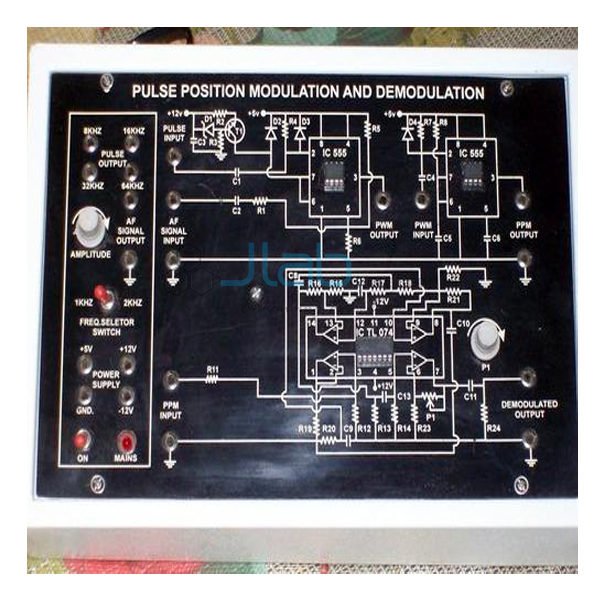
Product Code : EL-TKFCL-1202
Jlab Export is a leading Pulse Position Modulation and Demodulation Manufacturer,and suppliers in India
Pulse Position Modulation and Demodulation (code EL-TKFCL-1202) is a communication-lab panel on which students modulate a carrier in pulse position mode and then measure the frequency of the demodulated signal. It carries its own 5 V DC, 150 mA regulated supply, an AF sine wave oscillator and an IC 555 oscillator, with all connections on 4 mm sockets. JLab — Jain Laboratory Instruments Pvt Ltd — makes it at its works in Ambala, India.
Get a quote: use the Add To Cart enquiry button below, or send your quantity and destination through the contact page.
Specifications
| Parameter | Detail |
|---|---|
| Experiment | Modulation of a carrier signal in pulse position mode; frequency of the demodulated signal |
| Power supply | DC regulated, 5 V DC / 150 mA |
| Oscillators | AF sine wave oscillator; RF oscillator using IC 555 |
| Frequencies listed | 100 Hz and 10 kHz frequency output (the listing does not make clear which oscillator each figure applies to — confirm with JLab) |
| Panel | Circuit diagram printed on the panel; components mounted behind the panel |
| Connections | Supplies and components brought out to 4 mm sockets |
| Quality check | Each panel is visually inspected before dispatch |
| Pack quantity | Each (sold individually) |
| Minimum order quantity | 10 units |
| Dispatch time | Usually 7–10 working days |
| Product code | EL-TKFCL-1202 |
| Manufacturer | Jain Laboratory Instruments Pvt Ltd (JLab) — OEM |
| Country of origin | India (made in Ambala, Haryana) |
What Is the PPM Trainer Used For?
In pulse position modulation every pulse keeps the same height and width, but its timing shifts from the unmodulated position in step with the message amplitude. Because the information sits in the timing rather than the pulse height, PPM is less upset by amplitude noise than pulse amplitude modulation, which is why it is taught alongside PAM and PWM in B.Sc. electronics, engineering and polytechnic communication labs and ITI electronics courses. On this panel the AF oscillator supplies the message, the RF oscillator, built on the IC 555 timer chip that is widely used as an astable or monostable pulse generator, provides the carrier, and the demodulated output is compared on an oscilloscope with the original tone.
With the circuit diagram printed on the front and the components mounted behind, students follow the signal path on the panel itself while the parts stay protected. Every supply and test point comes out to a 4 mm socket, so standard 4 mm plug patch cords are used to make the links and connect the oscilloscope.
What to Specify When Ordering
- Quantity — the minimum order is 10 panels.
- Oscillator frequencies — ask JLab to confirm the AF and IC 555 oscillator frequencies if your practical sheet depends on them.
- Mains voltage and plug type — the mains input rating is not stated here.
- Patch cords and oscilloscope — list them in the same enquiry if your lab needs them.
Frequently Asked Questions
What does this PPM panel let students study?
Modulating a carrier in pulse position mode and measuring the frequency of the demodulated signal, which should match the message tone from the built-in AF oscillator.
What power supply is built in?
A DC regulated supply rated 5 V DC at 150 mA is part of the instrument. Its mains input rating is not given in this listing, so state your mains voltage when you enquire.
What frequencies do the oscillators produce?
The listing mentions 100 Hz and a 10 kHz frequency output alongside the AF sine wave oscillator and the IC 555 RF oscillator, but does not say clearly which figure belongs to which. Ask JLab to confirm before you write the practical sheet.
What leads does it take?
The connections are 4 mm sockets, so any standard 4 mm plug patch cords fit. Patch cords and an oscilloscope are not part of this listing.
How is it different from the Pulse Position and Pulse Width Modulation panel?
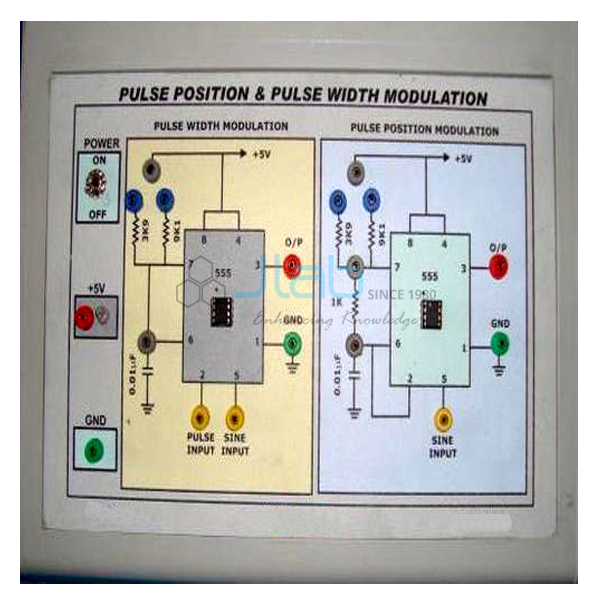
This panel is dedicated to PPM and its demodulation. The companion panel in the same range, linked below, is listed for both pulse position and pulse width modulation.
What is the minimum order and dispatch time?
Ten units minimum, sold individually; orders usually ship within 7–10 working days after each panel is visually inspected, plus export transit time.
Who manufactures this panel?
Jain Laboratory Instruments Pvt Ltd (JLab), at its own works in Ambala, Haryana.
OEM Manufacturer
Jain Laboratory Instruments Pvt Ltd, trading as JLab, is an Indian manufacturer of electronics and communication trainers and general laboratory equipment, incorporated in 2017 and working from Hargolal Road, Ambala, Haryana. The PPM panel is built at JLab’s own works rather than bought from a trader, so colleges, institutes, dealers and importers are buying factory-direct, each panel is visually inspected before it ships, and repeat orders and spare parts go through the manufacturer. JLab exports worldwide and ships to buyers in every region — for example Lithuania in Northern Europe, Mauritius in East Africa, Austria in Western Europe, Guyana in South America and Uzbekistan in Central Asia. Tender details are on the JLab lab tenders page.
Related Pulse Modulation Equipment
- Pulse Position and Pulse Width Modulation — the companion panel listed for both PPM and PWM.
- PPM Modulation and Demodulation Kit — a PPM kit with a variable sine source, TTL sampling-frequency generator and low-pass-filter demodulator.
- Pulse Width Modulation and Demodulation — a board for modulating a pulse carrier with a sine signal to obtain PWM, and recovering it.
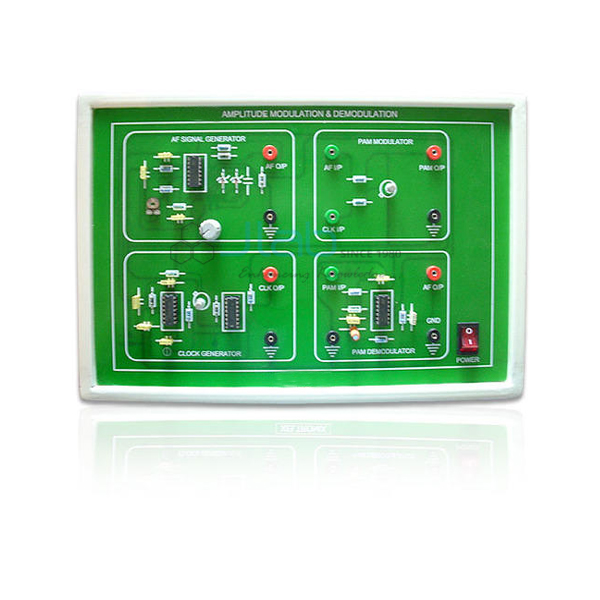
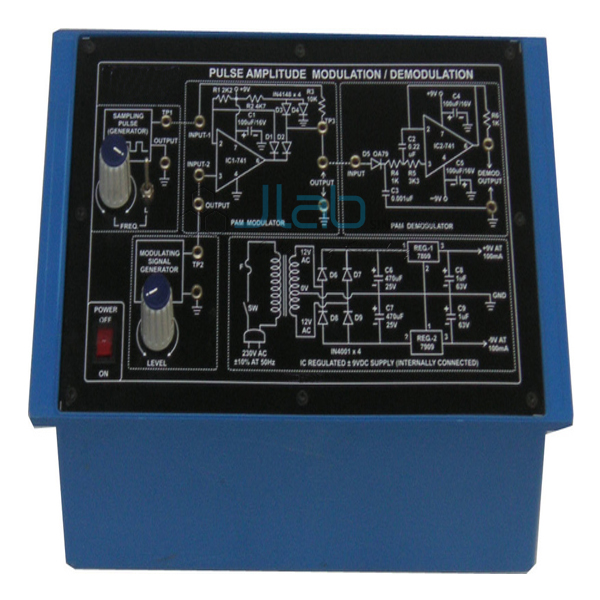
- Pulse Amplitude Modulation and Demodulation — the PAM trainer from the same range.
- Dual Trace Oscilloscope — to compare the original and demodulated signals on two channels.
See the complete Training Kits for Communication Lab range or the Scientific Instrument range.
Request a Quote
Quotes come direct from the manufacturer. Press Add To Cart on this page, or send the quantity (minimum 10 units), your mains voltage, any patch cords or oscilloscope needed and the destination through the contact page.
Last updated: 9 October 2026