R.C. Coupled Amplifier Two Stage Manufacturer,Supplier and Exporter in India
Product Code : EL-AK-1125
Jlab Export is a leading R.C. Coupled Amplifier Two Stage Manufacturer,and suppliers in India
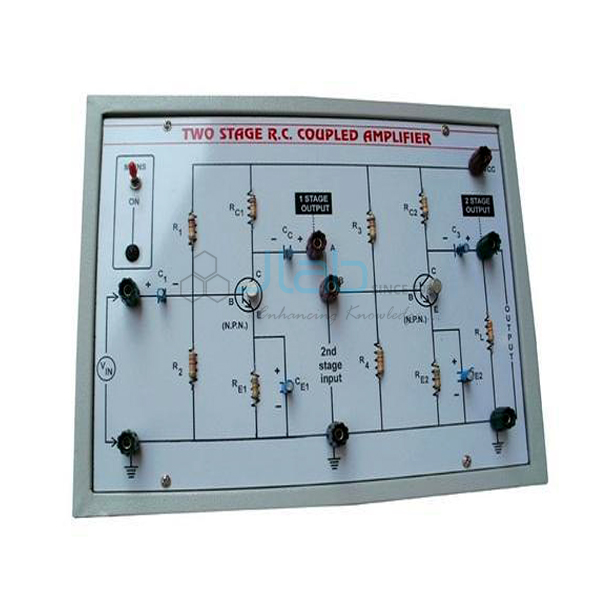
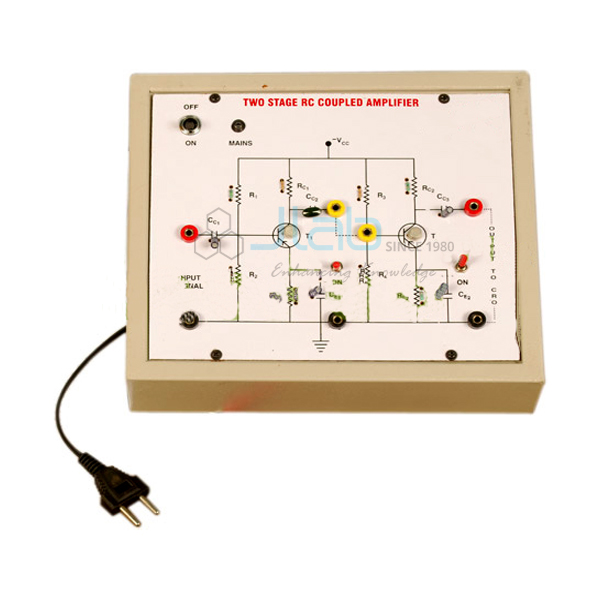
R.C. Coupled Amplifier Two Stage (code EL-AK-1125) is a trainer for studying the voltage gain and frequency response of a two-stage resistance-capacitance (RC) coupled transistor amplifier. Its two transistors are mounted on the front panel and powered by one DC regulated supply; a function generator, a VTVM and an oscilloscope are optional extras. It is made by Jain Laboratory Instruments Pvt Ltd (JLab) at its works in Ambala, India.
Specifications
| Parameter | Detail |
|---|---|
| Circuit | Two-stage RC coupled transistor amplifier |
| Studies | Voltage gain and frequency response |
| Transistors | Two, mounted on the front panel |
| Power supply | One DC regulated power supply (rating not stated in the listing) |
| Optional instruments | Function generator, VTVM (electronic voltmeter) and CRO (oscilloscope) — not included |
| Ask JLab about | Transistor type, supply rating, connection type and mains input |
| Quality check | Each trainer is visually inspected before dispatch |
| Pack quantity | Each (sold individually) |
| Minimum order quantity | 10 units |
| Dispatch time | Usually 7–10 working days |
| Product code | EL-AK-1125 |
| Manufacturer | Jain Laboratory Instruments Pvt Ltd (JLab) — OEM |
| Country of origin | India (made in Ambala, Haryana) |
How Does It Compare with Other JLab RC Coupled Amplifier Trainers?
| Trainer | Studies (as listed) | Built-in parts (as listed) | Instruments needed (as listed) |
|---|---|---|---|
| This trainer (EL-AK-1125) | Voltage gain, frequency response | Two transistors, one DC regulated supply | Function generator, VTVM, CRO (optional) |
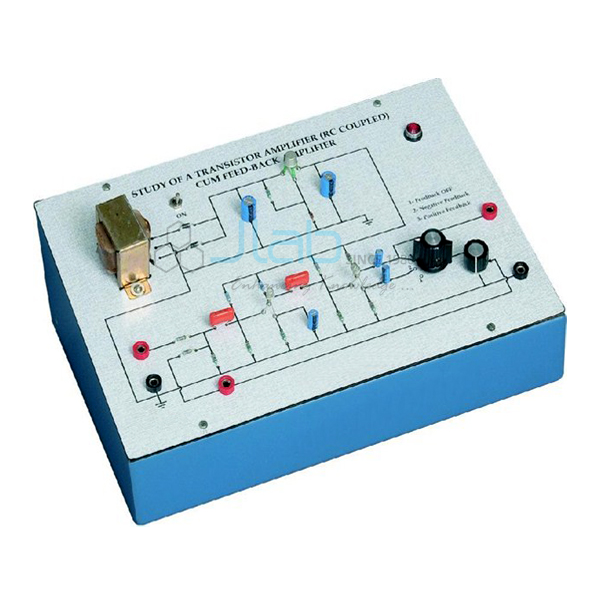
| RC Coupled with Inbuilt Two AC Millivoltmeter | Input and output readings for gain | Inbuilt power supply, two AC millivoltmeters | Not stated |
| Two Stage RC Coupled Transistor Amplifier (Analog Electronics Trainer range) | Overload characteristics; frequency response of each stage and the cascade; input and output impedance | −12 V IC regulated supply, two PNP transistors, mains switch and fuse, patch cords | Decade audio frequency generator, AC millivoltmeter, decade resistance box |
Choose this trainer for the standard gain and frequency-response practical with your own generator and meters; the version with inbuilt millivoltmeters saves bench instruments, and the Analog Electronics Trainer model adds stage-by-stage and impedance measurements.
What Is the Two-Stage RC Coupled Amplifier Used For?
The RC coupled amplifier is the standard example of a multistage amplifier in analog electronics practicals for B.Sc. physics and electronics, diploma and engineering courses and ITI/TVET electronics trades. A coupling capacitor carries the signal from the collector of the first stage to the base of the second while blocking DC, so each stage keeps its own bias. The overall voltage gain is the product of the two stage gains, and since in the usual common emitter arrangement each stage inverts the signal, the output of two stages is back in phase with the input.
For the frequency response, a sine signal of fixed amplitude is applied from the function generator and the output is read on the VTVM, or viewed on the oscilloscope, as the frequency is stepped from low to high. Gain in decibels plotted against frequency on a log scale is flat in the mid band and falls at both ends: at low frequencies because of the coupling and bypass capacitors, at high frequencies because of transistor and stray capacitances. The band between the −3 dB points is the bandwidth, which is narrower for the two stages together than for one stage alone.
What to Specify When Ordering
- Quantity — the minimum order is 10 trainers.
- Optional instruments — function generator, VTVM and oscilloscope, if your lab needs them.
- Mains voltage at the destination and any patch cords required.
Frequently Asked Questions
What does this trainer measure?
The voltage gain and the frequency response of a two-stage RC coupled transistor amplifier, from which the mid-band gain and bandwidth are found.
Why is the coupling between stages done with a capacitor?
The capacitor passes the AC signal but blocks DC, so the bias of the second stage is not upset by the collector voltage of the first. Its reactance rises at low frequencies, which is one reason the gain falls there.
Which instruments are needed?
A function generator for the input signal and a VTVM or AC voltmeter for the readings; an oscilloscope (CRO) is useful for watching the waveform. All three are listed as optional extras, not part of the trainer.
Who manufactures this trainer?
Jain Laboratory Instruments Pvt Ltd (JLab), at its works in Ambala, Haryana, India, quoting directly as the manufacturer.
OEM Manufacturer
JLab is the trading name of Jain Laboratory Instruments Pvt Ltd, a manufacturer of electronics trainers and laboratory instruments in India, incorporated in 2017 and based on Hargolal Road, Ambala, Haryana. The two-stage amplifier trainer is made at JLab’s own works rather than bought in from a trader, so colleges, polytechnics, ITIs, dealers and importers buy it factory-direct; each unit is visually inspected before dispatch, and repeat orders and spares are handled by the manufacturer. JLab exports worldwide and ships to buyers in every region — for example Spain in Southern Europe, the UAE in the Middle East, Indonesia in Southeast Asia, Slovakia in Eastern Europe and Barbados in Central America and the Caribbean. Tender information is on the JLab lab tenders page.
Instruments and Kits Used Alongside
- A.F. Oscillator Function Generator Cum Digital — sine and square signal source with a digital frequency readout.
- Dual Trace Oscilloscope — dual-channel display for comparing input and output waveforms.
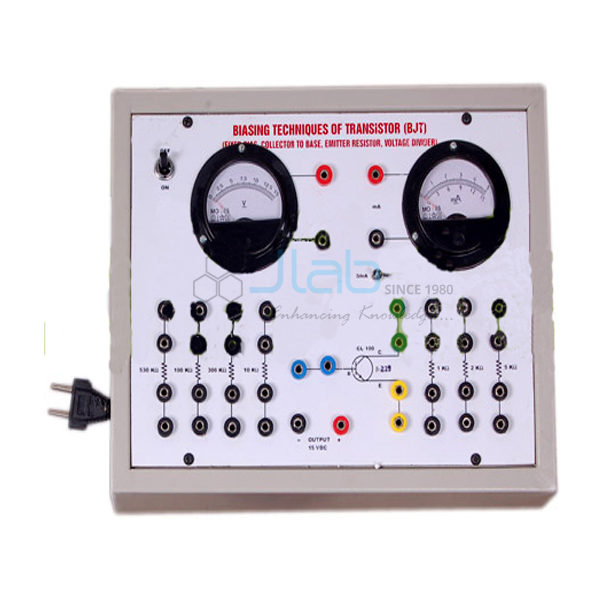
- Biasing of Transistor BJT — the bias circuits that set each stage’s operating point.
See all kits in the Amplifiers Kits range or the wider Scientific Instrument range.
Request a Quote
Quotes come direct from the manufacturer. Use Add To Cart on this page, or send the quantity (minimum 10 units), the optional instruments you want, your mains voltage and the delivery location — with delivery terms such as FOB or CIF and any tender reference for exports — through the contact page.
Last updated: 9 October 2026