Rain Gauge Manufacturer,Supplier and Exporter in India
Product Code : EL-WE-7500
Jlab Export is a leading Rain Gauge Manufacturer,and suppliers in India
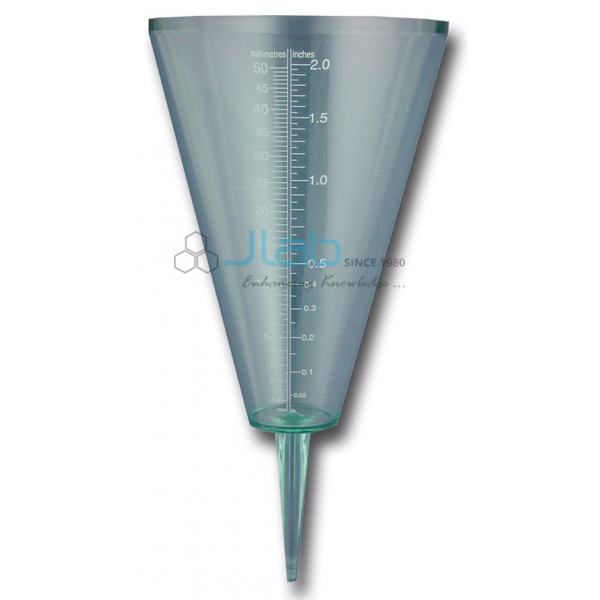
Rain Gauge (code EL-WE-7500) is a simple rain gauge made of translucent material and calibrated in millimetres and inches, used to measure daily rainfall in school weather stations, geography fieldwork and environmental science projects. It measures 210 x 100 mm (dia.) and is supplied complete with a rainfall chart for recording the readings. It is made by Jain Laboratory Instruments Pvt Ltd (JLab) at its works in Ambala, India.
Specifications
| Parameter | Detail |
|---|---|
| Type | Simple rain gauge |
| Body | Translucent material |
| Calibration | Millimetres and inches |
| Dimensions | 210 x 100 mm (dia.) |
| Supplied with | Rainfall chart |
| Quality check | Each rain gauge is visually inspected before dispatch |
| Pack quantity | Each (sold individually) |
| Minimum order quantity | 10 units |
| Dispatch time | Usually 7–10 working days |
| Product code | EL-WE-7500 |
| Manufacturer | Jain Laboratory Instruments Pvt Ltd (JLab) — OEM |
| Country of origin | India (made in Ambala, Haryana) |
How Does It Compare with Other JLab Rain Gauges?
| Model | Body | How rainfall is read | Other listed details |
|---|---|---|---|
| This rain gauge (EL-WE-7500) | Translucent material | Calibrated in millimetres and inches | 210 x 100 mm (dia.); rainfall chart included |
| Copper Rain Gauge | Copper inner receiving vessel and outer body (BA pattern) | Glass measuring cylinder graduated 0 to 10 mm x 0.1 mm (100 divisions) | 127 mm funnel |
| Rain Gauge with Plastic Measuring Cylinder | GI sheet | Plastic measuring cylinder | Measures precipitation over a set period of time |
Choose this gauge for simple classroom and school-garden rainfall records, where students read the calibrated scale and fill in the supplied chart. The copper BA-pattern gauge, with its separate glass measure graduated to 0.1 mm, suits more detailed observation work, and the GI-sheet gauge with a plastic measuring cylinder is a metal-bodied alternative.
What Is the Rain Gauge Used For?
A rain gauge records how much rain has fallen, expressed as the depth of water that would cover flat ground. Students use this one to keep a daily rainfall log, total it by week and month on the rainfall chart, plot bar graphs of monsoon and dry-season rain, and compare their figures with published weather reports. The rain gauge is one of the standard weather instruments studied in school geography and in class 11 practical geography, and it is a common first instrument for a school weather station or an eco-club project.
Place the gauge on open, level ground away from trees, walls and roofs, with the rim level and raised above the ground so that splashes do not enter. Read it at the same time every day, with your eye level with the water surface against the scale, record the value on the chart and then empty the gauge. Because the body is translucent, the water level can be seen against the calibration without pouring it out first.
What to Specify When Ordering
- Quantity — the minimum order is 10 rain gauges; schools often buy one per class or eco-club group.
- Gauge type — this translucent gauge, the copper BA-pattern gauge or the GI-sheet gauge with plastic measuring cylinder.
- Other station instruments — thermometers, a wind vane and a weather station housing can be quoted with it.
Frequently Asked Questions
In what units does this rain gauge read?
Millimetres and inches. The gauge is calibrated in both, so students can work in metric units and still compare with older records kept in inches.
What size is it?
The listed dimensions are 210 x 100 mm (dia.).
Is a rainfall chart included?
Yes. The gauge is supplied complete with a rainfall chart for recording readings.
Where should the rain gauge be placed?
On open, level ground away from trees and buildings, with the rim level and above the ground. Shelter from nearby objects and splashing from hard surfaces both give wrong readings.
How does it differ from the Copper Rain Gauge?
This gauge is translucent and calibrated directly in millimetres and inches. The Copper Rain Gauge is a BA-pattern copper gauge with a 127 mm funnel and a separate glass measuring cylinder graduated in 0.1 mm steps.
What should an export enquiry include?
Quantity, destination country and port or city, preferred delivery terms such as FOB or CIF, any packing or labelling needs, and a tender reference where applicable.
Who makes this rain gauge?
Jain Laboratory Instruments Pvt Ltd, trading as JLab, at its works in Ambala, Haryana, India.
OEM Manufacturer
JLab is the trading name of Jain Laboratory Instruments Pvt Ltd, a manufacturer of weather instruments and geography lab equipment in India, incorporated in 2017 and located on Hargolal Road, Ambala, Haryana. The rain gauge is produced at JLab’s own works and not bought from a trader, so schools, colleges, dealers and importers buy factory-direct, every gauge is inspected visually before dispatch, and repeat supplies come from the maker. The company is registered under CIN U29309HR2017PTC069123 and holds MSME Udyam registration UDYAM-HR-01-0003849 as a manufacturing enterprise. JLab exports worldwide and supplies every region — for example Qatar in the Middle East, Angola in Central Africa, Ecuador in South America, Singapore in Southeast Asia and Turkmenistan in Central Asia. See the JLab lab tenders page for tender supply.
Weather Station Essentials
- Weather Station — a wooden station with sloped roof and louvered door for mounting weather instruments.
- Mercury Free Max Min Thermometer — records the day’s highest and lowest temperatures alongside rainfall.
- Weather Vane — a wind vane on a metal stand for wind direction.
- Weather Instruments Chart — a laminated chart in English and Hindi combined.
More instruments are in the Weather Equipment range and in Geography Lab Models.
Request a Quote
Quotes come direct from the manufacturer. Use the Add To Cart enquiry button on this page, or send the quantity (minimum 10 units), the gauge type and any other weather station instruments you need, and your delivery location through the contact page.
Last updated: 3 October 2026