
Weather Instruments Chart Manufacturer,Supplier and Exporter in India
Product Code : EL-COG-3136
Jlab Export is a leading Weather Instruments Chart Manufacturer,and suppliers in India
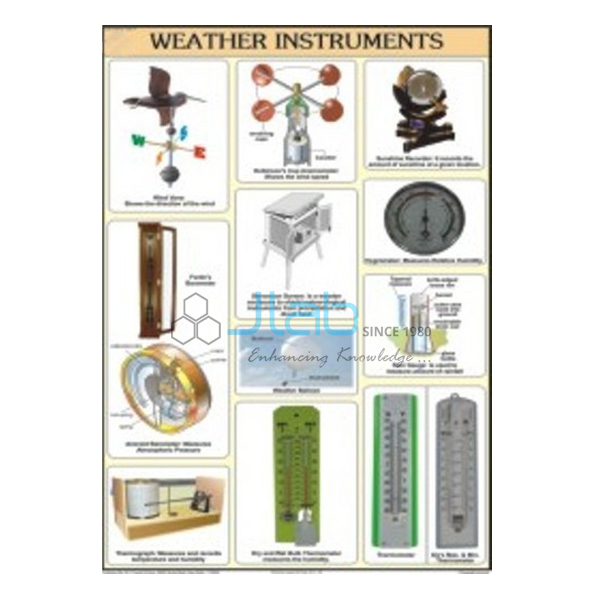
Weather Instruments Chart (code EL-COG-3136) is a laminated 50 x 75 cm wall chart introducing the instruments used to measure and record the weather, for geography and science classrooms, school weather clubs and practical geography rooms. English and Hindi share the one sheet. JLab (Jain Laboratory Instruments Pvt Ltd, Ambala, India) supplies it to schools, colleges and dealers.
Get a quote: use the Add To Cart enquiry button below, or send your quantity and destination through the contact page.
Specifications
| Parameter | Detail |
|---|---|
| Chart topic | Weather instruments |
| Size | 50 x 75 cm |
| Finish | Laminated |
| Language | English and Hindi combined |
| Instruments shown | Not itemised in the listing; a preview image can be requested |
| This listing covers | The chart only; the instruments themselves are separate catalogue items |
| Quality check | Each chart is visually inspected before dispatch |
| Pack quantity | Each (sold individually) |
| Minimum order quantity | 10 units |
| Dispatch time | Usually 7–10 working days |
| Product code | EL-COG-3136 |
| Supplied by | Jain Laboratory Instruments Pvt Ltd (JLab), Ambala, India |
What Is the Weather Instruments Chart Used For?
Each element of the weather has its own instrument, and the chart lets a class meet them before handling the real thing. A thermometer gives air temperature, and a maximum–minimum thermometer keeps the highest and lowest readings since it was last reset. A barometer measures air pressure — the aneroid kind uses a sealed metal capsule rather than mercury — with readings usually in millibars or hectopascals. A rain gauge collects rain through a funnel so that the day’s fall can be read in millimetres. A wind vane shows the direction the wind is blowing from, which is how winds get their names, and an anemometer measures wind speed. A wet-and-dry bulb hygrometer gives humidity: evaporation cools the wet bulb, and the gap between the two readings is looked up in a table to find the relative humidity. Outdoors, thermometers are kept in a white louvred box such as a Stevenson screen so that they read the shade temperature of the air.
The chart supports middle-school science lessons on weather and the chapter on weather instruments, maps and charts in the NCERT class 11 practical geography book, where students learn how each instrument works before taking readings. Schools often hang it beside a weather corner or a school weather station so pupils can match each instrument to its picture while keeping a daily record. The instruments drawn on the chart are not listed in the catalogue entry; ask for a preview image if you need a particular one shown.
What to Specify When Ordering
- Chart quantity — 10 units is the minimum order.
- Real instruments — rain gauge, barometer, thermometers, hygrometer or anemometer can go on the same enquiry.
- Outdoor housing — a louvred wooden weather station if readings will be taken in the school grounds.
- Delivery and terms — destination, FOB or CIF for overseas orders, and any tender reference.
Frequently Asked Questions
Which instruments does a school weather station need?
Usually a thermometer or maximum–minimum thermometer, a barometer, a rain gauge, a wind vane, an anemometer and a hygrometer, with the thermometers housed in a louvred screen. JLab lists several of these separately; see the links below.
How does a wet-and-dry bulb hygrometer measure humidity?
By comparing two thermometers. Water evaporating from the wet bulb cools it, and the drier the air, the bigger the cooling. The difference between the readings is converted to relative humidity with a table.
Which way does a wind vane point?
Into the wind — towards the direction the wind is coming from. A west wind blows from the west, so the pointer faces west.
What are the size, finish and language of the chart?
It is 50 x 75 cm and laminated, with English and Hindi on the same sheet.
Are the instruments included?
No. This listing is the chart alone; the instruments are separate items that can be quoted with it.
What is the minimum order and lead time?
Ten units, supplied individually. Dispatch is usually within 7–10 working days, after every chart is inspected by eye; delivery abroad takes longer depending on the destination.
Who supplies this chart?
JLab — Jain Laboratory Instruments Pvt Ltd of Ambala, Haryana — supplies it directly and handles the quotation.
Supplier
JLab is the trading name of Jain Laboratory Instruments Pvt Ltd, an Indian supplier of school science and geography equipment, incorporated in 2017 and based on Hargolal Road, Ambala, Haryana. The company resells printed teaching charts like this one alongside the weather-recording instruments and laboratory items in its own range, so a school can equip a weather corner through one supplier; each chart is checked visually before dispatch. JLab is registered for GST under GSTIN 06AADCJ9848D1ZE and exports under Importer-Exporter Code 3317504552. It ships worldwide to buyers in every region — Thailand in Southeast Asia, Burkina Faso in West Africa, Mauritius in East Africa, Tonga in Oceania and Latvia in Northern Europe among them. For tenders, see the JLab lab tenders page.
Weather Instruments to Pair with the Chart
- Rain Gauge — a translucent gauge calibrated in millimetres and inches for daily rainfall.
- Aneroid Barometer — a dial barometer graduated in inches of mercury and millibars.
- Thermometer Maximum Minimum Indoor or Outdoor — separate LCD screens for the maximum, current and minimum temperature.
- Hygrometer Wet and Dry — wet-bulb and dry-bulb thermometers for humidity.
- Anemometer — a hand-held electronic meter for wind speed and air temperature.
- Weather Station — a wooden housing with a louvred, front-hinged door for instruments kept outdoors.
Browse more Charts on Geography or the full Charts range.
Request a Quote
Ask JLab directly: use Add To Cart on this page or the contact page, and give the number of charts (minimum 10 units), any instruments you want quoted alongside, and the delivery destination.
Last updated: 4 October 2026