Resistance Coil Manufacturer,Supplier and Exporter in India
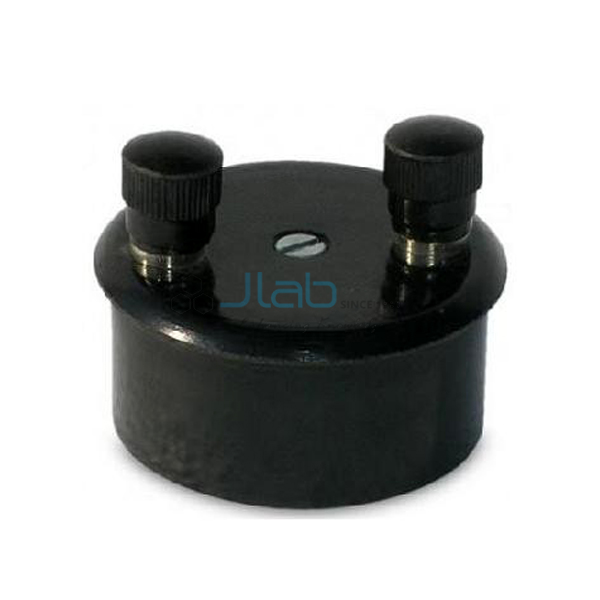
Product Code : EL-DB-1245
Jlab Export is a leading Resistance Coil Manufacturer,and suppliers in India
Resistance Coil (code EL-DB-1245) is a fixed resistor made from a non-inductively wound constantan coil in a hexagonal moulded case, used as an economical standard or as the unknown resistance in Wheatstone bridge and meter bridge experiments, and for series and parallel combination laws. Each coil is one value between 0.1 Ω and 500 Ω, accurate within ±0.5%. It is made by Jain Laboratory Instruments Pvt Ltd (JLab) at its works in Ambala, India.
Specifications
| Parameter | Detail |
|---|---|
| Resistance | Any one value from 0.1 Ω to 500 Ω (one value per coil) |
| Accuracy | Within ±0.5% |
| Resistance element | Constantan coil, non-inductively wound |
| Case | Hexagonal moulded case |
| Terminals | Two 4 mm socket terminals on the top |
| Intended use | Economical standard or unknown resistance for student Wheatstone bridge work; series and parallel combination of resistances |
| Quality check | Each resistance coil is visually inspected before dispatch |
| Pack quantity | Each (sold individually) |
| Minimum order quantity | 10 units |
| Dispatch time | Usually 7–10 working days |
| Product code | EL-DB-1245 |
| Manufacturer | Jain Laboratory Instruments Pvt Ltd (JLab) — OEM |
| Country of origin | India (made in Ambala, Haryana) |
How Does It Compare with Other JLab Resistance Standards?
| Model | Values | Accuracy (as listed) | Construction |
|---|---|---|---|
| Resistance Coil (EL-DB-1245) | One value from 0.1 Ω to 500 Ω | ±0.5% | Non-inductive constantan coil; hexagonal moulded case; two 4 mm sockets |
| Standard Resistance | 0.001 Ω to 1000 Ω | 0.05% to 0.005%, depending on value | Aged manganin coils immersed in oil in metal vessels; silver-soldered connections |
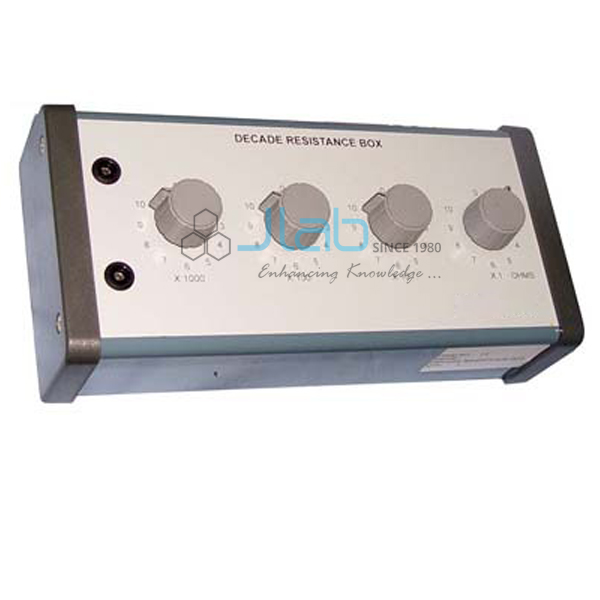
| Resistance Boxes | Adjustable, decades from 0.01 Ω to 10,000 Ω | Not stated | Dial type, one to five decade dials |
Choose the resistance coil for student benches where an inexpensive known or unknown resistor is enough. The oil-immersed Standard Resistance suits precision comparison work, and a dial-type resistance box is the choice when the value must be changed during an experiment.
What Is the Resistance Coil Used For?
In a Wheatstone bridge or meter bridge, one coil serves as the known resistance and another as the “unknown” that students measure, so a set of coils gives every group a different value to find. The same coils are used to verify the laws of combination of resistances: in the class 10 practical students measure the equivalent resistance of two resistors in series and in parallel, and in class 12 the series law is checked with a meter bridge. College and polytechnic labs use them as simple reference resistors for Ohm’s law and bridge experiments.
Constantan is used because its resistance changes very little as it warms, and the non-inductive winding cancels the coil’s magnetic field so it behaves as a plain resistance. Connect it with 4 mm plug leads, keep the current small and the circuit on only while readings are taken, and label each coil’s value if students are not meant to see it.
What to Specify When Ordering
- Resistance values — list each value you need between 0.1 Ω and 500 Ω and how many coils of each.
- Sets for bridge practicals — mixed values let each student group measure a different unknown.
- Leads and bridge — 4 mm leads, a meter bridge or a resistance box can be added to the same enquiry.
- Quantity — the minimum order is 10 units in total.
Frequently Asked Questions
Which resistance values can I order?
Any one value from 0.1 Ω to 500 Ω per coil. State the values and the number of each in your enquiry.
How accurate are the coils?
They are accurate within ±0.5%, which is ample for student bridge measurements and for checking series and parallel combination laws.
Why is the coil wound non-inductively in constantan?
Constantan keeps its resistance steady as the temperature changes, and the non-inductive winding cancels the coil’s inductance, so the coil acts as a pure resistance in the circuit.
How is the coil connected?
Through two 4 mm socket terminals on top of the hexagonal moulded case, which take standard 4 mm plug leads.
How is it different from the Standard Resistance?
The Standard Resistance uses aged manganin coils immersed in oil and is listed with tighter accuracy, from 0.05% to 0.005%; the resistance coil is the economical ±0.5% option for student use.
Who manufactures the resistance coil?
Jain Laboratory Instruments Pvt Ltd, trading as JLab, at its works in Ambala, Haryana, India.
OEM Manufacturer
JLab is the trading name of Jain Laboratory Instruments Pvt Ltd, an Indian manufacturer of physics and electrical lab equipment, incorporated in 2017 and located on Hargolal Road, Ambala, Haryana. The coils are wound and cased in JLab’s own works instead of being bought from a trader, so schools, colleges, dealers and importers order straight from the maker, each coil is visually inspected before dispatch, and repeat orders for further values come from the same works. JLab exports worldwide and ships to buyers in every region — Mexico in North America, Jamaica in Central America and the Caribbean, Kuwait in the Middle East, Botswana in Southern Africa and Kazakhstan in Central Asia, to name a few. Tender information is on the JLab lab tenders page.
Related Bridge Equipment
- Meter Bridge — the constantan-wire bridge for finding an unknown resistance.
- Resistance Boxes — dial-type boxes for an adjustable known resistance.
- Resistance P.O. Box — a Post Office box for Wheatstone bridge measurements.
- Standard Resistance — oil-immersed manganin standards for precise work.
- Decade Resistance Box — a band-switch decade box in a wooden case.
See the Decade Box range and the Scientific Instrument range.
Request a Quote
Quotes come direct from the manufacturer. Use the Add To Cart enquiry button on this page, or send the values and quantities you need (minimum 10 units in total), any leads or bridges to add, and your delivery location through the contact page.
Last updated: 8 October 2026