Resistance Boxes Manufacturer,Supplier and Exporter in India
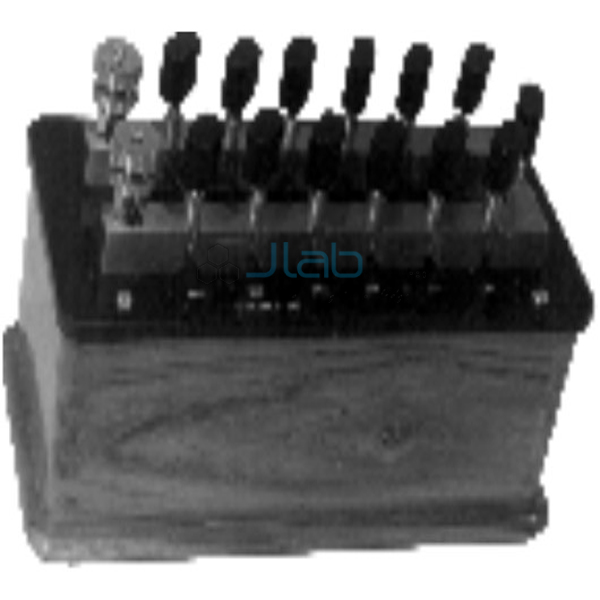
Product Code : EL-DB-1244
Jlab Export is a leading Resistance Boxes Manufacturer,and suppliers in India
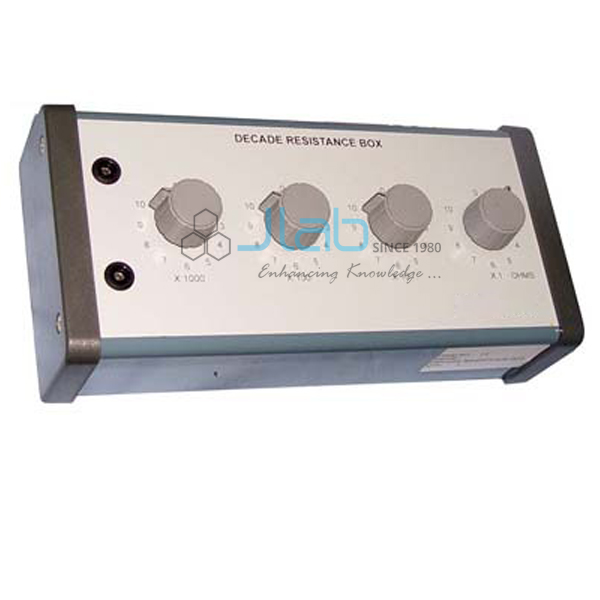
These Resistance Boxes are dial type decade boxes that set a known resistance with one to five rotary dials. Each dial adds resistance in ten equal steps of one decade, such as ten steps of 1 Ω. Single-dial boxes come in steps from 0.01 Ω to 100 Ω, and the largest five-dial box has decades from 1 Ω to 10,000 Ω. For a dial box offered with constantan or manganin coils, see the Dial Type Resistance Box.
Specifications
| Type | Dial type, with decade dials |
| Dials per box | One to five |
| Steps per dial | Ten |
| Smallest decade | 0.01 Ω steps (0.01 to 0.1 Ω) |
| Largest decade | 10,000 Ω steps, on a five-dial box |
| Models | Sixteen, from one to five dials |
| Pack quantity | Each (sold individually) |
| Minimum order quantity | 10 units |
| Dispatch time | Usually 4–6 working days |
| Manufacturer | JLab (Jain Laboratory Instruments Pvt Ltd), Ambala, India |
Which Box Suits Which Practical
Each dial has ten steps, so a dial with 1 Ω steps reaches 10 Ω and one with 10 Ω steps reaches 100 Ω. Add the dial readings, each times its step, to get the total.
| Dials | Decades in the box | Typical use |
|---|---|---|
| One | 0.01 Ω, 0.1 Ω, 1 Ω, 10 Ω or 100 Ω steps | A single adjustable arm or a low-value shunt |
| Two | 0.01 and 0.1 Ω; 0.1 and 1 Ω; 1 and 10 Ω; 10 and 100 Ω | Meter bridge arms and Ohm’s law circuits |
| Three | 0.1, 1 and 10 Ω; 1, 10 and 100 Ω; a box starting with 0.01 and 0.1 Ω decades | Finer bridge balancing |
| Four | 0.1, 1, 10 and 100 Ω; 1, 10, 100 and 1000 Ω | Potentiometer and galvanometer work |
| Five | 0.1, 1, 10, 100 and 1000 Ω; 1, 10, 100, 1000 and 10,000 Ω | High series resistance, as when converting a galvanometer into a voltmeter |
Using and Caring for a Dial Box
Change the dials with the key open, so no current flows while a contact moves. Turn each dial fully into a position, as a dial left between steps gives a wrong value.
Pass current only while taking a reading, so the coils stay cool. Keep the box dry and the panel clean, so the dial contacts stay bright.
Frequently Asked Questions
How many dials does a college physics lab need?
A two- or three-dial box covers most meter bridge and Ohm’s law work. Four- and five-dial boxes are worth adding for potentiometer practicals and galvanometer conversion, where finer steps or a high total are needed.
How can a box be checked when it arrives?
Set a few values on each dial and measure them with a multimeter or a bridge. Very low settings read slightly high, because the meter leads and contacts add a little resistance. Tell us about any fault soon after delivery.
What is the difference between a dial type and a plug type resistance box?
In a dial box, you turn rotary switches to bring resistance into the circuit, one decade per dial. In a plug box, you pull brass plugs out of gaps so that current must pass through the coils below them. Dials are quicker to set, while well-seated plugs give very low contact resistance.
What is the difference between a rheostat and a resistance box?
A rheostat changes resistance smoothly with a sliding contact, but its exact value at any setting is unknown. A resistance box gives known, fixed values in steps. Use a rheostat to control current, and a resistance box when the value itself enters the calculation.
Why should the meter bridge balance point fall near the middle of the wire?
Near 50 cm, both lengths of wire are large, so a small reading error in either has the least effect on the result. End resistance at the copper strips also matters less there. Set the box close to the unknown resistance to bring the balance point near the centre.
Other Resistance Boxes
- Dial Type Resistance Box
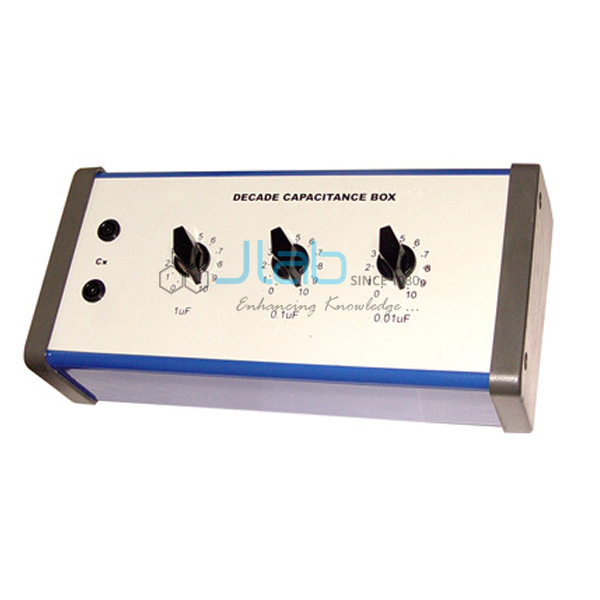
- Decade Resistance Box
- Resistance Box Decade Type (Single Dial)
- Resistance Box Plug Type (Superior Type)
- High Meg Resistance Box
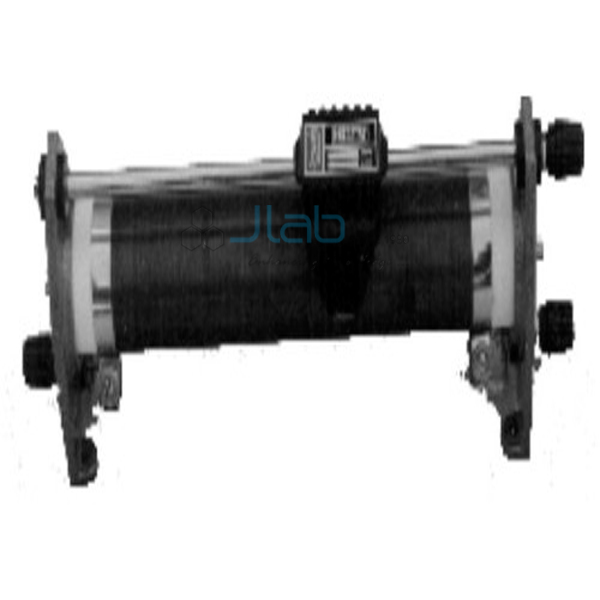
- Slide Wire Rheostats
For a quote, use Add To Cart or send us a message through the contact page.
Last updated: 26 November 2026