Spot Welding Machine Manufacturer,Supplier and Exporter in India
Product Code : EL-WEAWLM-8724
Jlab Export is a leading Spot Welding Machine Manufacturer,and suppliers in India
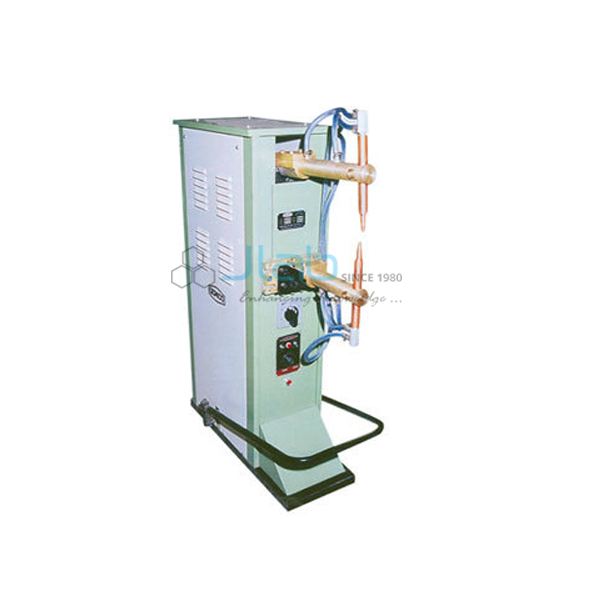
This spot welder squeezes overlapped steel sheets between its electrodes with an air-worked ram and passes a heavy current through them to fuse a weld nugget. It comes in AC versions rated 50 to 340 kVA and in a 100 kVA three-phase MFDC version. Throat depths run from 450 to 1200 mm, and nominal electrode force from 350 to 1000 kg at 5.5 bar.
Specifications
| Versions | AC, and 3 phase MFDC |
| AC rating | 50 kVA to 340 kVA, 2 phase |
| MFDC rating | 100 kVA, 3 phase |
| Throat depth | 450 mm to 1200 mm |
| Nominal electrode force | 350 kg to 1000 kg at 5.5 bar |
| Transformer | Encapsulated |
| Secondary circuit | Low loss |
| Ram | For high-speed operation |
| Control | Secondary current feedback controller |
| Cooling water | Flow cut-off switch for transformer, thyristor and inverter |
| Minimum order quantity | 1 unit |
| Dispatch time | Usually 14–18 working days |
| Manufacturer | JLab (Jain Laboratory Instruments Pvt Ltd), Ambala, India |
Resistance Welding Practicals for Trainees
Trainees cut coupons of Galvanized Steel Sheet, lap them and weld a row of spots at an even pitch. One coupon is then peeled apart, with one end gripped in the Bench Vice. A sound weld tears a button of metal out of one sheet instead of parting at the joint face. Students measure each button with the Vernier Caliper 0-300 mm and compare the sizes across current settings.
Welds that must stay in service are checked with a chisel test instead. The Flat Cold Chisel is driven between the sheets beside a spot, and a weld that holds has passed. Because the ram is worked by air, the machine draws on a workshop Air Compressor. Teachers can raise the air pressure to show that a harder squeeze lowers the contact resistance, so the same nugget then needs more current.
Frequently Asked Questions
What is the difference between the AC and MFDC versions?
An AC machine feeds its welding transformer at mains frequency and draws its load from two phases. The MFDC version uses an inverter to raise the frequency, then rectifies the output, so the electrodes carry direct current. It draws a balanced load from all three phases.
How do I choose the throat depth?
Throat depth is the distance from the electrodes back to the frame, and it sets how far from a sheet edge a spot can be placed. This series runs from 450 to 1200 mm, so pick a depth that reaches the farthest spot on your biggest panel.
Why does the machine need cooling water?
The transformer, thyristor and inverter carry heavy currents and are cooled by water. A flow switch cuts the machine off if the water stops. Connect a steady supply before switching on, and check the flow at the start of each session.
What does the secondary current feedback controller do?
It measures the welding current in the secondary circuit and corrects the output while each weld is made. The current can then stay close to the set value as the electrode tips wear or the mains voltage changes.
What compressed air supply does it need?
The ram is worked by air, and the nominal electrode force of 350 to 1000 kg is given at 5.5 bar. A workshop compressor with a regulator set to that pressure feeds it. Keep the air dry and clean so the cylinder and valves move freely.
Other Spot Welders and Welding Trainers
- Spot Welding Machine (floor type, foot operated)
- Spot Welder (portable)
- Welding Training Set
For a quote, use Add To Cart or send us a message through the contact page.
Last updated: 6 November 2026